


 Francais
 Deutsch
 Italiano
Refine Your Search
Nevada United States 1936 stock footage and images
- Showing 23977 to 23982 of 27246 results more
more Hide
Hide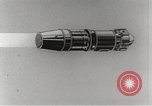
General Electric plant and operations at Lockland, Ohio. Advances in jet propulsion. Jet airplanes of the early 1950s.
Animated illustration of rapid improvements in GE jet engine designs. Views of the GE plant at Lockland, Ohio. Interior of a jet passenger liner airplane, as envisioned in 1951. View of flight attendant or stewardess in uniform, delivering tray of food to a passenger in the cabin of a passenger aircraft in flight. View of Dr. Sanford A. Moss, standing in front of the Collier Trophy, looking at his award certificate, in 1941. The trophy was awarded to him and the U.S. Army Air Corps for development of the aircraft engine supercharger. Discussion of Atomic Energy Commission, U.S. Air Force, General Electric and Convair ideas about building an atomic powered airplane. Views of the GE gas turbine laboratory. Montage of jet aircraft of the early 1950s. Among those seen are: Convair SF-92 delta wing fighter plane; The Chase XCG-20A 4-engine cargo plane; North American F-86 sabrejet; Grumman F9F panther; F-89 Scorpion; and B-36 bomber, plus several unidentified experimental aircraft. Several scenes of B-47s in rocket assisted takeoffs.
American home front life during World War II. Reminders of American historic involvement in earlier conflicts since the Revolution.
American revolutionary soldiers march in reenactment of post-revolutionary past. They are led by two drummers and a fife player. American soldiers charge from their trenches in France during World War I. A man removes an antique musket from a wall. Two men converse in a rural agricultural area, in America during World War 2. The men look up in the sky as some U.S. Army Air Forces fighter planes fly overhead. An exploding bomb is artificially superimposed upon a typical residential street in an American neighborhood. The exploding bombs are next seen in Europe during World War II. Buildings are destroyed. Fires rage and heavy smoke fills the air. Views of destroyed cities.
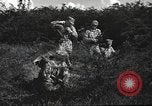
U.S. Marine Reconnaissance Team picked up by Grumman S2F aircraft. Marines in realistic field training exercises
A U.S. Marine Corps Reconnaissance Team begins a field training exercise, after having landed from a submarine and changed into their camouflage fatigues. They patrol through small trees and underbrush. A Grumman S2F aircraft lands on a small airstrip, and the recon team emerges from the woods to board it for flight back to their base. A formation of marines with field gear, starts to move double-time along a dirt path. A formation of Sikorsky H-34 helicopters seen flying low over plumes of black smoke rising. Marines, in amphibious assault training operation, approach surf in Landing Vehicles Tracked (LVTs). They run from the LVTs as they hit the beach. Marine infantry and M48 Patton tanks during actual combat (or realistic training exercise), with large plumes of black smoke rising in various locations.
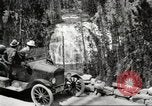
Tourists exploring places like America's National Parks by automobile
Tourists in an open car,on a bridge, pause to look at a river and waterfall. Motorists travel along a road through scenic mountainous area. Several tourists are seen walking to a scenic spot along the road, where a park bench can be seen at edge of road.
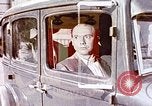
Reenactment of FBI agents battling against criminals in Washington DC. Also footage from Lindbergh kidnapping events and trial
An introduction of the Federal Bureau of Investigation in Washington DC. A reenactment of FBI agents during prohibition fighting against gangster criminals on the streets. Reenactment of the famous Kansas City Massacre. Next, newsreel scenes shows the Lindbergh baby with his mother. Lindbergh murder trial in session in 1932. Bruno Richard Hauptmann in a court and view of FBI commission under Hoover in session. Reenactment shows FBI agents firing at John Dillinger on a street and behind cars. Also reenactments of FBI agents firing at Baby Face Nelson, capture of Machine Gun Kelly, and a shootout with Pretty Boy Floyd.
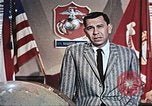
U.S. Navy and Marines coordinate planning and deployment of their joint forces in contingencies world wide.
Actor Jack Webb speaks from an office decorated with American and U.S. Marine Corps flags and other Marine symbols. With his hand on a world globe, he speaks of America's treaties and agreements with other nations in the world and the importance of the U.S. Navy/Marine Corps in supporting world peace efforts. Scene shifts to Marines on parade heading straight toward and to either side of the camera. More views from various places, of the marching marines. Next, various radar antennas are seen rotating, some on land and some on ships at sea. Two sailors are seen plotting positions of detected things with white grease pencils on a large plexiglass display. A sailor in a communications center hands a report to a Marine standing nearby. The next scene shows the Marine delivering the message to an officer in a command and control center, staffed with Navy and Marine Corps personnel. A Navy Commander stands in front of a large wall map covering the Indian Ocean and bordering land masses. He uses a pointer while briefing an audience of very high ranking officers about places in Southeast Asia, Indonesia and the Philippines. Seated in the front row are Commandant of the Marine Corps, General David M. Shoup. Beside him is Chief of Naval Operations, Admiral George W. Anderson, Jr. They both confer and decide that U.S. Marines should be deployed in this situation. Admiral Anderson questions the briefing officer.
CRITICALPAST.COM: About Us | Contact Us | FAQs - How to Order | License Agreement | My Account | My Lightboxes | Shopping Cart | Advanced Search | Featured Collections | Website Terms & Conditions | Privacy Policy ©2026 CriticalPast LLC.
License Agreement |
Terms & Conditions |
Privacy Policy
©2026 CriticalPast LLC.