


 Francais
 Deutsch
 Italiano
Refine Your Search
Nevada United States 1936 stock footage and images
- Showing 24031 to 24036 of 27246 results more
more Hide
Hide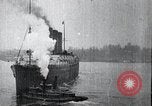
Various scenes dealing with World War 1 and American General Pershing, spanning 1917 to 1927.
A ship underway near a U.S. port. President Woodrow Wilson seen signing the declaration of war against Germany in World War 1. A close up of the start of the draft process, as two blind-folded civilian men draw the first draft numbers for American men to enter service in World War 1. U.S. Army General John J. Pershing stands in a line with other Army officers circa 1917. A large group of people together inside a large cross-shaped stage (possibly American red cross drive of some kind during World War I). Scene on July 4, 1927 in Indianapolis, Indiana, as General Pershing participates in cornerstone laying ceremonies for the Indiana World War Memorial at American Legion Headquarters. General Pershing is with Governor Ed Jackson, Marcus Sonntag, and Adjt General William H. Kershner. General Pershing places wreath on a service flag during the ceremony. Other Indianapolis buildings and view of people on streets in the background.
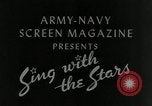
Bob Burns plays bazooka and Shirley Ross sings 'Clementine' on the 'Sing with the Stars' show.
'Sing with the Stars' features Bob Burns as 'Bob Bazooka Burns'. Begins with scene showing a bazooka being fired. Bob talks about the bazooka and shows the audience his humorous musical instrument, for which the weapon was named. Then, he and American Hollywood actress and singer Shirley Ross sing 'Clementine' together. For part of the song, Bob Burns actually plays his bazooka as one would play a trombone. The lyrics of the song are displayed for audience sing-a-long. Bob and Shirley joke about Clementine.Cartoon artwork of funny characters are shown on screen along with the lyrics, and a bouncing ball over the words for sing-a-long.
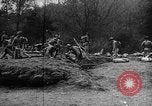
U.S. Marines practice trench warfare techniques during their training in World War I
U.S. Marines occupy trenches at their training facility in World War 1. Once positioned in them, they climb from the trenches, in squads, and charge forward. They are followed by a second wave of squads. Some marines are seen down in a dugout of the trench. Another scene shows more squads of marines going over the top of deep trenches, in successive waves. They climb rustic ladders to get out of these deep trenches.
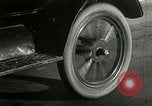
How the automobile and new highways and roads changed life in America, up to 1953
Closeup of early 1900s Ford Model T wheels turning while car is moving. Scene opens to newly built modern highways of 1953 with lots of mixed traffic. Views from roadways of industrial plants, sheep grazing, and farmer plowing his land with a tractor. Close up views of 1950s car tires running on highway at high speed. A woman carrying groceries from her station wagon to her house. People outdoors in front of garden apartments. Children leaving school and boarding buses. View from car of an oil field worker driving to work. Modern apartment buildings.Scenic views from car driving along near lakes, hills, and ocean. Modern car passing a Model T on the road.
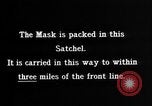
A U.S. soldier demonstrates how to carry a mask and wear the mask in an alert position during World War I.
A World War 1 training film shows how to carry and don a gas mask. A U.S. soldier stands at attention. He carries a mask in a satchel. The satchel is slung over the shoulder of a soldier. He shows the satchel. He turns. The soldier demonstrates the way to carry the satchel in trenches. The satchel is slung around his neck. He opens the satchel, takes out a string and ties it around. He opens the satchel and takes out the mask . He puts his chin forward and wears it.
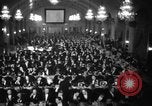
U.S. President Roosevelt talks about America's support to Britain and praises Winston Churchill during a speech in the U.S.
Excerpts from speech of U.S. President Franklin D. Roosevelt at the White House Correpondents' dinner on March 15, 1941 in Washington DC. Officials and dignitaries seated in a hall having dinner. President Roosevelt at a podium and speaks into a microphone. He speaks about people of the world supporting Britain and even Canada. He talks about America's full support to the British. Roosevelt in his speech praises British Prime Minister Winston Churchill. He also speaks about America's support in world reconstruction and humanity. Roosevelt speaks that their should not be any racism. Every one should be treated equally and have equal rights. He talks about security, standard of living, and market for manufacturing. He says of dictators in Nazi Germany and Imperial Japan, "We believe that the rallying cry of the dictators, their boasting about a master-race, will prove to be pure stuff and nonsense. There never has been, there isn't now, and there never will be, any race of people fit to serve as masters over their fellowmen."
CRITICALPAST.COM: About Us | Contact Us | FAQs - How to Order | License Agreement | My Account | My Lightboxes | Shopping Cart | Advanced Search | Featured Collections | Website Terms & Conditions | Privacy Policy ©2026 CriticalPast LLC.
License Agreement |
Terms & Conditions |
Privacy Policy
©2026 CriticalPast LLC.