


 Francais
 Deutsch
 Italiano
Refine Your Search
Nevada United States 1936 stock footage and images
- Showing 25159 to 25164 of 27247 results more
more Hide
Hide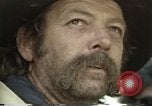
Victims of a 1987 California forest fire talk about it. Scenes of the aftermath.
Residents of an area of forest fire in California in 1987. A rancher speaks of being "wiped out." He says he has his horses because he moved them the day before the fire. Everything else, he says is burnt to the ground. Another rancher says he doesn't know how his place is still standing. Views of aftermath of the fire showing total destruction of a home. Man and woman sitting by the wreckage in dispair.
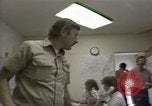
U.S. Forest Service personnel in a command center during a 1987 California forest fire.
A uniformed U.S. Forest Service officer answers a telephone from a command post dealing with a forest fire in California in 1987. He informs the caller that the area of his interest is well outside the fire zone, but that the Stanislaus National Forest is completely closed due to the fire. Workers in the center pass information about closed areas to others by telephone. Copies of information bulletins are seen.

Wild fire refugees being cared for at community facilities in California, 1987
Views of community activities to assist persons fleeing from a forest fire in California, in 1987. A pickup truck parked on a road, loaded with personal belongings, including a stuffed deer head. A radio shown as an announcer speaks of the need at the Fair Grounds, for items related to animal care, such as dog food, etc. A food establishment worker speaks of taking care of 500 people a day with hamburgers, and other simple foods. View inside a building of people going through a food line staffed by volunteers. Large number of people displaced by wild fire are seated at tables eating.
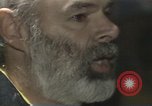
Firefighters enter final phase of battle against fire in Stanislaus National Forest, California, 1987
A supervisory firefighter briefs teams about people not seeing flames and not feeling threatened, so they may be getting tired of seeing firefighters all the time. He describes this as approaching the "5th stage" of rescue which he defines as "shoot the rescuer." The assembled firefighters chuckle about this. A long line of firefighters walks along a dirt road and enter the Stanislaus National Forest. Smoke blows from the entrance.
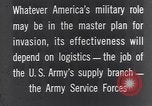
Commanding Generals of U.S. Army Services Forces and their missions are reviewed in this World War II film
Film starts with view of the U.S. military headquarters Pentagon building in Virginia, as seen from Columbia Island, across the lagoon, in World War 2.. Closeup of the building. Inside, Lieutenant General Brehon Burke Somervell , Commander of the Army Service Forces (ASF) is seen presiding over a staff meeting that includes seven Major Generals, who head the ASF technical services. Flag of the Quartermaster Corps seen in closeup. Officers of that organization are seen meeting. Scene shifts to a warehouse where military supplies are being moved on trailers pulled by small tractors. Carts filled with equipment are seen. Men prepare some for transport to America's allies overseas. Men fill packages with articles of clothing. A sign reads: "Maj. Gen. Reybold, Chief of Engineers." Engineers officers at a conference table rise as their Commander, General Reybold, enters. He sits and they begin their meeting. Closeup of staff officers in the meeting. Officers walk through a section of the Army Map Service, where cartographers, draftsmen and others are busy at tables creating maps. One of them is seen fitting several aerial photographs together to form a detailed map. A cartographer at the mapping service is seen annotating a map of the Marseille area of France. Views of high speed offset presses printing large scale maps for the military. A sign identifies the office of the Chief of Ordnance. Staff officers of that office are seen at work. Closeup of small arms being placed in a shipping box. An open yard filled with M24 Chaffee light tanks. A vast yard at a railroad siding, containing countless tanks on one side and building materials on the other. Sign inside the Pentagon at office of Major General H.C. Ingles, Chief Signal Officer. Closeup of General Ingles at his desk. Members of his staff consult with him. Sign at office of the Chief, Chemical Warfare Service. Major General William N. Porter, the Chief, looks over maps with several staff. Troops training under gas attack and smoke screen conditions. The entrance to the office of the Surgeon General of the U.S. Army. Inside, Major General Norman Thomas Kirk , Surgeon General, confers with a Colonel. Maps of areas where disease poses a threat to U.S. military forces. Office of Major General C.P. Gross, Army Chief of Transportation. Inside He holds a meeting with members of his staff. View of a pier where military supplies are being offloaded by means of derricks.
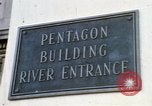
Chairman of the Joint Chiefs of Staff General Earle Wheeler greets the Secretary of Defense Laird at the Pentagon in Virginia.
Ceremony at the Pentagon for the Secretary of Defense Melvin R Laird in Virginia. A sign board at the entrance reads: 'Pentagon building river entrance'. The Honor Guard on Pentagon lawn. People gather outside the building awaiting the arrival of General Laird. Cars parked along a side of the street in front of the building. Chairman of the Joint Chiefs of Staff General Earle Gilmore Wheeler standing with other officials. General Laird and family arrive by car and are greeted by General Wheeler.
CRITICALPAST.COM: About Us | Contact Us | FAQs - How to Order | License Agreement | My Account | My Lightboxes | Shopping Cart | Advanced Search | Featured Collections | Website Terms & Conditions | Privacy Policy ©2026 CriticalPast LLC.
License Agreement |
Terms & Conditions |
Privacy Policy
©2026 CriticalPast LLC.