


 Francais
 Deutsch
 Italiano
Refine Your Search
Nevada United States 1936 stock footage and images
- Showing 2593 to 2598 of 27246 results more
more Hide
Hide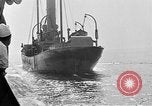
Tuscania leaves a port and mine sweepers in operation in the United States.
A ship underway at sea in the United States. A man watches from the deck of another ship. American mine sweepers in operation. Tuscania leaves a port. Mine sweepers work on the deck of the ship.
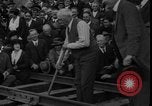
Train service is inaugurated on a new section of railroad in the Western United States
An audience of well-dressed people at railroad construction site watch as an old man drives the final spike to complete a section of railroad in a rugged part of the Western United States. The scene shifts to views from a train inaugurating travel over the new rail line. It passes between rocky walls and through a short tunnel. View from locomotive as it proceeds around a curve, revealing a long line of passenger cars comprising the train.
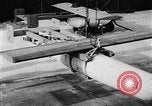
A DT-15 torpedo with air frames attached is dropped in water in the United States.
A review of research and development in guided missiles by the United States Air Force from 1919 to 1948. A DT-15 torpedo with air frames attached. The DT-15 is attached to the bottom of an aircraft. This is a preset control glide missile. DT-15 drops. It descends towards water. About 50 feet above water surface the air frame separates from the torpedo. Wake left by the torpedo as it goes through water. A freighter is hit by the torpedo. Explosion on the freighter. Black smoke rises up from water.
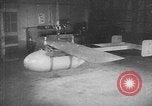
A GB-1 bomb is dropped from a B-17 and the launch of a GB-8 missile in the United States.
A review of research and development in guided missiles by the United States Air Force from 1919 to 1948. A GB-1 bomb is suspended from a chain hoist in the interior of a laboratory. This is a preset glide bomb. A B-17 with GB-1 attached, takes off. The B-17 in flight with GB-1s attached to the bottom of the aircraft. Aerial launching of the GB-1 from the B-17. Side view of a GB-8. Flares attached to the tail section of the GB-8. This is a radio-controlled missile, flares are used to assist in guiding the missile to target area. The GB-8 descends. Smoke trails behind. The GB-8 hits a flat open desert terrain. (World War II period).
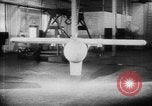
A television controlled GB-4 missile is dropped from a B-17 aircraft in the United States.
A review of research and development in guided missiles by the United States Air Force from 1919 to 1948. A GB-4 radio controlled bomb is suspended from a chain hoist in a work laboratory. This is a television controlled missile. Attaching television equipment to the bottom of missile. A B-17 takes off and is directly overhead. The B-17 in flight, GB-4 attached to its bottom. Interior of the aircraft shows television equipment as a bombardier prepares to drop a missile. The television equipment being put into operation. The B-17 drops the GB-4 missile. Interior of the aircraft shows the bombardier following the course of missile on the television equipment. GB-4 missile dives down towards a train. The locomotive moves across a flat open terrain. The missile hits the target area. The GB-4 missile dives towards a target building. It strikes the ground directly in front of the same and crashes through the building. (World War II period).
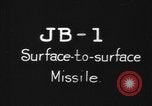
A drawing of a JB-1, surface to surface missile in the United States.
From a review of research and development in guided missiles by the United States Air Force from 1919 to 1948. A JB-1, (Jet Bomb 1) surface-to-surface missile. A drawing of the JB-1 missile by Nothrop, with General Electric B1 turbojets. (World War II period).
CRITICALPAST.COM: About Us | Contact Us | FAQs - How to Order | License Agreement | My Account | My Lightboxes | Shopping Cart | Advanced Search | Featured Collections | Website Terms & Conditions | Privacy Policy ©2026 CriticalPast LLC.
License Agreement |
Terms & Conditions |
Privacy Policy
©2026 CriticalPast LLC.