


 Francais
 Deutsch
 Italiano
Refine Your Search
Nevada United States 1936 stock footage and images
- Showing 26623 to 26628 of 27247 results more
more Hide
Hide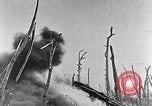
Extract from film "The Somme" depicts German troops in trench warfare against South African Brigade in Battle of the Somme, World War I.
Scenes from British feature film "The Somme" made in 1927, about the Battle of the Somme in World War 1. Part of it depicts events involving the South African Brigade in the battle. The extract opens with shells bursting all along No Man's Land among fragments of trees. Explosions and smoke everywhere. On July 18, 1916, Nine German Battalions deploy to drive the South African Brigade from the Delville Wood. Several soldiers of the Brigade seen entrenched in a sand-bagged position as a German shell explodes only yards from them. German soldiers advance through the broken trees and brush, while under fire by British gunners using Vickers machine guns. Some German soldiers falling and others seeking cover in abandoned trench. A line of South African troops firing their rifles from a trench, as several German soldiers reach them and are shot dead just feet away. A British soldier is shot while climbing out of a trench containing several fallen comrades. Other British (or South African) troops scrambling to find a safer place. One crawling across the ground. A British gunner firing a Lewis gun. German troops starting to go over-the-top, from their trench. British soldiers advancing. German gunner firing Maxim gun from fortified position, as shells burst in the distant background. A horizontal line of British troops advancing toward the German position. Some are cut down by the machine gun fire. German gunner firing a captured British Vickers machine gun. British soldiers hunkered down in a deep shell hole behind a ridge. They use their trenching tools to dig in deeper. Several German shells burst in the air. Two British soldiers watch as a tank approaches through the smoke. Large numbers of British troops attack downhill through smoke and haze. German soldiers preparing to defend an occupied structure, as more British troops charge forward. Post-battle view of the area, with fallen soldiers marked by rifles stuck in the ground with helmets on them. (Note: The tanks shown in this film are models Mark V which did not enter service until 1918.)
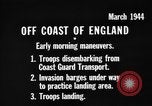
American troops practice amphibious assaults on English coast during World War II.
Opening scene shows a motor launch being lowered from the transport ship, USS Bayfield (APA-33). View of a Coast Guard Crewman with many U.S. soldiers on deck behind him. Next, the troops are seen descending a landing net over the side of the ship, into Higgins boat landing craft. Waves cause the net to sway out over the water with several soldiers on it. Silhoutttes of landing craft underway in the water with sun rising through haze in background. Landing craft heading toward a beach, and then troops charging ashore over the beach. (World War II; WW II; World War 2; World War Two)
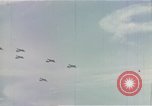
Formation of B-17s in flight over countryside, England.
Aerial formation of B-17s over English countryside. Formation of B-17s at relatively low altitude. .Views from gunners' positions and from pilot's position in the cockpit of one aircraft.
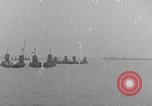
German U-boats obtained by Britain after World War I
German submarines taken as war prizes by Britain after World War I. A British official is taken by boat to inspect the submarines. Accompanied by British Naval offiers, he steps walks along the deck of the German submarine, U-9, pointing to its identifying letters. He poses with the officers. Visible behind them is the British submarine, L-15. (Note: The German U-boat, U-9, was surrendered on November 26, 1918 and broken up at Morecambe, England, in 1919.)
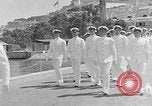
Dedication of memorial to lives lost on U.S. Coast Guard Cutters Tampa and Seneca, in 1918
U.S. Coast Guardsmen parade in dress whites, at pier in Gibralter harbor, and assemble in formation for ceremony to dedicate a memorial. The Coast Guard Ensign hangs over, and hides a memorial plaque on wall of building. Participants include British and American officers and British and American civilian officials, several dressed formally, with top hats. A number of ladies are seated for the event. After brief invocation by clergyman, A British military brass band plays, Coast guardsmen, with rifles, present arms, and the Coast Guard ensign is removed, unveiling the memorial plaque. The plaque honors those lost when the Cutter Tampa was torpedoed by an enemy submarine, in Bristol Channel, on September 26, 1918, with loss of all 115 souls on board. It also honors 11 officers and men of the Cutter Seneca, who volunteered, and were lost attempting to salvage the torpedoed British Steamer, Wellington, in the Bay of Biscay, September 17, 1918. The American flag is displayed above the new plaque, and Coast Guard officers place four wreaths at the base of the memorial. .
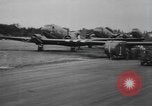
U.S. Paratroopers preparing, and then departing from England, to airdrop over Normandy during World War II
An airfield in England, filled with Waco CG-4A Gliders and their C-47 tow planes, in readiness for the invasion of Normandy, France, in World War 2. U.S. Army Air Forces intelligence officer briefing C-47 and Glider pilots and crews about conditions expected in the drop zones of Normandy before D-Day in World War 2. Brigadier General James Gavin,Commander of the 82nd Airborne Division, giving a final briefing to his paratroopers. A military chaplain holding final religious services for troops. General Dwight D. Eisenhower, visiting paratroopers of the 101st Airborne Division, as they prepare to depart on the night of June 5, 1944. U.S.Army paratroopers boarding their C-47 aircraft to depart for Normandy on June 5, 1944. Several are seen tying parapacks of heavy equipment to the aircraft for separate release. Paratroopers of 101st Airborne Division, loading equipment aboard a CG-4A Glider, and getting final briefing from their pilot. Other 101st Airborne troopers don personal equipment on the ramp near their C-47 airplane, which displays paint-striped wings and fuselage. Jumpmaster makes final check of his troopers. The paratroopers boarding their aircraft with heavy loads of equipment. C-47 aircraft take off towing their gliders.
CRITICALPAST.COM: About Us | Contact Us | FAQs - How to Order | License Agreement | My Account | My Lightboxes | Shopping Cart | Advanced Search | Featured Collections | Website Terms & Conditions | Privacy Policy ©2026 CriticalPast LLC.
License Agreement |
Terms & Conditions |
Privacy Policy
©2026 CriticalPast LLC.