


 Francais
 Deutsch
 Italiano
Refine Your Search
Nevada United States 1936 stock footage and images
- Showing 26659 to 26664 of 27247 results more
more Hide
Hide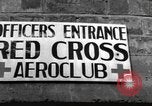
U.S. bomber crews at 127th Replacement Battalion site, Washington Hall, Chorley, Lancashire, England during World War II
U.S. bomber crew members on leave in England while awaiting final orders to return home to the USA, during World War 2. A sign reads 'Officers Entrance Red Cross Aeroclub'. U.S. airmen and officers have drinks and snacks in a garden, compliments of the Red Cross, at the aeroclub of 127th Replacement Battalion site, Washington Hall, Euxton, Chorley, Lancashire. The airmen line up in formation for a retreat ceremony and salute as the American flag is lowered and folded by Military Police. An announcement over Loudspeakers prompts the fliers to rush toward Squadron "O" Bulletin Board to find their names on the list of those scheduled to return home to the USA. One flier wears a leather jacket with image of B-17 named "American Beauty" and 36 bombs (for missions) painted on it. Another wears jacket with image of a B-24 and 31 bombs, and one has room only for the name,"Piccadilly Willy," because the rest of the jacket contains bombs for 65 combat missions. Army Air Forces Methodist Chaplain, Clifford Peace, from North Carolina, conducts a brief service of blessings and good wishes for the fliers who will now be returning home.
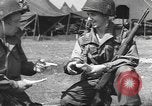
U.S. paratroopers of 101st Airborne Division at Royal Air Force Greenham Common airfield, Britain during World War II.
U.S. Army paratroopers of the 502nd Parachute Infantry Regiment, 101st Airborne Division, bivouacked at British RAF Greenham Common, England, prior to the Operation Market Garden invasion of Holland. Two paratroopers of 502nd Parachute Infantry Regiment (hearts on their helmets), 101st Airborne Division, clown for the camera with foreign currency. A Lieutenant performs a good-natured inspection of his platoon, for the camera. Paratroopers prepare boxes of demolition charges for air drop. Another Lieutenant of the 502nd PIR inspects members of his Platoon. Soldierss clown around and have fun giving and receiving haircuts. Troopers seated under a tent, sharpening their personal knives and testing the edge by shaving hair on their arms. Group of U.S. Army paratroopers being briefed outside tents and reviewing orientation techniques while one holds a magnetic compass.
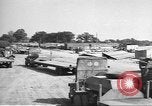
U.S. Waco CG-4 assault gliders being assembled at RAF Station Greenham Common , England during World War II.
U.S. gliders being assembled at RAF Greenham Common, England, in preparation for the D-Day invasion during World War II. Truck trailers arrive at the airfield. Packing crates placed on field. Workmen assemble U.S. Waco CG-4 assault gliders. Man directs arriving vehicles. Light tractor pulls crate loaded with glider part. Truck loaded with men arrives. Men work under the wing of a glider.
Baseball game being played by British teams in the UK during World War II.
Scoreboard reads ‘Next Saturday - USA Bears Vs Brad Bros’. The opposing teams run side by side toward home plate to start the game. One team's bench with players, and bat boys (some barefoot) seated in front of a picket fence, with spectators on benches and a club house behind them. View of game action from spectators perspective, behind home plate. Batters hitting and driving in a run. A lone American soldier watching in midst of the spectators. Players coming off the field to their bench at end of an inning. Spectators in stand watching the game. Items left after the game include several English shilling coins. A man's hand reaches down and picks up two shillings.
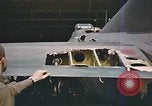
Crewmen inspect flak damaged U.S. 8th Air Force B-17 Flying Fortress bomber at an airfield in England during World War II.
U.S. 8th Air Force B-17 Flying Fortress bombers in England during World War 2. Crewmen inspect flak damage to B-17F, tail number 42-29487 named "Ritzy Blitz" (name not shown) of the 91st Bombardment Group, 324th Squadron, stationed at RAF Bassingbourn, Cambridgeshire, England. Severe damage is seen on left wing flap and left elevator.
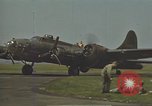
U.S. 8th Air Force B-17 bomber "Memphis Belle" taxis on airfield in England during World War II.
U.S. 8th Air Force B-17 Flying Fortress bomber "Memphis Belle" taxiing on outboard engines with inboards shut down, on an airfield in England during World War II. The pilot, Captain Robert K. Morgan is seen on the ground smiling, after the B-17 is parked. A crew member looks out of the pilot's cockpit window.
CRITICALPAST.COM: About Us | Contact Us | FAQs - How to Order | License Agreement | My Account | My Lightboxes | Shopping Cart | Advanced Search | Featured Collections | Website Terms & Conditions | Privacy Policy ©2026 CriticalPast LLC.
License Agreement |
Terms & Conditions |
Privacy Policy
©2026 CriticalPast LLC.