


 Francais
 Deutsch
 Italiano
Refine Your Search
Nevada United States 1936 stock footage and images
- Showing 26707 to 26712 of 27247 results more
more Hide
Hide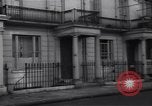
President of League of Nation union , Lord Viscount Cecil dictates a letter to daily telegraph in London.
Exterior of President of League of Nation union , Lord Viscount Cecil's house in London. He dictates a letter to daily telegraph.
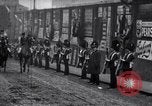
British horseguards escort German Kaiser Wilhelm II and entourage in London
Kaiser Wilhelm II and party arrive in horse-drawn carriages escorted by British Horse Guards on parade in London, England.
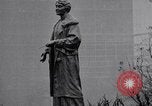
Brief montage of moving images from early 20th Century Women's suffrage and equal rights movement in Great Britain.
Scene opens showing the statue of British Women's suffrage movement leader, Emmeline Pankhurst, located in Victoria Tower Gardens next to the Houses of Parliament, Westminster. (This was erected in her memory, in 1930, two years after her death.) A World War 1 parade of women in clothing of religious orders; nurses; some military; and academics. One group carries a banner reading "Demonstrate-Trained Nurses." It also depicts What appears to be an Angel of Mercy and an appeal to buy war bonds. They are followed by women carrying a large British Union Jack, and by others, in academic garb, carrying banners of academic institutions. (This march was probably organized by the "Women's Party," the 1917 group founded by the Panghursts' to replace their "Women's Social and Political Union." The new party emphasized support for the British war effort.) Scene shifts to suffragist Emmeline Pankhurst (sometimes called a suffragette) viewed from camera behind her right shoulder as she addresses a large crowd. She is standing on a roofed platform in a park-like setting. The audience is mostly civilian, but a soldier is seen here or there. Several London Bobbies are in the audience, close to the speaker's stand. The next scene shows pedestrians gathered near Buckingham Palace, in London. A number of Bobbies (London policemen) are present, some on foot and some on horseback. The Queen Victoria monument is visible in the background. A horse-drawn carriage passes in front of the camera. Next, a woman is seen being arrested by two Bobbies, as passersby watch. An automobile passes and then the woman and police are seen approaching the camera as more officers become involved, keeping spectators away. In the final scene, in the 1920s, a man standing in front of a large group of women, congratulates one (probably Christabel Pankhurst). Closeup shows, from left to right, the man; a somewhat tired-looking Emmeline Pankhurst; and her daughter, Christabel.
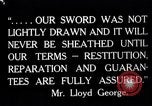
Britain's Prime Minister David Lloyd George on a balcony with another official in London, England, during World War I
Mr Lloyd George stands on a balcony with another official in London, England, after responding to German peace overtures, by demanding "...restitution, reparation, and guarantees..." during World War 1.
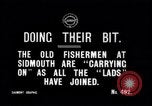
Old fishermen work short-handed at Sidmouth, England, during World War I
Old fishermen at Sidmouth, Devon, South West England, during World War 1. The elderly fishermen work without help from young men (all of whom have left to fight in the war). Young boys stand by and watch as the men shake fish from their nets, on the shore. Two pick fish up from the shore where they have emptied them from their dory, seen behind them. The elderly fishermen seen earlier, emptying their nets, are now placing their catch into baskets, crouched over a large pile of fish on shore, with the fishing boat behind them. Change of scene, to buyers inspecting the barrels of newly caught fish. Fishermen standing by barrels of fish at market near sea shore.
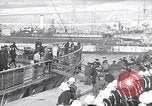
British Field Marshal Douglas Haig reviews Royal Navy guard of honour upon arrival in Dover, late at end of World War I
British Expeditionary Force commander and Field Marshal, Sir Douglas Haig, debarks from a smaller ship onto a dock in Dover in December 1918, soon after the signing of the armistice ending World War 1. White cliffs of Dover seen briefly in background behind a large ship. Victorious Marshal Haig is met by Vice-Admiral Sir Roger Keyes. A man with a royal mace stands behind the officers. British Royal Navy Guard of Honor band in white helmets plays as Commander Haig and Commander Keyes pass by the assembled forces. Civilians are lined up behind the military forces to welcome home Field Marshal Haig.
CRITICALPAST.COM: About Us | Contact Us | FAQs - How to Order | License Agreement | My Account | My Lightboxes | Shopping Cart | Advanced Search | Featured Collections | Website Terms & Conditions | Privacy Policy ©2026 CriticalPast LLC.
License Agreement |
Terms & Conditions |
Privacy Policy
©2026 CriticalPast LLC.