


 Francais
 Deutsch
 Italiano
Refine Your Search
Nevada United States 1936 stock footage and images
- Showing 27037 to 27042 of 27248 results more
more Hide
Hide
Proclamation of accession of Princess Elizabeth Alexandra Mary as Queen Elizabeth II, in London England
Following the death of King George VI the night before, ceremonies are held in London proclaiming the accession of Princess Elizabeth to the throne as Queen Elizabeth II. People gather in a large number on a street in London. A royal carriage passes on the street. Cavalry moves along with the carriage. Buildings along the sides of the street. People standing behind roped off area. Officials come outside the at the Royal Exchange in London and stand on the steps of the building. One of the officials speaks on behalf of the Lords Spiritual, the Lords Temporal, the Lord Mayor of the City of London, the Aldermen of the City of London and representatives of Commonwealth nations. He reads the formal Proclamation of Accession announcing Princess Elizabeth Alexandra Mary as Queen Elizabeth II. He then declares "God Save The Queen." People applaud after the announcement and the band plays God Save the Queen.
Scenes from foundation stone ceremony during reconstruction of British House of Commons, following World War 2
The House of Commons in London England. Damaged and roofless areas of the building, with standing water on floors. The ruined buildings after the German bombardment in 1941 during World War 2. The debris on the ground. A man standing nearby. View of Big Ben clock tower. Officials gather outside the House of Commons, including Prime Minister Winston Churchill. They step up onto a stage with construction scaffolding nearby. Official on podium with Churchill standing behind.
King George VI arrives with his queen to dedicate a memorial to his father in London, England.
King dedicates memorial to his father in London, England. King George VI arrives with his queen at Wellington Barracks. A car arrives outside the building. Dignitaries come out of the car. Soldiers stand in formation and greet the King and Queen. King meets other officials. He arrives to attend the unveiling ceremonies at a memorial to his father, George V.
People gather at the railroad station in London to greet Metro-Vickers Affair staff returning home after Soviet spy-trials
Freed British industrial engineers and company executives from Metro-Vickers return home to London, England following show trial in the Soviet Union that alleged their involvement in espionage and so-called wrecking activities at Soviet electrical power stations. People at Liverpool Street station in London, England. A railroad train arrives on the railway track. Crowd greets Metro-Vickers Moscow Chief Allan Monkhouse and engineer Charles de Nordwall (C.H. Nordwall) on their return after the trials. Monkhouse and Nordwall pause and appear to talk to press. British police bobbies stand by train car. Nordwall and his wife enter a waiting car along with one other woman. View of Great Eastern Hotel entrance in background as car drives away.

Sir Winston Churchill returns home after being in hospital due to an injury in London, England.
Former British Prime Minister Sir Winston Churchill arrives home in London, England. Churchill returns back to his home after being in hospital for 54 days. His wife arrives at the hospital. A large crowd gathers outside the hospital. Churchill seated on a chair is transferred to a van by the soldiers. The van leaves the area. They arrive home. He is taken out of the van.
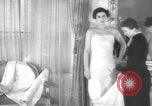
White Russian, Anna de Wolkoff, at work in her Haut couture Boutique in London, England.
The Haut couture Boutique of White Russian Anna de Wolkoff (aka Anna Nikolayevna Wolkova), daughter of Admiral Nikolai Wolkoff, the Imperial Russian Naval Attache in London, who remained there after the Bolshevik revolution. She pins underlayment fabric on a customer and then has her assistant bring a roll of dress fabric which de Wolkoff drapes and folds, to create a new gown for her customer. The assistant comments about having trouble finding matching fabrics. Anna De Wolkoff suggests a shop in Herald Square, where she used to go when she was a "matching girl." Three takes are repeated during this film. In the last one, the garment is beginning to take final shape. (Note: Anna de Wolkoff was arrested on 20 May 1940 and charged with violating the Official Secrets Act. She was tried, convicted,and sentenced, On 7 November 1940, to 10 years imprisonment for "attempting to assist the enemy.")
CRITICALPAST.COM: About Us | Contact Us | FAQs - How to Order | License Agreement | My Account | My Lightboxes | Shopping Cart | Advanced Search | Featured Collections | Website Terms & Conditions | Privacy Policy ©2026 CriticalPast LLC.
License Agreement |
Terms & Conditions |
Privacy Policy
©2026 CriticalPast LLC.