


 Francais
 Deutsch
 Italiano

Refine Your Search
Nevada United States 1936 stock footage and images
- Showing 30523 to 30528 of 35683 results more
 Hide
Color Sound

A collapsed testing rig and a damaged building structure in Nagasaki, Japan.
A survey of physical damage of bomb blasts in Nagasaki, Japan after World War II. A broken corrugated asbestos roof lying on the floor. A collapsed testing rig into a torpedo testing basin. Control equipment and instrument panels on the torpedo testing rig. A U.S. Army officer inspects the damage inflicted on the torpedo testing basin and building structure. A wall leaning inwards as a result of the pressure exerted on it by a blast.

Atomic bomb damage in Nagasaki, Japan from World War II
A survey of physical damage from atomic bombing of Nagasaki, Japan, filmed after World War 2. Flash burns on a telephone pole. A damaged machine shop of a commercial school. Burnt out machine shop and the commercial school which was gutted by fire. Stripped roof of the building. Displacement and distortion of a wall as a result of blast. The bowed wall of the machine shop as a result of the force exerted which was transmitted through the frame of the structure. The destruction of the municipal tenement district located in a valley. A view of hills in the valley. Damaged buildings of the Shirayama School and the Nagasaki Hospital in the background. A damaged machine shop and several overturned lathes near it. A wrecked milling machine and a concrete block. Lieutenant Commander A. N. Vardac of the United States Naval Reserve stands near the concrete block. Distortion of steel frame roof of the machine shop. Burnt out casting with the machine shop in the foreground and the commercial school in the background. Cracks in concrete. A steel casement window frame blown out.

B-29's of the 73rd Bomb Wing on Saipan at end of World War 2
United States Army Air Force Boeing B-29 Superfortress aircraft of the 73rd Bomb Wing, 500th Bomb Group (Tail Code "Z") seen on Saipan. A B-29 aircraft taxis and turns on a runway. A rainbow in the sky. A B-29 being moved with a tug. Ground handling of a B-29 aircraft. An airman direct a pilot to the parking spot. A group of airmen stands near the parked aircraft. On its fuselage below the cockpit, it displays a black bird's wing on top of a black globe and a long yellow paint stripe underneath. The airmen take equipment out of the aircraft and haul it away in a cart. Three B-29 aircraft parked.

Postwar scenes from Guam. Improvised wind-powered washing machines. Tent camp. Chow line. B-29s.
Activities of airmen at U.S. 20th Bomber Command headquarters in Guam immediately after end of World War II. Improvised wind-driven washing machines. A tent area and palm trees. Men in a chow line. They sterilize their mess gear in water heated by a stove. A sign on a building reads 'Headquarters, 20th Bomber Command'. A man walks out of the building. B-29s of the 314th Bomb Wing, 29th Bomb Group (Tail Code "O") are parked on flight line.
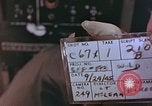
Airmen from 20th Bomber Command Headquarters, Guam, make a fun movie about pilot in cockpit of P-51 aircraft
About a month after the end of World War 2, Airmen at the Headquarters, U.S. 20th Bomber Command, Guam, Marianas Islands, try their hand at movie making for fun. Numerous takes of airman's hand on control stick in cockpit of a P-51. The first is with a glove on. Others are barehanded. He manipulates the control stick and presses weapons firing buttons. In a different scene, a "pilot" sits in cockpit of a dented P-51 and with help of contrived background appears to be flying. He acts somewhat bewildered.

Soldiers load and fire from an M107 Self Propelled 175mm gun in Bien Hoa, Vietnam.
Artillery fortification in Bien Hoa, Vietnam during the Vietnam War. Soldiers of U.S. 8th Artillery 54th Artillery Group work on an M107 Self Propelled 175mm gun. Filled sacks in the foreground. Firing from the howitzer. The soldiers come out of a bunker. A soldier carries shells and places them on a howitzer. Two men load the shells in the howitzer and clean a gun barrel.
CRITICALPAST.COM: About Us | Contact Us | FAQs - How to Order | License Agreement | My Account | My Lightboxes | Shopping Cart | Advanced Search | Featured Collections | Website Terms & Conditions | Privacy Policy ©2026 CriticalPast LLC.
License Agreement |
Terms & Conditions |
Privacy Policy
©2026 CriticalPast LLC.