


 Francais
 Deutsch
 Italiano

Refine Your Search
Nevada United States 1936 stock footage and images
- Showing 31921 to 31926 of 35683 results more
 Hide
Color Sound

Leather worker gives new leather purses to store manager. Woman customer seeks purse to match new skirt
A leather shop specializing in women's accessories, Boston, Massachusetts. A leather worker gives new leather purses to the store manager who places them on a rack for display. A woman customer seeks a purse to go with her new skirt. Saleswoman helps her . A small sign in the background above a rack of accessories reads 'Phelps Associates'

Amelia Earhart conquers the Pacific in a historic flight from Hawaii; Eleanor Holm Jarrett breaks her own record in swim meet
Achievements of American women in 1935. Eleanor Holm Jarrett in a Miami swim meet. She performs backstroke and breaks her own record. A close up of Jarrett. Next segment: Amelia Earhart conquers the Pacific in a historic flight from Hawaii to Oakland California. Earhart emerges from cockpit. People crowd around the plane. A close up of Amelia Earhart receiving flowers from crowd and later posing for photographers. From a December 14, 1959 newsreel recounting events 25 years earlier.
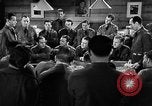
An officer briefs the Sergeants about the wedge and Echelon platoon formations and its usage and advantages (WW2)
The advantages of the different Platoon formations during World War II. The Sergeant seated on a desk. A Rifle Squad officer uses a model to explain them the formations. The officer briefs them with the formation that is platoon wedge the formation of readiness. The Platoon is ready to fight in any direction. A Sergeant questions that why is the wedge formation called the formation of readiness. The officer compares the wedge formation with the platoon column and answers his question. The next formation is the Echelon to the right and left provides good coverage of an area. The officer holds a poster which reads 'Echelon'. It is used by the platoon in approach march when the flank is exposed. He explains the explosion of flank in any conditions.
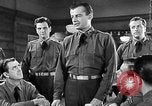
An officer with the help of a model explains when is the Skirmish Line formation used during a battle (WW2)
The advantages of the different Platoon formations during World War II. The Sergeants seated on a desk. A Rifle Squad officer uses a model to explain when is the Skirmish Line used. He starts from the approach march. The model shows the squad breaking into small platoon columns after firing of an artillery. The Sergeants listen to him. He also speaks that the troops are in squad column formation until they reach the particular range of the rifles. He focuses on two things first not to fire from more than 400 yards and do not deploy skirmish until we are forced to fire. He speaks about when and why to deploy skirmishes. He also states three reason for delaying the deployment of skirmishes.
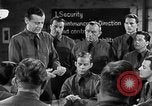
An officer briefs sergeants about the responsibility of a platoon leader, Sergeant during a platoon formation in a battle (WW2)
The advantages of the different Platoon formations during World War II. The Sergeant seated on a desk . A Rifle Squad officer uses a model to explain different responsibility of the platoon leaders, Sergeants and guides at the time of the approach march. He first talks about the job of the platoon leader. He is between the platoon squad and the leading squad. His task is to get the platoon safely forward, maintain contact with his neighbors. The job of the platoon Sergeant. He is in the center of the formation. He goes where he needs to do his job.. Supervises and control the platoon in absence of the platoon leader and acts immediately during any critical situation in the absence. The last is the job of platoon guide. He should fulfill the duty of platoon Sergeant in his absence. He moves in the rear of the platoon and keeps an eye to flank. He duty is to inform about the any unusual event. His job is the toughest one. A Sergeant asks questions to the officer about the platoon Sergeant and he answers.
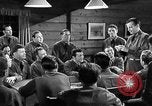
An officer highlights the basic and important points that can be used during different formations (WW2)
The advantages of the different Platoon formations during World War II. The Sergeant seated on a desk. A Rifle Squad officer stands in the center sums up with the highlights that were done in the lesson. He focuses on few big points during the formations they are provide good control, allow and use cover, get forward faster. Deploy skirmishes only when you are forced too. Always adopt a formation that will provide you with support squad. Maintain contact on the units to the right and left. To take up Echelon formation if the platoon leader has an open flank. The Sergeants listen to him.
CRITICALPAST.COM: About Us | Contact Us | FAQs - How to Order | License Agreement | My Account | My Lightboxes | Shopping Cart | Advanced Search | Featured Collections | Website Terms & Conditions | Privacy Policy ©2026 CriticalPast LLC.
License Agreement |
Terms & Conditions |
Privacy Policy
©2026 CriticalPast LLC.