


 Francais
 Deutsch
 Italiano

Refine Your Search
Nevada United States 1936 stock footage and images
- Showing 32011 to 32016 of 35683 results more
 Hide
Color Sound
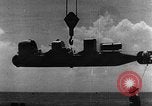
Italian human torpedo used in maritime sabotage operations against Allied ships.
Methods and machines used by Germans and Italians in maritime sabotage operations. One method in sneak craft is the use of human torpedoes. Dramatization: an Italian human torpedo. The torpedo is lowered. The crewmen equip themselves with scuba diving suits and breathing apparatus. They ride on the torpedoes. Detachable warhead attached to the torpedo. The controls and switches of the torpedo. Animation shows the action of the human torpedoes for destruction of ships. Germans use human torpedoes. One man seated on the torpedo. The torpedo dives deep in water. (World War II period).
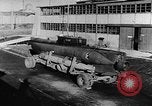
German submarines used as sneak craft in maritime sabotage operations against Allied ships.
Methods and machines used by Germans and Italians in maritime sabotage operations. One method used as sneak craft is German midget submarine. Dramatization depicts the use of a German midget submarine. German 'Beaver' submarines in view. Submarine lowered in water. Submarine underway and then submerged in water. The parts of submarine explained like the propeller and glass observer. The crew members seated in the submarine. The Captain orders the engineers to prepare for firing. Periscope in view above water. Two crew members seated on the submarine above water. (World War II period).
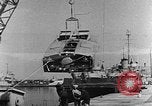
Italian and German World War 2 sneak craft torpedo motorboats, including Italian MTSM and German Wendel.
View of Italian MTSM torpedo motor boat from WW2. Retractable propellers shown. MTSM underway as torpedo is launched from the stern. German Wendel torpedo boat. Torpedos seen in stern of Wendel boat. Closeup of rocket launchers in action. Italan explosive boat. Retractable propeller of explosive boat demonstrated. Explosive boat driven over submarine netting, also known as harbor netting. Driver of Italian explosive boat falls backward into water as boat is guided to target.

Sneak craft used in maritime sabotage operations against Allied ships.
Methods and machines used by Germans and Italians in maritime sabotage operations. One method used as sneak craft is a craft launched by a trailer. Trailer on road. Dramatization depicts the launching of the sneak craft in water. Men push the craft in water. Shoreline in the background. Men seated on the craft underway. The crew member jump at the last moment. The charge of 800 pounds blasts as it comes in contact with Allied ships causing explosion. (World War II period).

Fliers are briefed in Ready Room of the USS Princeton (CV-37) during the Korean War
View inside pilot's Ready Room aboard the USS Princeton (CVA-37) during the Korean War. Intelligence officer discusses a map with a pilot from Fighter Squadron FS-191, who wears the "Satan's Kittens" patch on shoulder of his leather jacket. The pilot and intelligence officer also speak with two other fliers seated, who consult their own maps. Upon conclusion of briefing, the three fliers pick up their helmets and oxygen masks, and leave the ready room. A loudspeaker is shown, presumably in use. (Note: Squadron FS-191 is made up of former members of the Navy's "Blue Angels" demonstration team, which was dissolved when the Korean War broke out.)

Areas mined can be in river, harbor, channels and coastal water and various types of mines used are explained.
Characteristics and capabilities of Minesweeper ships. These ships are equipped for detecting, destroying, removing or neutralizing explosive marine mines. The ships underway at a sea. Animated map shows the locations of mines. Mines can be laid in river, harbor, channels and coastal water. Animated diagram show 'moored' and 'bottom' types of mines. Contact mines and influence mines are explained. The influence mines can explode by magnetic, acoustic and pressure influence. The Ocean Minesweepers are called as MSO, the Coastal Minesweepers are called as MCS, the Shallow Minesweepers are called MSL and Harbor Minesweepers are called as MSB.
CRITICALPAST.COM: About Us | Contact Us | FAQs - How to Order | License Agreement | My Account | My Lightboxes | Shopping Cart | Advanced Search | Featured Collections | Website Terms & Conditions | Privacy Policy ©2026 CriticalPast LLC.
License Agreement |
Terms & Conditions |
Privacy Policy
©2026 CriticalPast LLC.