


 Francais
 Deutsch
 Italiano

Refine Your Search
Nevada United States 1936 stock footage and images
- Showing 32413 to 32418 of 35683 results more
 Hide
Color Sound

Bison graze at the Buffalo Ranch in the Yellow Stone National Park, Wyoming, USA.
Sign board reads, 'Buffalo Ranch'. View of the Buffalo Ranch at the Yellow Stone National Park in Wyoming, USA. Bison graze in the field. View of sun setting.
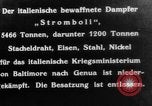
German U-Boat sinks Italian armed freighter, "Stromboli," by means of explosives and gunfire during World War I
Slate describes the Italian armed steamer, "Stromboli" carrying bulk cargoes of iron, steel, and nickel for the Italian war ministry, from Baltimore, U.S.A. to Genoa, Italy. It states that the ship was sunk and her crew released. View from deck of German U-Boat,U-49, under command of Captain Hans von Mellanthin. Several crew seen in conning tower. The single stack ship "Stromboli," stopped in the background. The U-49 approaches portside of the Stromboli, where a 7.6 cm deck gun is seen astern. An explosives technician, is dispatched by dinghy from the U-Boat, and boards the Stromboli. The U-Boat crew members obtain fresh water from the STromboli, before setting explosives to sink her. The German explosives technician is seen lighting fuses on deck of the Stromboli. The charges explode at her waterline. The U-Boat then fires its deck gun to hasten sinking of the Stromboli. View from the submarine as the Stromboli settles lower in the water and finally sinks stern-first. The location is off Capo Mele, (43.57N, 08.12E) in the Mediterranean Sea. Scene shifts to view from the U-49 deck during sunrise at Algiers.
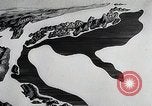
Commercial fishing industry of Japan before World War II
Animated map of fishing grounds around Japan that provide one fourth of the world's catch. Movement of the seasonal catch is tracked as it moves Northward during the year. Men and women engaged in commercial fishing, gathering in nets teeming with fish. Fishing boats plying waters of an inland sea. Fishing boats moored along the shores. Larger seagoing fishing boats leaving to operate along the coast of Honshu. Fishermen letting out nets from these boats and using cable winches to retrieve them. Views of refrigerated Japanese fishing ships that also freeze their catches, operatiing in the Siberian maritime provinces and in Alaskan and Arctic waters. Fishing boats, operating before World War 2, are seen pulling crabs aboard. View inside a floating cannery ship where salmon and crabmeat are being canned for export to places like the U.S.A. Closeup of a can displaying "ICEBOUNDBRAND" and text reading: " World Renowned Floating Cannery Pack Fresh from the Deep Sea Waters of Northern Japan. Net contents 13ounces. SELECTED CRABMEAT." Japanese wading in a river, and using trained cormorants, to catch fish. View of fisherman taking fish from his cormorant and placing them into a large jug. view of edible seaweed being harvested and laid out in the sun, in racks. Animated illustration of Japanese man and items included in his dinner of rice, soybean, fish, sea slugs, sea urchins, octopus, lily bulbs, bamboo shoots, bean curd and pickled fruits and vegetables, accompanied by a little saki (rice wine).
Second Sino-Japanese War
Opening scene shows formation of Japanese Mitsubishi G3M bombers in flight. View of bombardier at bomb sight inside a bomber. Bombs falling from the aircraft, upon the Chinese city of Shanghai, on a day in September, 1937. Ground level view of bomb exploding and Chinese civilians running for cover. A huge explosion throwing earth up. Aerial view of smoke rising from bomb strikes below. More ground views of bombs destroying structures. Chinese people fleeing across a bridge. Cluster of bombs falling from a Japanese airplane. More explosions and destruction. view from a G3M bomber, of others with bombs falling from them. View from above of civilians filling a street as they run for shelter. People on the ground rushing in all directions. Some are in horse-drawn carriages with luggage on top and other in rickshaws, apparently fleeing the city altogether. Bombing victims lying on the ground near destroyed structures. Heavy dark smoke rising from the attacks. Scene shifts to Japanese army officers entering the Yasukuni shrine in Tokyo. Behind them is A Shinto Tori (Gate) and behind that, the monument (statue) of Omura Masujiro. Scene shifts again, to view of the Temple of Heaven, an ancient Imperial Sacrificial Altar in Peking (Beijing) China. Chinese agriculture. Crowds of Chinese people. Stone statue of traditional Chinese lion. Picture of 1851 oil-on-canvas painting by the German American artist Emanuel Gottlieb Leutze, of Washington crossing the Delaware. Drawing of 15th century ship similar to one in Columbus'1492 voyage to America. Drawing of Roman Empire era building. Michelangelo’s statue of Moses. Drawing of ancient Egyptian pyramid and statue. Drawing of Chinese city and environs representing 4 thousand years ago. Extant ancient Chinese shrines and statues. Animated Relief map of China and surrounding countries of U.S.S.R., India,Burma,Thailand, Indo-China, Philippines, and Japan. Animation outlines China Proper. It also shows Manchuria and scenes from there of desolate mountainous land, with miners at work extracting raw materials. Mongolia and Sinkiang are outlined. The Gobi desert is seen with a long camel caravan crossing it. Closeup of nomads transporting animal skins by camel. The last region outlined is Tibet. The ice covered Himalayan mountains are shown. Buddhist monks praying in the courtyard of a shrine in Tibet. The Yellow, Si Kiang, and Yangtze Rivers are shown on the map. Views of Chinese sailing vessels.
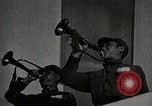
Recruitment of Civilians for Chinese Peoples Army during 2nd Sino-Japanese war. First All-volunteer Group (Flying Tigers) formed by Claire Chennault
Events in 2nd Sino-Japanese War covering late 1930's through 1943 in World War 2 Scene opens with two Chinese army buglers sounding a call. Next, a line of recruits is seen marching on a field. Chinese officers sit at a table with civilian officials. A Huge crowd of army volunteers are seated, each holding a small white flag. Two more buglers sounding a call. Crowd of recruits move through a gate. Northern Chinese soldiers in fur hats march. Recruits are shown from the East and West of China. Recruits in formation. Bugler sounding a call. Chinese cavalrymen joining the army. More scenes of Chinese people joining together to fight the Japanese. Newly recruit Chinese solders engaged in close order drill and physical training exercises. Uniformed soldiers in helmets, performing synchronized calisthenics and physical combat drills with rifles. Platoons of Chinese soldiers practicing marching and tactical maneuvers. Chinese youth training as first aid workers, carrying stretchers and learning first aid techniques. Chinese women in uniform marching with rifles. A Chinese girl kneels down behind a Maxim machine gun, as an officer instructs and other girls sit around in a group. Glimpse of girls training with rifles on an outdoor firing range. Claire Lee Chennault and his American "Flying Tigers" pilots and P-40 airplanes at an airfield. The American flag flying from a flagpole behind them. Pilots scrambling to their aircraft. Chenneult, now a U.S.A.A.F Major General, commander of 14th Air Force in China, in seen congratulating Chinese army aviators. He is accompanied by a Chinese Air Force General. Behind them is parked a B-24 Liberator bomber of the 308th Bombardment Group. A Chinese Nationalist P-40 with tiger teeth logo on air intake, starts its engine and taxis out for takeoff. View from cockpit of a P-40 pursuing and shooting down a Japanese Nakajima Ki-27 aircraft. Chinese soldiers in precision drills at a garrison.
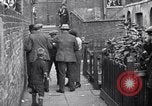
Events that initiated World War I and animated map showing involvement of nations from 1914 through 1918
Opening scene is circa 1930s and shows a man being roughed up by a group of men in an alleyway with pushing and shoving as they fight. A slate comments (in French) that when nations are bellicose, an assassination can cause a world war. Next, a slate shows picture of the world and states (in English) "One murder may start a world war." Another slate (in French) states that In 1914, while Europe's armies and fleets were more powerful than they had ever been, the nephew of the Emperor of Austria (Archduke Ferdinand) was assassinated. A front page is shown of newspaper, "Journal De Geneve" carrying the story. Next scene is a view of the city of Sarajevo. The ancient Emperor's Mosque dominates the scene. A slate appears asking Where is Sarajevo? It is followed by a map of Europe in 1914, which zooms in on Austria and Serbia and identifies and labels Sarajevo,in Austria, close to the Serbian border. Slates (in French) says Austria accused Serbia of War and other nations enter the melee. Animated World map shows the nations getting involved, starting with the German Empire in 1914, including its African colonies, and then successively showing Russia, France, Belgium,Great Britain, Japan, and the Ottoman Empire. Map advances to 1915, showing the Italian empire, Bulgaria,and Central Arabia. In 1916 it adds Portugal, Roumania. Next, the U.S.A. is added in, 1917, along with Central and South America, Greece, Siam, and China. Finally, the slate shows the war ending in 1918. Slate shows Armistice Day, the 11th hour of the 11th day of the 11th Month (November), with time shown on hands of Big Ben in London.
CRITICALPAST.COM: About Us | Contact Us | FAQs - How to Order | License Agreement | My Account | My Lightboxes | Shopping Cart | Advanced Search | Featured Collections | Website Terms & Conditions | Privacy Policy ©2026 CriticalPast LLC.
License Agreement |
Terms & Conditions |
Privacy Policy
©2026 CriticalPast LLC.