


 Francais
 Deutsch
 Italiano
Refine Your Search
Nevada United States 1936 stock footage and images
- Showing 3889 to 3894 of 27246 results more
more Hide
Hide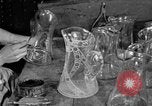
Workers draw design on glass pitcher and cut design by steel wheel and carborundum dust at glass factory in the United States.
Cut glass making at a glass factory in the United States. A worker draws design on a glass pitcher. Other workers roughly cut design with a steel wheel and carborundum dust. The glass cutter used to smoothen the rough incisions. The workers complete the design with a stone wheel. The women workers make more delicate designs and do fine glass cutting. A worker polishes the glass after cutting is completed. Other workers cut design on bowl. The prepared glass treated to an acid bath to preserve its luster. Finally the glasses are washed.

Workers place designs,moisten them and remove them leaving the design on goblets at a glass factory in the United States.
Goblet etching at a glass factory in the United States. Goblet design is prepared from transfer papers. Workers place transfer paper with designs on goblets. Workers moisten the transfer paper while in the goblet to properly etch design in the glass. A female worker carefully removes transfer paper on goblet after design has been etched on the glass. A Guiding Master engraving a batch of grass goblets from his workstation.

A worker paints roosts with crude oil and apply antiseptic powder to disinfect chicken during raising in the United States.
Poultry farming in the United States. A man painting chicken coop roosts with a mixture of crude oil and stock dip to eliminate roost mites. Two workers disinfect a hen by applying antiseptic powder on feathers. A man holds a chicken on its legs while applying powder on its feathers. Two hens resting on a table. Solid white chickens peck grains in their roosts.
Display of clay pots,flower vase,round and square frames on a table in the United States.
Early 20th century ceramic clay pottery and handicrafts in the United States. Under a sign saying “CLAY” is a display of ceramic art depicting vases, pots, plate, and a frame. The clay ceramics on display are glazed and some are embellished with Eastern and floral motifs.
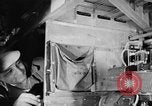
An electrical specialist checks regulators,igniter,alarm bell,motor during the B-24 aircraft inspection in the United States.
The 50-hours inspection of the ignition and electrical system of the USAAF B-24 Liberator heavy bomber aircraft at an airfield in the United States. The electrical specialist checks the regulators in the aircraft nose compartment. The specilaist checks starters and removes window strap for proper inspection. The specialist checks brush condition and inspects the heaters. He takes out screws and pulls out back casting and inspects the back plate for deformation of metals. The electrical specialist uses air hose to clean the oven. He checks and cleans the igniter using a brush. The specialist makes a similar inspection with the side heaters and cleans solenoid belt. He runs the motor and checks its functioning. He inspects the battery plug connection on the outside of the aircraft. He checks the A/C inverter. O perational check of alarm bell is done. He opens the fuse box to repair it, and with the help of a diagram he replaces the bad fuse with the new fuse. The aircraft in flight after completion of inspection.

A man secures stabilizer to ring tail,covers with drag ring,adjusts valve before the release of torpedo in United States.
New techniques in aerial torpedo attack, United States. An aircraft in flight over a sea. The aircraft releases torpedo in water. Torpedo moves. Men haul trolley loaded with the torpedo. The shroud ring or ring tail is in conjunction with the drag ring on nose of the torpedo. Using ring tail and drag ring with wooden stabilizer results in successful test drops. A man secures the stabilizer to ring tail with wooden dowels. The man covers the torpedo with a drag ring which helps to stabilize the torpedo during air travel, and seals the ring. The man adjusts the water trip delay valve which prevents the torpedo from burning up during long travels. Depth setting is done. (World War II period).
CRITICALPAST.COM: About Us | Contact Us | FAQs - How to Order | License Agreement | My Account | My Lightboxes | Shopping Cart | Advanced Search | Featured Collections | Website Terms & Conditions | Privacy Policy ©2026 CriticalPast LLC.
License Agreement |
Terms & Conditions |
Privacy Policy
©2026 CriticalPast LLC.