


 Francais
 Deutsch
 Italiano
Refine Your Search
Nevada United States 1936 stock footage and images
- Showing 5401 to 5406 of 27250 results more
more Hide
Hide
United States soldier examines emaciated patients, gravediggers exhume corpses in Hadamar Euthanasia Center yard, US Major Bulker performs autopsy, US soldiers interrogate chief administrator and nurse of Hadamar Clinic in Germany during WW2
United States Army jeep arrives in Hadamar Clinic (also known as Hadamar Euthanasia Center), a Nazi institution seized by First Army troops in Germany during World War II. Flag of United States drapes over the front of the Hadamar Euthanasia Center after being seized by the Americans. The locals referred to the building as the "house of shutters." United States soldiers get out of jeep and enter the building. United States soldier walks through ward and talks to a patient in bed. Patient in bed talks to United States soldier. United States soldier inspects the rib area of an emaciated, bald male patient. Soldier uncovers the bedsheet of patient and touches patient’s skeletal legs. Bald patient in hospital bed. Soldier sees a patient sitting on bed. Soldier inspects emaciated, shirtless patient. Gravediggers with gas masks exhume corpses from graveyard attached to the Nazi institution. Gravediggers digging for corpses. Gravedigger drags an emaciated, naked corpse out of the soil. A gravedigger unearths a corpse. Gravediggers drag a corpse by her limbs from the earth. Gravediggers pull out a naked corpse. Gravediggers line up corpses for later inspection by WCIT (War Crimes Investigation Team) officials. Major Bulker performs an autopsy of the corpses found in the Hadamar Euthanasia Center graveyard. One soldier takes notes, and another soldier takes photographs of the autopsy. Soldier taking notes while smoking a pipe. United States soldiers interrogating Hadamar Euthanasia Center Chief Administrator, Alfons Klein, and male nurse, Karl Willig. Soldier shows bottle of morphine, used by nurses to euthanize patients. Alfons Klein and Karl Willig leaves the interrogation room.
Filipino citizens after United States occupation of Philippines
Dramatization of the Second Continental Congress during the American Revolutionary War. The United States Declaration of Independence. The Thomas Jefferson Memorial (16 E Basin Dr SW, Washington, DC 20242, United States) in Washington DC. Bronze statue of Thomas Jefferson. The statue of United States President Abraham Lincoln at the Lincoln Memorial (2 Lincoln Memorial Cir NW, Washington, DC 20002). President Woodrow Wilson meets European leaders in France after World War I. Artistic depiction of United States soldiers fighting in the Spanish-American War. Map showing the Philippines, one of the two territories acquired by the United States after the Spanish-American War. Filipino students attend a class. They listen to the teacher standing in front of them. Behind the teacher are two blackboards. Two American consultants working with a Filipino man at the Manila City Planning. A scale model of Manila. Men constructing a house in the Philippines. Filipino men carry an entire native Kubo nipa house as a form of “Bayanihan”. A parade in Manila in 1946. The United States grants independence to the Philippines on July 4, 1946. Paul V. McNutt, High Commissioner to the Philippines, reads a proclamation at the ceremony held at the Independence Grandstand in front of the Rizal Monument. Filipino women wearing traditional Filipiniana dresses attend the ceremony. The United States flag is lowered as the Philippine flag is raised.
Woodrow Wilson and Theodore Roosevelt campaigns for the 1912 United States presidential election
Intertitle saying “1912”. United States Presidential candidate Woodrow Wilson delivers a campaign speech. Woodrow Wilson’s opponent, former United States President Theodore Roosevelt delivers a speech. Intertitle saying “1913”. Outgoing United States President William Howard Taft shakes hands with United States President-elect Woodrow Wilson. United States President Woodrow Wilson’s inauguration at the United States Capitol.
United States Marines evacuate casualties, fire machine gun at Japanese during Battle of Okinawa in WW2
United States Marines evacuate casualties during Battle of Okinawa in World War 2. United States Marines fire at Japanese soldiers while wounded are evacuated. United States Marines carry wounded in a stretcher. Two United States Marines fire with machine gun. Belt of ammunition moving into machine gun. United States Marine fires with rifle. United States Marines evacuate casualty.
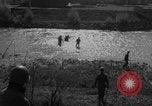
United States soldiers cross river, arrest more German prisoners in Bavarian town of Murnau am Staffelsee during WW2
United States soldiers cross a mined river in Germany during World War 2. German prisoners assist small group of US infantrymen in crossing the river. A United States soldier directs a military vehicle to park. Soldiers cross a bridge. Two United States soldiers into brush at side of road to hide. German locals meet United States soldiers arriving in Murnau am Staffelsee, in the Oberbayern Region of Bavaria, Germany. United States soldiers follow a tank inside Murnau am Staffelsee. In the Murnau am Staffelsee town square, United States infantrymen apprehend more German prisoners.

United States soldiers bombard La Haye du Puits to capture the town from German forces (WW2)
The capture of La Haye du Puits by United States First Army troops under General Omar Bradley in Normandy (World War 2). An M4 81 mm Mortar Carrier Halftrack vehicle and jeep of the United States First Army driving to La Haye du Puits in Normandy. United States infantry troops travel on foot to capture La Haye du Puits. United States First Army soldiers traversing a meadow, crossing a puddle. United States First Army troops fire artillery under camouflage nets. Soldiers load shells into artillery and fire. United States soldiers fire mortar in a forest outside La Haye du Puits. A soldier fires his rifle through a hedgerow. Soldiers duck while firing mortars. Distant Haye du Puits covered in smoke. A soldier fires a rifle grenade launcher (probably an M7) into the air.
CRITICALPAST.COM: About Us | Contact Us | FAQs - How to Order | License Agreement | My Account | My Lightboxes | Shopping Cart | Advanced Search | Featured Collections | Website Terms & Conditions | Privacy Policy ©2026 CriticalPast LLC.
License Agreement |
Terms & Conditions |
Privacy Policy
©2026 CriticalPast LLC.