


 Francais
 Deutsch
 Italiano
Refine Your Search
Nevada United States 1936 stock footage and images
- Showing 5557 to 5562 of 27250 results more
more Hide
Hide
United States aircraft carrier USS Independence (CVL-22) damaged in Operation Crossroad "Test Able," risk in daily lives and discussion of radioactivity.
'Radioactive contamination' about the hazards posed by the sinking of a United States aircraft carrier and the methods to control radioactivity. United States Navy F6F-3 Hellcat aircraft taking off from United States aircraft carrier USS Independence (CVL-22) in the Pacific Ocean during World War II. F6F-3 Hellcat firing rockets in air. Landing signal operator LSO using flags while guiding plane for landing on USS Independence. Kamikaze attacks at Tarawa. Anti aircraft guns on carrier cut down kamikaze planes as they attack. USS Independence flying USA flag at Tokyo Bay. Scene of surrender of Japanese at Tokyo Bay aboard the USS Missouri. Aerial view of atomic bomb blast at Bikini in 1946. The wrecked carrier Independence being towed away after it was used as a target for an atomic bomb test in 1946 as part of Operation Crossroads. Men at a construction site talk about contamination caused in sea water due to sinking of Independence containing radioactive waste. They comment, "she's all full of that radioactive poison" and with respect to eating fish in water near the ship, "would you eat fish again?" Two women dressed in furs, in a car, also discuss radioactivity. One woman says, "from what I've heard it's very dangerous. " View of 1940s car backing into oncoming traffic and almost causing an accident. An aerial view of atomic explosion at Bikini. Damaged USS Independence ship after TEST ABLE. Signs on board warn of radioactivity with words, "Keep Clear, Danger! Very Radio-Active" and "Radioactivity. Do not remain more than 2 hours." Men in small boat near USS Independence examine damage to the ship. Parts of the USS Independence being tested for radioactive contamination at the Naval Radiological Defense Laboratory NRDL, Hunter's Point Naval Shipyard in San Francisco, California. The USS Independence being sunk in 1951. View of Bikini atomic bomb blast within a bay surrounded by ships. Simulation shows the effect a similar blast would have on a coastal city as a radioactive cloud covers the city. Officers holding handkerchiefs to their mouths as they enter an office building from outside. Firemen climb ladders while putting out a large fire. A house wife working in a kitchen and responding to a pot boiling over on the stove burns her hand. A man slips on a bar of soap in the shower while singing. An officer honking at an oncoming car as he is run off the road. Woman driver dressed in furs exclaims to her friend about the bad driving of men. Officer just run off the road by woman driver exclaims, "Women !" with frustration. Aerial view of test nuclear explosion at Bikini Atoll.
Villagers are treated during United States Navy Medical Civic Action Program in Vietnam.
United States Navy Medical Civic Action Program (MedCAP) in Vietnam. A native boat near a shore. Trees and buildings on the shore. A U.S. Navy Swift Boat (patrol boat) underway at sea. United States flag on the boat. A Vietnamese boat approaches the Swift Boat. The MedCAP team boards the native boats. They are ferried to the shore. United States Navy Medical Civic Action Program is set on the porch of a Vietnamese school. A sign on the school reads in Vietnamese. Villagers line up for the medical examination. The villagers are treated.
U.S. President Nixon at graduating ceremony of United States Air Force Academy in Colorado Springs
United States President Richard M Nixon at the graduating ceremony of the United States Air Force Academy at Falcon Stadium, in Colorado, United States. Graduating staff, officers, dignitaries and spectators applaud. Cadet Commander John W Martin Jr. invites President Nixon at the stage to address the ceremony. Commander Martin presents a gift of a sabre to the President and affirms the support of the cadets for the President and the country. He presents a letter to the Cadet Commander allowing amnesty for cadets for minor violations.
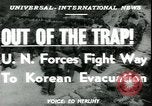
United States Marines trapped in Chosin reservoir area begin to retreat during the Korean War.
United States Marines retreat southwards from 38th Parallel as a result of Chinese aggression in Korea. United States Marines retreat in trucks as they cross bridges over rivers. In north east Korea U.S. marines trapped in Chosin reservoir area. Aerial view of the region with a convoy of trucks on road. Marines seated in a snow covered field as they pack up to retreat. Marines sleep in bags. Food and ammunition being packed in Japan for transporting it to the Marines trapped in Korea. United States Air Force C-119 aircraft in flight as it carries the supplies. Bridges, food and medical supplies being air dropped. Marines eat food. Marines destroy installation and equipment. Wounded marines being carried on litters and loaded aboard an aircraft at an airstrip. Wounded being loaded onto planes for flight to Japan. A Korean child being loaded onto a plane. Marines retreat along a road.
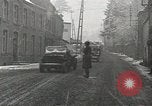
United States 1st Infantry Division soldiers cross the Ramegan bridge and enter into Germany during World War II.
The role of United States 1st Infantry Division in various campaigns during World War II. United States 1st Infantry Division men cross the Ludendorfff bridge at Remagen, over river Rhine in Germany. Smoke rises from the banks of the river. American soldiers move across Germany and enter Czechoslovakia. Closeup of faces of war weary United States Army infantrymen shown. A U.S, Army soldier sleeps.
United States 1st Cavalry Division soldiers board and take off in a UH-1D helicopter in Vietnam.
United States 1st Cavalry Division soldiers during phase II of Operation Mosby in Vietnam during the Vietnam War. Soldiers of United States 1st Cavalry division walk towards United States Army UH-1D helicopter on a field in Vietnam during the Vietnam War. Soldiers board the helicopter at Ankhe, Vietnam. African American soldier stands beside the helicopter. Closeup view of a soldier inside the helicopter and then it lifts off. Pilot at controls of an airborne UH-1D helicopter.
CRITICALPAST.COM: About Us | Contact Us | FAQs - How to Order | License Agreement | My Account | My Lightboxes | Shopping Cart | Advanced Search | Featured Collections | Website Terms & Conditions | Privacy Policy ©2026 CriticalPast LLC.
License Agreement |
Terms & Conditions |
Privacy Policy
©2026 CriticalPast LLC.