


 Francais
 Deutsch
 Italiano
Refine Your Search
Nevada United States 1936 stock footage and images
- Showing 5581 to 5586 of 27250 results more
more Hide
Hide
United States Coast Guard preparing for the Allied invasion of Normandy (WW2)
June 9, 1944. Sand flats seen at low tide in Normandy, France. Allied forces fighting their way inland during the Normandy invasion (Three days after D-Day) in World War II. Landing craft and destroyed buildings on the beaches of Normandy. German steel beach obstacles have been stacked out of the way. A United States Sherman DD tank sunk in sand. Badly damaged LCT-25 on the beach at Normandy, with her cargo of half-tracks still aboard and remains of the first one off, sitting at her ramp where it was hit by a German shell. Higgins Boat riddled with bullet holes. Scene shifts to January 1944 when United States Army troops descend from a troop transport ship into LCT-504 for practice maneuvers in the Chesapeake Bay. A soldier operates a Higgins Boat. Another soldier directs a Higgins Boat to the shore. Troops hit the beach in Higgins Boats driven by U.S. Coast Guardsmen from the Attack Transport ship, USS Samuel Chase (APA-26). United States troops carry equipment or belongings as they board ships to England in February 1944. Views of live aboard transport ships in convoys crossing the Atlantic Ocean. Coast Guardsmen near weapons at duty stations. Some troops are seen wearing life vests on board. Troops sleep or lie in hammocks in their quarters. Soldiers pass the time by playing cards, sleeping, reading and writing letters, and mending clothes on deck. Troops line the deck of the transport ship, USS Bayfield (APA-33), as the ship approaches port in England. Landing craft from the Bayfield, carrying troops, are seen in assault training exercises in England. Troops wading ashore during training. Coast Guard officers and sailors are seen aboard larger landing ships in exercises. Coast Guard officer smoking a cigar, as landing craft from the USS Samuel Chase speeds away after landing troops ashore. Trucks drive ashore from landing craft. Scene shifts to May 1944 and a formation of Consolidated B-24 Liberator bomber aircraft dropping bombs on enemy targets in Normandy. Aerial view shows bombs falling.
African American students learn to paint and make ceramic wares at Howard University in Washington DC, United States.
A film by the Harmon Foundation titled "African American education for American living: Art in the African American schools" about academics and fine arts education in African American schools in the United States. A map of the United States depicts the proportion of African Americans to the total population as one out of every 10 persons. Next are a series of close-up views of various African American people of all ages. Well-dressed, college aged Black men and women are shown. An African American woman and man farmer are shown in an agricultural setting. The man holds a young girl. Close-up views of African American boy and girl as they smile in a school classroom. A map of the United States locates places of African American education in the country. Another map locates centers of African American education. Scene changes to a studio art class at Howard University in Washington DC. A class of young women and men paint a subject who is posing in the front of the room, wearing traditional African clothing. Professor Lois Mailou Jones instructs and advises a male student artist. Various portraits made by students depicting a man in African clothing. College students paint pottery. Male African American Students place ceramic pottery in a furnace as a male professor describes operation of the furnace. A young black woman paints a ceramic ware.
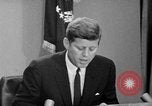
U.S. President Kennedy asks for support of citizens and business leaders to end racial discrimination in the United States
Second part of U.S. President John F. Kennedy's speech in Washington DC following events at the University of Alabama when two African American students, Vivian Malone and James Hood, attempted to enroll. United States President Kennedy seated at desk and speaks over a microphone. The President speaks about ending racial discrimination and importance of equality and civil rights in the United States. He says that it's time for the Congress to act. President Kennedy says that he will ask the Congress of the United States to act, to make a commitment it has not fully made in this century to the proposition that race has no place in the American life or law. The President talks about the necessary measures that Congress can provide. President Kennedy, in his speech, asks the Congress to enact legislation giving all Americans the right to be served the facilities which are open to the public. He talks about, and scenes are shown from his recent meeting with business leaders in the white house, together with Vice President Lyndon Johnson, as Kennedy urged them to take voluntary action to end workplace discrimination. The business leaders in a large room of the White House. The President says that he has also asked the Congress to authorize the Federal Government to participate more fully in lawsuits designed to end segregation in public education. He also speaks about giving employment to African Americans. President Kennedy, in his speech, pays tribute to those citizens of the North and South who have been working in their communities to make life better for all. The President asks for support of all the citizens so that discrimination can be removed. Many television cameras and cameramen. The President gets up from the desk and leaves.
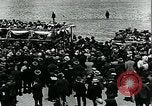
People crowd at the shipyard and a woman hoists a United States flag during shipyard dedication in Oakland, California.
A shipyard dedicated in Oakland, California during World War I. People crowd at the shipyard. Dignitaries and officials seated on a platform. A dignitary with a woman. The woman hoist the United States flag. The United States flag flatters in wind. People at the shipyard. A woman holding a bouquet. Men stand on a tower. The women stand holding a United states flag. The sailors wave.
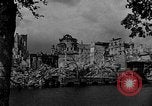
People in the U.S. listen as President Truman speaks during the United States flag raising ceremony in Berlin at end of World War 2
Filmed shortly before the Potsdam Conference in Berlin, Germany. A view of the devastated city of Berlin shortly after the end of World War 2 in Europe. Aerial views of bomb damaged Berlin and point of view shots from a moving car passing destruction, rubble, and skeletons of buildings from bomb damage. U.S. President Harry Truman surveying the damage from an open car, and view of his car approaching the Brandenburg Gate and driving on the Unter den Linden. Three flag towers each decorated at the base with an image of Truman, Stalin, and Churchill. U.S. President Harry S. Truman is riding through Berlin with General Secretary of the Communist Party of the Soviet Union Joseph Stalin and Soviet Foreign Minister Vyacheslav Mikhailovich Molotov. Flashback shows German Fuhrer Adolf Hitler parading in Berlin. People crowd on either side of a street to cheer. Close up back and side profile view of Hitler as he stands in a moving car waving to the crowd. Hitler speaking at a Nazi Rally, forcefully and animated, about Germany wiping out inferior races, and decrying America's society of mixed people, saying that it has a ridiculous notion of equality and freedom that cannot stand up against Germany. The German people in the hall applaud. Truman speaks into a microphone in Germany after the war. U.S. delegates stand in the background. A radio tower. A U.S. military serviceman operating controls for the radio broadcast. People in the U.S. listen to President Truman speaking from a Berlin Radio Station. A hand on a typewriter. People of the United States in groups listening to radio: Men gathered at a city store listening to the radio speech; a woman typist listening to the radio beside her typewriter; men in a rural general store gathered around a radio near a wood stove; farmers listening to a radio; office workers gathered around a radio; a family in a living room listens to the radio; group of U.S. Army soldiers gathered to listen to the radio . Truman speaking on the grounds of the United States Group Control Council Headquarters in Berlin. He is in a courtyard that had been the home of the German Air Defense for Berlin. An honor guard from Company 'E' of the 41st Infantry is present, along with Secretary Stimpson, Assistant Secretary McCloy, and Generals Eisenhower, Patton, Clay, and Bradley. Soldiers stand in formation in the background. He speaks about peace in the world during the ceremony raising the United States flag over the U.S. controlled area of Berlin. His words included the statement, "Let's not forget that we are fighting for peace and for the welfare of mankind. We're not fighting for conquest."
Sixth United States Army troops attend the burial ceremony of a war photographer on Leyte, Philippines during World War II.
Sixth United States Army troops on Leyte island in the Philippines during World War II. Sixth United States Army tanks followed by troops move on the island. A U.S. soldier helping a wounded soldier. The soldiers in a wooded region. The soldiers taking the body of a dead U.S. war photographer from an army jeep and laying the body on the ground. The soldiers attending a military ceremony during which the photographer is buried at the place where he died. The soldiers stand with their heads bowed. People in Tacloban City receive clothing and supplies from the United States. Children seated on a bench. A signboard on a building reads 'First Aid Clinic, Public Dispensary'. Clothes are distributed to the people. A small child is made to wear new clothing. A girl wearing a new dress. View of the people seated. The girl smiles and poses.
CRITICALPAST.COM: About Us | Contact Us | FAQs - How to Order | License Agreement | My Account | My Lightboxes | Shopping Cart | Advanced Search | Featured Collections | Website Terms & Conditions | Privacy Policy ©2026 CriticalPast LLC.
License Agreement |
Terms & Conditions |
Privacy Policy
©2026 CriticalPast LLC.