


 Francais
 Deutsch
 Italiano
Refine Your Search
Nevada United States 1936 stock footage and images
- Showing 5635 to 5640 of 27250 results more
more Hide
Hide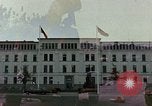
Air Force officers on the grounds of Headquarters United States Air Forces in Europe at Lindsey Air Station
Headquarters United States Air Forces in Europe, at Lindsey Air Base near Wiesbaden, Germany. Exterior views of the HQ building. View of the emblem above the door. An Air Force officer emerges from a door marked "DCS/Plans". Another comes from a door marked "DCS Operations" at building B05. Another leaves a building with marker "DCS Intelligence" above the door. All three carry brief cases. The men converge on the sidewalk in front of the Headquarters building and enter together. View of an emblem and door stating "Commander in Chief" and 'Vice Commander in Chief" below a gold seal of the United States Air Force.
Japanese attack Hawaii islands in United States during World War 2, and U.S. response to attack.
A film titled 'Jap-US at war' shows Japanese diplomats leave the venue of the diplomatic talks in Washington DC in United States, soon after Japanese attack on Pearl Harbor, Hawaii islands. Secretary of State, Cordell Hull also leaves the building. President Roosevelt is seen. Japanese troops prepare for war. Japanese troops in mainland Japan board trains as crowds of Japanese citizens wave Japanese flags and cheer for their troops leaving for war. Scenes of Diamond Head in Hawaii in peaceful times are shown, including buildings, people on beaches with sunbathers and fast small boats with outriggers in the surf. City streets in Honolulu Hawaii are shown with cars and shops and view of Aloha Tower lighthouse in background. Japanese planes drop bombs over Pearl Harbor in Hawaii. United States Presidential Secretary Stephen Early tells the press of Japanese attack and the damage suffered by America. People in American cities read newspapers and scrolling lit sign (likely Times Square New York) with news about Japanese attack as the lead story. American citizens buying newspapers describing the attack at newsstands. U.S. troops march in front of War Department - Navy munitions building in Washington DC. Night time view of soldiers on guard in Washington DC. Sailors return to battle stations. U.S. Navy sailors boarding ships of U.S. Navy in the U.S. west, bound for battle. Brief scenes from American ports in Guam and Wake Island. U.S. Navy fleet ships underway in Pacific heading west toward battle with Japanese forces. Biplanes launched via catapult from U.S. Navy ships and then seen flying over Navy ships in formation as narrator encourages Americans to work together and put aside differences to win the war. Overhead view of a U.S. Navy ship passing under a bridge with deck busy with sailors and operations.
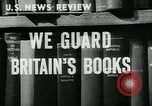
British books preserved in World War 2 by copying them to microfilm and storing them in United States Library of Congress.
British books being preserved from destruction during World War 2. Images from May 13, 1933 when twenty five thousand books were burned by Nazis in Germany on orders from Hitler. The book-burning included many classics of literature. Aerial view of London buildings burning at night from Nazi blitz raid during Battle of Britain. Books and important records being preserved by British as they transfer them to film, with one page of each book recorded to one frame of film, so that an entire book can be captured on a small roll of film. View of books copied onto motion picture film one page at a time by a British man. View of U.S. military personnel reviewing motion picture film used to image letters sent to troops via V-mail during the war. Narrator states that the filming process followed by the British is similar to the American mail filming process.The films being looked at by a man. Men pack the films in boxes for shipment to the United States. Wooden boxes being lifted by ship crane for transport. Exterior street view of United States Library of Congress building where the films are being kept. Librarian checking and stamping each film on arrival. Film being viewed on a large microfilm viewer. The description of each film on cards placed in the library card catalog. View of the original preservation films being filed and stored in shelves in the basement of the Library of Congress.
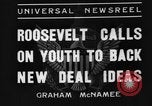
President Franklin Roosevelt addresses the youth of the United States talking about the changes in the life of Americans.
U.S. President Franklin Roosevelt addresses youth in the United States. The President seated at a desk in his office in Washington DC. He addresses the youth of the United States outlining the changes that have occurred in American life. He states that the changed conditions require a new approach.
United States Coast Guard inspects merchant ships off the coast of Saudi Arabia
Highlights the role of United States Coast Guard in Operation Shield, Saudi Arabia. A military cargo shipment leaves for Saudi Arabia from United States. Boarding teams of Maritime Interception Forces inspects merchant ships off the coast of Saudi Arabia. Lieutenant Bob Atkin, Coast Guard boarding officer, explains the process of inspecting merchant ships. CPO Bill Clifford states how explosives were found on board a merchant ship. Captain Dick Reass explains the nature and the importance of inspecting job done by the boarding teams. CPO John Hagy explains that the job of inspecting ships is tedious. A member of the boarding team climbs down a ladder to inspect ships in the sea.
United States Coast Guard patrols the sea off the coast of Saudi Arabia as Operation Desert Storm begins.
Highlights the role of United States Coast Guard in Operation Desert Storm, Saudi Arabia. Tanks and planes take off during early hours of 17th January 1991 to attack Iraq and Operation Desert Storm gets underway. Newspaper headline reads, "WAR! Forces Launch Attack on Iraq" President George H W Bush in his address explains the need and importance of military action against Iraq. United States Coast Guards on board a patrol boat underway at sea off the coast of Saudi Arabia during Operation Desert Storm. Men send messages on wireless. A man at a gun on board a boat. BM2 Joe Gosh and PS1 Jim Cudney state the preparedness for the war.
CRITICALPAST.COM: About Us | Contact Us | FAQs - How to Order | License Agreement | My Account | My Lightboxes | Shopping Cart | Advanced Search | Featured Collections | Website Terms & Conditions | Privacy Policy ©2026 CriticalPast LLC.
License Agreement |
Terms & Conditions |
Privacy Policy
©2026 CriticalPast LLC.