


 Francais
 Deutsch
 Italiano
Refine Your Search
New Mexico United States 1946 stock footage and images
- Showing 8353 to 8358 of 30777 results more
more Hide
Hide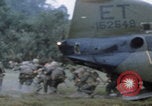
United States Marine Corps cross river and battle enemy during Operation Prairie (Vietnam War)
United States Marine Corps (USMC) Marines disembark from the back of helicopter beside a river. The Marines move into a jungle. Marines walk over rocks to cross a stream. Sergeant Jimmy Little narrates Marines’ patrol mission in Vietnam, a mission near route 9 and then back to base camp. Marines wearing foliage on their helmets carefully move on jungle trail. Marines wading in knee-deep river. Some Marines are seen smoking or carrying M40 recoilless rifles as they search the river for bodies and weapons. Marines hiding behind grass and trees and a small cliff. A soldier points and shouts orders while wading in river. A pair of Marines pull a gravely wounded comrade from the top of a cliff. A Marine loads an M79 grenade launcher and shoots at Vietcong forces. A rifle is fired. ‘Combat Art’ depicting a Marine looking at dead bodies. United States Marine Corps officers inspect captured weapons from Vietcong forces. A hand holds a hand drawn map. Debris and abandoned weapons and dead bodies are seen in the field. USMC Major General Wood B. Kyle summarizes the Marines’ experience in Operation Hastings and Operation Prairie, saying that the battles "stand as notable achievements in our battle against communist aggression...."
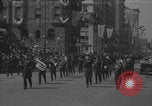
United States Army troops marching at the Portland Rose Carnival Parade
Rose Carnival celebration in Portland, Oregon. United States flags and other decorations hang on the buildings. Crowds gather on the street sidewalk to watch a United States Army marching band and troops marching. Men and women sit on bleachers as they watch with great enthusiasm. A group of men in white march and dance. Flower decorated floats and a riding club with well-dressed men on horseback are followed by a civilian band.
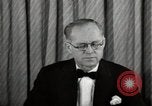
Joseph Kennedy says that opposing ideas should be tolerated in the United States.
U.S. Ambassador to UK Joseph Kennedy records a speech in Washington D.C., United States during World War II. He espresses concern about the "habit of smearing an opponent" because one disagrees with what he stands for. He asks, how can we maintain national unity when the motives of patriotic men are indiscriminately assailed. He says that if intolerance of contrary opinions flourishes, at this point of time, then future of theUnited States is dark.
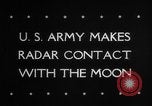
Radar for establishing contact with the moon reflects rays back on the earth from the moon in United States.
U.S. Army radar equipment used to contact the moon. Steel structure of a radar. Men work at controls. Moon in the background of the radar. Animation shows distance of moon and earth being 238000 miles. Radar beam reaches to the earth in 2.4 seconds. Radar rays go to moon and comes back to earth after reflecting. Readings of radar shows signals. Picture of the surface of the moon. Narrator says, "no longer beyond men's dreaming is the possibility of reusable airplane-like space ships to commute between the two planets (the earth and the moon)" as animation shows an aircraft space ship flying from the earth to the moon (foreshadowing the NASA Space Shuttle program).
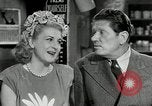
Bob Burns and Shirley Ross sing a song in the United States.
Shows Bob Burns, an American radio and film comedian and American Hollywood actress and singer Shirley Ross singing a song together. She talks about singing another song. They look into a paper and sing sunshine Nel-lie song. They stand near a fan .The lyrics of the song.
United States 2nd Field Force change of command ceremony at Long Binh, Vietnam.
A change of command at 2nd Field Force Artillery Headquarters at Long Binh, Vietnam. A U.S. 2nd Field Force soldier poses. A sign reads 'Headquarters II Field Force Vietnam Artillery'. Soldiers walk around outside the headquarters. Unit flags at the headquarters. Passing of colors to the new commander. Troops lined up on a field. Brigadier General Leo D. Kinnard speaks to the troops. Brigadier General Francis J. Roberts addresses troops. Lieutenant General Julian J. Ewell shakes hands with both of the brigadier generals. (Vietnam War period).
CRITICALPAST.COM: About Us | Contact Us | FAQs - How to Order | License Agreement | My Account | My Lightboxes | Shopping Cart | Advanced Search | Featured Collections | Website Terms & Conditions | Privacy Policy ©2026 CriticalPast LLC.
License Agreement |
Terms & Conditions |
Privacy Policy
©2026 CriticalPast LLC.