


 Francais
 Deutsch
 Italiano
Refine Your Search
New Mexico United States 1946 stock footage and images
- Showing 79 to 84 of 30776 results more
more Hide
Hide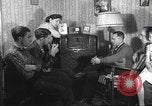
American citizens gather around living room console radios and portable radios in other locations, listening to news.
Multiple scenes of groups of people in the United States gathered around radios, listening. Timing is conclusion of labor strike by Coal Miners in the United States. On December 7, 1946, United Mine Workers President John L. Lewis called an end to a walkout of 400,000 coal miners that he had called on November 20, 1946. First scene shows a family seated in a living room listening to the news on a large console radio. The men, young and old, share cigarettes and pipes and smoke while listening intently. Next scene is a bar or tavern and shows a group of men, presumably coal miners, gathered around a portable radio on the bar to listen to the news. Two large American flags hang in the bar. Several men are drinking beer. Next scene shows four men playing cards at a table while they listen to a portable radio on the table. Wall calendar page for December 1946 is on the wall behind them. Next scene shows three men gathered around a wood burning pot belly stove that is heating a room, as they listen to a portable radio. Final scene shows a man and a woman huddled close to a living room console radio as they listen.

The Philippines gains independence from the United States on July 4, 1946; also scenes from 1941 Japanese invasion WW2
The Philippines are established as an independent nation. Crowds of Filipinos gathered at Rizal Park (Luneta Park) in Manila on the July 4, 1946. View of Independence Grandstand (a temporary structure built in front of the Rizal Monument) with American flag and Philippine flags on tall flag poles.. View looking down on General Douglas MacArthur at a podium, speaking into microphones. Camera pans over various segments of the audience. A map shows the Philippine Islands in context of its neighbors in the Pacific Ocean. Camera pans closeup across faces of many Filipinos gathered at the independence event. View of the Jones Bridge over the Pasig River in downtown Manila. Heacock’s Department Store on the Escolta. The Legislative Building. (later the National Museum of the Philippines). Ocean going ships in a harbor. Cargo being offloaded from a ship onto smaller boat. An industrial complex with eight tall smoke stacks emitting smoke. Steel and petroleum plants. Filipino workers in an assembly plant. The Legislative building with people coming and going. Air raid sirens sounding and people running in streets of Manila at onset of Japanese invasion of the Philippines in December, 1941, at start of World War 2, in the Pacific. People running across the Jones Bridge, seeking shelter. Others boarding a bus. Smoke rising from Japanese bombing. Glimpse of Japanese tanks entering Manila during attack and invasion. Japanese infantry climbing a hill. Bodies of persons killed during the Japanese invasion. Glimpse of Japanese troops occupying Corregidor. U.S. General Wainwright negotiating the surrender of Corregidor with Japanese General Homma. View of an American warship firing during the U.S. campaign to defeat the Japanese on islands in the Pacific. An American landing ship carrying U.S. troops who storm ashore. General Douglas MacArthur striding ashore with a retinue of officers, at Leyte, Philippines, on October 20, 1944. as he keeps his promise to return to the Philippines. Views, back again, to MacArthur speaking at the Independence Day ceremony in Manila on July 4, 1946. Also seen at the ceremony are: U.S. Senator Millard Tydings, (co-sponsor of the 1934 Tydings–McDuffie Act, which provided independence to the Philippines after a 10-year transition under a limited autonomy), and Paul V. McNutt, U.S. High Commissioner of the Philippines, who read President Truman's proclamation of Philippine Independence to the assembly. Camera pans over the gathering which includes many U.S. Service personnel in uniform. The oath of office is administered to the elected President of the Philippines, Manuel Roxas. At the conclusion, the American flag is lowered by Paul McNutt, as President Roxas raises that of the Republic of the Philippines. A celebratory parade in Manila includes a float with signs reading: "Let's Produce and Rebuild," among other things. Other floats represent "Mountain Province," and "The City of Manila," "The University of the Philippines," and "The Division of City Schools." One float, sponsored by the Chamber of Commerce, contains a huge replica machine gear, and models of an aircraft and a ship. It's message is about turning the gear that helps make the nation great. American and Filipino soldiers march, carrying their respective national flags. A white-helmeted military band plays for the marchers. Final scene shows large loose formation of military aircraft in flight very high above the Independence Grandstand, at Rizal Park.
B-29 "Dave's Dream" returns to airfield in Marshall Islands after Test Able atomic bomb drop on Bikini Atoll
The B-29 "Dave's Dream" returns to airfield in Marshall Islands, after dropping atomic bomb on Bikini Atoll, in Test Able of Operation Crossroads, on July 1st, 1946, during U.S. nuclear testing. The B-29 lands and taxis to a parking place on the ramp. The area around the aircraft is cordoned off and the crew is confined therein as they deplane. Navy photographers take photos. An interviewer talks to crew members. The crew walks away from the aircraft along a cordoned pathway between numerous military personnel on hand to greet them on this historic occasion. The aircraft, number 44-27354, was actually participating in its second atomic mission. It also served as a photographic platform for the mission to Nagasaki on August 9, 1945, when it was named "Big Stink.". Pilot for the Bikini mission was Major Woodrow Swancutt of Wisconsin Rapids, WI. The aircraft was renamed "Dave's Dream" in honor of Captain David Semple, a bombardier killed during the crash of another B-29 on March 7, 1946, near Albuquerque, New Mexico. (World War II period).
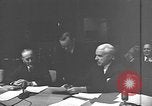
Delegates to United Nations Security Council meeting at Flushing Meadows, New York, in 1946
United Nations meeting in Flushing Meadows, New York. U.S. ambassador to the UN , Edward Stettinius, is seen at conference table, seated next to Sir Alexander Catogan, of the United Kingdom. Meeting adjourns and members prepare to depart.
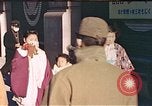
Japanese women dressed in kimonos walk along sidewalks in Tokyo, Japan on New Year Day of 1946.
Citizens and United States soldiers walk along the streets in Tokyo, Japan on New Year Day (Oshōgatsu) of 1946. Japanese women and children dressed in kimonos walk along a sidewalk. Some Japanese men and women are also seen wearing face masks. They are wearing face masks during winter influenza season. A woman wearing a surgical mask and fur coat glances at the camera as she walks by. Japanese women and children walking along the streets.
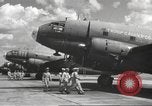
Chinese airmen board a U.S. troop carrier aircraft at Austin, Texas
United States and Chinese airmen at Bergstrom Field, Austin, Texas July 1946. The Neo-Classical building is the Texas State Capital at Austin, Texas and Austin Texas is noted on the graduate’s diploma “Bergstrom Field, Austin, Texas”. At this time the 349th Troop Carrier Group was based at Bergstrom and assigned to the Third Air Force, Tactical Air Command as noted on the diploma. Also “Air Force Combat Units of World War II” Edited by Maurer Maurer states this unit trained Chinese crews to operate C-46 aircraft. Film is very interesting in that it visually shows the transition from “Army brown to Air Force Blue” for the C-46s still carry the I TROOP CARRIER COMMAND insigne on the nose, with was disbanded on 4 Nov 1945 but they have the new AAF wide "Buzz Numbers" for all aircraft operating solely within the continental USA, by T.O. 07-1-1 of November 1945 and the graduate’s diploma is notating the new post-war air force type command reorganization of March 1946.
CRITICALPAST.COM: About Us | Contact Us | FAQs - How to Order | License Agreement | My Account | My Lightboxes | Shopping Cart | Advanced Search | Featured Collections | Website Terms & Conditions | Privacy Policy ©2026 CriticalPast LLC.
License Agreement |
Terms & Conditions |
Privacy Policy
©2026 CriticalPast LLC.