


 Francais
 Deutsch
 Italiano
Refine Your Search
New Mexico United States 1946 stock footage and images
- Showing 1111 to 1116 of 30776 results more
more Hide
Hide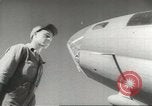
A USAAF officer trains a new B-17 pilot in cockpit inspection and start up procedures in the United States.
A U.S. Army Air Forces (USAAF) training film titled 'How to fly the B-17. Part I. Ground Operations.' about inspections and safety precautions by a pilot prior to take off. A USAAF officer trains a new pilot beginning his career as a USAAF B-17 Flying Fortress pilot. The instructing officer, trainee pilot and aircraft engineer in the cockpit, prepare for take off. The fire guard gives the all clear. The pilot is instructed to check and adjust the: master and ignition switches, batteries and inverter power, volts on the inverter. The pilot reaches out of the cockpit window and gives the hand signal for external power (source of electric power). The ground crew man turns on the portable generator and links the power cable to the aircraft. Further cockpit check includes turning on or inspection of: parking brakes, hydraulics check, booster pumps, pressure carborator filters, fuel quantity in the tanks. the pilot is instructed to give the signal to start engine number 1 and adjust the throttle. Check: the starter switch, hand timer, other start and mesh controls, oil pressure, RPM. The pilot gives the signal to start engine number 2. Adjustment of the vacuum selector switch, flight indicator check. The officer instructs the pilot to repeat all inspection procedures for engine number 2 as conducted for engine number 1. (World War II period).
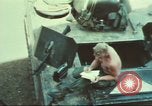
News report and informational programs are broadcast to a large majority of servicemen in the United States.
American servicemen are kept informed by American Forces Radio and Television Station facilities. A soldier listens to a radio and writes a letter. Another soldier in southeast Asia looks at a post with directional arrows showing distances thousands of miles away to cities like Seattle, San Francisco, and Denver. He sits on a bench and listens to the radio. Aerial view of the broadcasting station part of the American Forces Radio and Television Station. Power is supplied by portable generators housed in wooden shacks. View of radio studios, control rooms and administrative blocks. A man serving as Disc Jockey or DJ operates a control panel and a phonograph turntable to play a record. He turns dials on the control panel and works on a program schedule. View of a reel to reel tape machine running. News report and informational programs are broadcast to a large majority of servicemen. Military cooks working in a kitchen to prepare food. Army soldier standing at washroom sink and shaving, while listening to a portable radio. Two Army soldiers, one white and one African American, playing pool or billiards while listening to a portable radio. Soldiers on a rest break during a patrol in the Vietnam War listen to a radio.
New York Journal "Buccaneer" dispatch boat leaves the United States to cover events of the Spanish-American War
The "Buccaneer" dispatch boat of the New York Journal steaming through the water, having aboard war correspondents assigned to cover the Spanish-American war. The dispatch boat sails rapidly in the water.
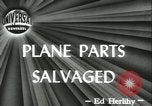
Damaged aircraft parts being used for making new airplanes at the Alameda Naval Air Station in California, United States.
Scrap of damaged airplanes being used for manufacturing new aircraft at the Alameda Naval Air Station in California. An aircraft in a hoist. A heap of wrecked aircraft parts. Women look at an aircraft. Men pull out metal pieces from the scrap to be used for manufacturing new aircraft. Butch O'Hare's aircraft also being used for the purpose. Metal pieces being piled up at the air station.
Testing of a new shaft driven motorcycle at the Holabird Quartermaster Motor Base in Maryland, United States.
A film titled 'shaft driven motorcycle' depicts features of a new shaft motorcycle. A U.S. soldier takes a test drive at the Holabird Quartermaster Motor Base. The new motorcycle moves on a road. The features of the motorcycle are a drive shaft, a foot accelerator and four forward gears. (World War II period).
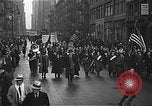
Supporters of expanded W.P.A. (Works Progress Administration) parade on streets of Manhattan, New York City, United States.
Marchers parade on the streets of Manhattan, New York City, to promote support for continuation and expansion of the WPA (Works Progress Administration), part of the New Deal Federal programs enacted in the administration of President Franklin D. Roosevelt during the Great Depression. The parade is led by a group of well-dressed men in business suits. It includes a brass band and many marchers carrying banners and signs. (A boy is knickers, on roller skates moves about near the front of the parade.) A woman walking alongside the marchers, carrying a canister, solicits contributions from spectators on sidewalks. The following are among the many banners and signs seen: "Workers Alliance-Greater New York"; "Yorkville Workers Alliance"; "On to Washington, January 15th, for the Continuation and Expansion of W.P.A. (Furriers Joint Council)"; "Stop! Mass Lay-offs on WPA (Fur Floor Boys and Shipping Clerks Union)" A big part of the march takes place on 8th Avenue. (A Department of Sanitation worker with broom and barrel on wheels is seen cleaning the edge of street near curb.) A float with popup figures of WPA worker, housewife, and farmer, is seen with another figure holding an ax over the WPA workers head. Writing on the float reads: "A blow to WPA is a blow to all" Finally, view towards backs of marchers is shown, near end of the parade.
CRITICALPAST.COM: About Us | Contact Us | FAQs - How to Order | License Agreement | My Account | My Lightboxes | Shopping Cart | Advanced Search | Featured Collections | Website Terms & Conditions | Privacy Policy ©2026 CriticalPast LLC.
License Agreement |
Terms & Conditions |
Privacy Policy
©2026 CriticalPast LLC.