


 Francais
 Deutsch
 Italiano
Refine Your Search
New Mexico United States 1946 stock footage and images
- Showing 11359 to 11364 of 30777 results more
more Hide
Hide
Parts of a K-12 camera described in United States.
A U.S. Army training film about parts of the K-12 camera. Title of the film 'Aerial Photography', Part 2, 'The K-12 Camera'. A man shows a K-12 camera used for night photography. A diagram of the camera. A pointer shows parts of the camera like photo electric cell and amplifier. A solenoid is attached to the shutter. Lenses and 12 volt battery. The aligned system of camera must be 13 and a half inches. Portals attached to a battery current. Before assembling the camera it is cleaned by air blower. Lenses are wiped. Amplifier is attached and locked over camera. Electric nodes are fastened. horizontal and lateral leveling of camera is measured. Number of exposures are calculated. Shutter speed is provided at three levels. Shutter and amplifier are set at on position. Cut film holder is loaded in a dark room and roll film magazine is loaded. The man shows the parts of camera mount.
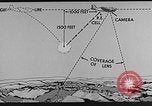
The process of taking pictures from a K-12 camera is described in United States.
A U.S. Army training film about the functioning of K-12 camera. Animation shows the process of aerial photography. A plane flies at 4000 feet above the ground. Lenses of camera are beyond the coverage of bomb. A photographer adjusts the mounting ring. As the pilot signals he sets the amplifier on and releases the bomb. At the sound of explosion he switches the amplifier off. A dark slide is replaced from holder. Exposed film is removed. The electrical connections are checked time to time. Film magazine is placed and locked. Suction tube is checked on cheek. The process is repeated again. One time filming covers one quarter square mile. Overlapping of the field must be done at 35% as it facilitates careful matching. (World War II period).
The importance of gas mask depicted through dramatization in United States.
A U.S. Army training film about gas masks. The film is titled 'Defense Against Chemical Warfare'. A soldier lies down removing his gas mask kit. His sergeant tells him not to do so. He tells him a story about a soldier named Joe. He says when the call of joining army came, many people came from different professions. Joe used to think that the training with a gas mask was a joke. Soldiers were tested in a gas chamber but Joe did not learn from that experience. They were sent to the front as advance patrol. Soldiers passed through a chemical contaminated area. The general of patrol had given maps of contaminated area to soldiers. Joe did not pay much attention to this information. During an enemy attack he got hit by gases and fell on ground. Soldiers put gas mask over his face and left him there only. He was then taken on a stretcher. Medical vans pass on road. A bomb explosion on road. Soldiers hide at sides. (World War II period).

Opportunities for men and women in the navy and workers already part of navy interviewed in the United States.
A U.S. Navy recruitment film about interest of high school students in the U.S. Navy. Opportunities for men and women on ship or on helicopter are discussed. A crew member cleans a helicopter. Crew members doing electrical work. A man works as a diesel mechanic on a bulldozer. A man describes his work as a navigator. A female crew member at a tug and at controls does ground duty.

High Line Method and Burtoning Method of replenishing cargo from one ship to another described in the United States.
A U.S. Navy training film about replenishing in sea. The film is titled 'Fueling and Replenishing at Sea'. Two ship in sea transfer ammunition, cargo, fuel and personnels from one to another. Provision ships and cargo ships in the sea. Boom head cranes and winches at ship. Two types of transfer methods are described using pointers High Line Method and Burtoning Method. To transfer high load wire winches are used. An operator at wire handing winch. Forward loading area at ship described. Type of hooks, their functioning on both the delivery ship and the receiving ship is explained. Work of winch-men on both ships discussed. Horizontal lift of provisions. Use of slings in transfer demonstrated. A cargo is unloaded on a ship and sailors move it on a conveyor belt. Ammunitions handled with extra care during transfer. The distance between two ships is maintained at 70 feet. Sailors talk on communication line between both ships. High Line Method of transfer described in detail. Arrangements of haul line described.
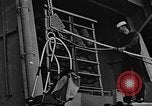
Personnel transfer from one ship to another using High Line Method described in the United States.
A U.S. Navy training film about replenishing in sea. The transfer of personnel described. A one carrier Pipe frame chair is used for transferring personnel. High line method is used for this purpose. In Haul line and Back Haul line described. Back haul line is always supported. In haul line is supported by sailors at the time of personnel transfer. Special chairs used to transfer disabled persons. High lines are kept elevated and lowered by men power when required.
CRITICALPAST.COM: About Us | Contact Us | FAQs - How to Order | License Agreement | My Account | My Lightboxes | Shopping Cart | Advanced Search | Featured Collections | Website Terms & Conditions | Privacy Policy ©2026 CriticalPast LLC.
License Agreement |
Terms & Conditions |
Privacy Policy
©2026 CriticalPast LLC.