


 Francais
 Deutsch
 Italiano
Refine Your Search
New Mexico United States 1946 stock footage and images
- Showing 1201 to 1206 of 30776 results more
more Hide
Hide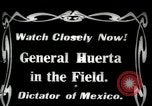
Mexican President General Huerta and subsequent President Carranza, seen during Mexican Revolution
Brief scene shows former President of Mexico, General Victoriano Huerta (entitled "Dictator of Mexico" on film slate) looking through binoculars with other officers in Mexico during the Mexican Revolution. Scene shifts to the new President of Mexico, General Venustiano Carranza, seen walking with several other men along a railroad track on a harbor pier.
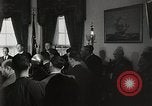
General Marshall is sworn in as the new United States Secretary of State
General George C. Marshall being administered the oath by Chief Justice Fred M. Vinson in the Oval Office of the White House, Washington DC. President Harry S. Truman and members of the cabinet look on. President Truman congratulating General Marshall. Former Secretary James F Byrnes congratulates General Marshall during the ceremony.
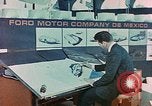
Cars model of Ford Motors, General Motors and Chrysler Corporation on display at Alliance of Progress exhibition, Mexico.
Alliance of Progress initiated by U.S. President John F. Kennedy to establish economic cooperation between North and South America. The exhibition of the program is inaugurated in Mexico City. Progress in technology. A man draws a sketch of Ford Motor cars. The sketch of different models of Ford cars on a board. The man explains the features of the new Ford car with the help of a model. The visitors listen to him as he explains. A close of the model. The visitors look at the model. A 1956 General Motors Firebird II. A car of General Motors being exhibited. Young children look at the car. A car of Chrysler Corporation on display. A man explains the capacity of the engines and mountings in the car. The visitors listen to him. A model of a car on display. A workshop. A man speaks into a microphone. Visitor stand near the workshop. A car with an open bonnet of a car.
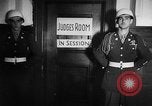
Nazi criminals are brought to justice as the Nuremberg Trials give final verdicts; scenes of World War 2 Nazi activities
Events related to the Nuremberg Trials held at the Palace of Justice in Nuremberg, Germany. Shows two guards standing outside the 'Judges Room'. Judges from Allied nations seated around a table. On 1st October 1946, judges give their final verdict. Scenes from the court room. Lord Justice Geoffrey Lawrence, President of the tribunal states the final verdict. Majority of the accused Nazi criminals are given death sentence, some of them given imprisonment and only a few are found not guilty. Multiple Nazi leaders are shown in the courtroom and in flashback scenes from the World War 2 years, including Hermann Göring, Rudolf Hess, Joachim von Ribbentrop and Wilhelm Keitel (both also shown at unidentified signing ceremonies), Ernst Kaltenbrunner, Alfred Rosenberg, Hans Frank, Wilhelm Frick, Julius Streicher, Walther Funk, Karl Dönitz, Erich Raeder, Baldur von Schirach, Fritz Sauckel, Alfred Jodl, Franz von Papen, Albert Speer, Konstantin von Neurath, Arthur Seyss-Inquart. Many flashback scenes show scenes of Nazi activities, Nazi atrocities, and the holocaust during World War 2 including: Boycott of Jewish shops and stores in 1930s, beating, dragging, and expulsion of resident Jews from ghettos, Nazi rallies with crowds giving Nazi salutes, book burning, massed overcrowded prisoner encampments, emaciated Concentration camp victims, nurses and doctors aiding starving and liberated concentration victims, gestapo dragging a man across a street, bin of gold teeth of murdered concentration camp victims being poured out for display, a German ship being launched, Erich Raeder meeting with Japanese military leaders or political leaders from Imperial Japan, and talking to Adolf Hitler; Hitler youth in training; Nazi slave labor workers at terraced hillside mines digging and doing mining operations; interior of a Nazi German submarine; German industrial worker at a steel furnace in a munitions war production factory. View of prison cells at Nuremberg Prison just north of Palace of Justice in Nuremberg, where some Nazi criminals were kept during the trials. View of exterior prison cell door of Hermann Goering. A guard patrols the roof of the Nuremberg Prison.
The challenges of reconstruction and rise of communism in Europe after World War II
Reconstruction problems in Europe in the aftermath of World War II. Examples of prewar Germany's industrial and commercial prowess, showing its consumer products and famous cameras. A German coal-burning power plant and miners extracting coal from Germany's vast natural supplies. Coal being transported by conveyer belt. Open rail cars loaded to capacity with German coal. A German iron and steel plant dependent on coal. Shift to postwar destruction including destroyed: German factory; locomotive; rail yards; trucks; farm machinery; fertilizer plant; farm fields lacking crops. Shift to prewar era with view of British coal cars getting ready to be emptied for export to Europe. Current postwar view of British coal cars and coal, that narrator says are barely enough for her own needs. View of prewar German coke being loaded onto conveyers. Coal miners receiving food ration cards. Animated map showing "Iron Curtain," of Soviet occupation, separating traditional German regions of agriculture from those of industry. British Foreign Secretary, Ernest Bevin; French Foreign Minister, Georges Bidault; Soviet Foreign Minister Vyacheslav Molotov; and U.S. Secretary of State, George Marshall; are seen at the Paris Conference in 1946 where they negotiated the postwar future of Germany. Reminder footage of Hitler with brownshirts in 1930s. Italian police coping with communist inspired unrest in Italy. Bombed out buildings in snow. Europeans literally scratching for bits of food from pavement and trash heaps. Two women fighting with each other during time of shortages and ration. Dejected woman. French Communist party leader, Maurice Thorez, speaking to a large crowd. Party flag with hammer and sickle behind him.
Pilots of X-15, X-15 in flight with new XLR-99 engine and Scott Crossfield interviewed in United States.
Annual report of X-15. Pilots stand in front of X-15. U.S. Navy Commander Peterson in front of X-15. NASA Researcher pilot Jack McKay. USAF Captain Rushworth stands in front of X-15. NASA pilot Neil Armstrong in front of X-15. All the X-15 pilots stand in front of X-15. NB-52A Stratofortress shows rear view of X-15 mounted on pylon underneath wing of aircraft and vapors come out from the tail of X-15. Nose of X-15 inscribed with 'X-15 North American Aviation'. Pilot in window of X-15 hanging underneath NB-52A while aircraft is in flight. C-104B Starfighter in flight to left. Chase plane shows NB-52A with X-15 in flight to the right and followed by F-104. Nose of X-15 under Nb-52A in flight to right. Spectators look towards the sky. Contrails of NB-52A. Several chase planes and X-15 in flight to left. Spectators and USAF officers look up in the sky. Chase plane shows NB-52A with X-15 in flight and producing large contrails. Nose of X-15 hanging beneath wing of NB-52A in flight. Pilot in helmet and mack in X-15. NB-52A looking at rear view of X-15 with XLR-99 engine hanging from wing of NB-52A in flight. F-104B in flight to left. NB-52A with X-15 in flight and makes large contrails. Scott Crossfield wearing helmet and mask. Nose of X-15 under wing of NB-52A in flight. NB-52A shows a rear view of X-15 with XLR-99 engine under wing of NB-52A. Scott Crossfield eyes and he is wearing helmet and mask in X-15. Chase plane shows NB-52A in flight, releases X-15 and X-15 drops away and in flight. Pilots helmet van be seen from the window of X-15. X-15 in flight and leaves large contrail. Spectators on ground look up. Contrail from X-15 while in flight. Scott Crossfield in helmet and mask. Scott Crossfield seated on a table and interviewed by press personnel.
CRITICALPAST.COM: About Us | Contact Us | FAQs - How to Order | License Agreement | My Account | My Lightboxes | Shopping Cart | Advanced Search | Featured Collections | Website Terms & Conditions | Privacy Policy ©2026 CriticalPast LLC.
License Agreement |
Terms & Conditions |
Privacy Policy
©2026 CriticalPast LLC.