


 Francais
 Deutsch
 Italiano
Refine Your Search
New Mexico United States 1946 stock footage and images
- Showing 1249 to 1254 of 30776 results more
more Hide
Hide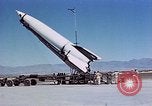
A German V-2 rocket is raised into firing position from top of a special elevating trailer at the White Sands Proving Ground.
A German V-2 rocket is launched and tested at the White Sands Proving Ground, New Mexico. The V-2 is raised into firing position from top of a special elevating trailer or carryall machinery. The warhead of the V-2 rocket. Final firing preparations shows workers standing on a platform at the base of the rocket.
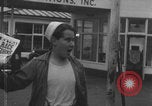
Roosevelt wins 1944 United States Presidential Election during WWII
Newspaper boy peddling newspapers with headline "Nip and Tuck Race." View of Times Square in New York City during WW2. Shops in Times Square with barricades to prevent vandalism by crowds. View of Times Building. An Asian man and a White man standing together while checking for election updates from Times Building. Election officials and staff open a machine processing election returns from the small towns from the Eastern United States. Election official opens a Perfection ballot box. Radio announcer with CBS microphone, possibly Bob Trout, broadcasts updates as votes are tabulated. Volunteers tabulate results. Woman's hand seen turning on radio. United States soldiers based in Italy and France listen to radio to hear that current United States President and Democratic party candidate Franklin D. Roosevelt was leading race. Two United States soldiers smiling as they hear the news. WEAF Radio announcer broadcasts election returns from the west coast. An American family listening to the radio in their living room. An American family, with a picture of a serviceman on top of radio, listens to the news that Roosevelt won. Zipper marquee on Times building announcing election returns. Crowds gathering in Times Square New York. Americans celebrated the victory in New York. View of the Times Square at night. American civilians and soldiers celebrate the victory of United States President Franklin D. Roosevelt’s fourth term in office.
U.S. Vice President Nixon talks about the foreign policy of America prior to presidential elections in the United States.
The fourth presidential election debate between Democratic nominee Senator John F. Kennedy and Republican nominee U.S. Vice President Richard Nixon on 21st October 1960 in in New York, United States. News correspondent Quincy Howe speaks prior to the fourth Kennedy-Nixon presidential debate. Mr. Howe reads out the rules and conditions under which the candidates will proceed. He says that Senator Kennedy will make the second opening statement and the first closing statement. Vice President Nixon speaks about the present issue in the United States which is keeping peace without surrender. The peace which is threatened by international communist movements. Nixon says that the United States has to learn from mistakes made in past. He relates to this by mentioning the period of the Iron Curtain in Europe and during the Korean War. Nixon says that situation in President Dwight Eisenhower's administration is reversed. He says that the United States made errors in the past in misjudging the Communists, applying same rules of conduct that are applied to the leaders of the free world. Nixon mentions East-West Paris summit conference of 1960 and Eisenhower's policy regarding Formosa Strait (Taiwan). Nixon speaks that that United States should increase its military strength to high level regardless of what potential opponents have and if any surprise attack is launched, the United States can destroy their war-making capacity. Nixon further says that American policies of military strength, economic strength, and diplomatic firmness will keep the peace without surrender.
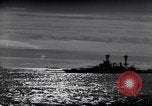
U.S. Navy Pacific Fleet maneuvers in Fleet Problem XIX, 1938
U.S. Pacific Fleet maneuvers including Colorado, New Mexico and Tennessee class battleships during Fleet Problem XIX. Several battleships underway in a line. Two battleships with various classes of heavy cruisers in the background. Lines of warships proceeding at sunset and in daylight. Four battleships and a heavy cruiser.The aircraft carriers, USS Lexington (CV-2) and USS Saratoga (CV-3), behind a line of U.S. warships. Several U.S. battleships headed by a Colorado class battleship. View of triple 14 inch guns on a New Mexico or Tennessee class battleship.
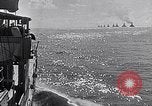
U.S. Navy fleet exercise and war game during 1925.
Line of U.S. battleships, including 1917 class (New Mexico class) such as the USS Idaho, USS Mississippi, USS New Mexico. Image of U.S. Capitol in Washington seen. U.S. Navy sailors parading in Washington, DC. Crowd gathered at Washington monument. Sailors on signal bridge of a U.S. warship, hoisting signals. Ships in distance. U.S. Navy sailors, aboard a destroyer, launching depth charges which explode and produce upsurge of water, behind the vessel. Sailors hurrying to their battle stations.
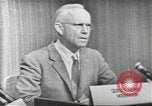
U.S. Senator John Kennedy talks about the foreign policy of America prior to presidential elections in the United States.
The fourth presidential election debate held between Democratic nominee Senator John F. Kennedy and Republican nominee U.S. Vice President Richard Nixon in New York, United States on 21st October 1960. ABC news correspondent Quincy Howe speaks prior to the fourth Kennedy-Nixon presidential debate. Senator Kennedy says he agrees with the policy of Eisenhower's administration regarding the Formosa Strait (Taiwan). He speaks about Communist influence of Cuban Prime Minister Fidel Castro on Latin Americans which is becoming a threat for the United States. Kennedy also mentions Communist Russians broadcasting ten times as many programs in Spanish to Latin America as the United States does. He talks about technical assistance given to Africa by the United States. He speaks about future of increasing communist influence in world. Kennedy mentions Liberia and the Union of South Africa who voted with America on the question of admission of Red China in the United Nations. Senator Kennedy speaks about Communist influence increasing in the world and relates to it by saying that there are six counties in Africa that are members of the United Nations and there is not a single American diplomatic representative in any of these six. He further speaks about military progress of Communist nations.
CRITICALPAST.COM: About Us | Contact Us | FAQs - How to Order | License Agreement | My Account | My Lightboxes | Shopping Cart | Advanced Search | Featured Collections | Website Terms & Conditions | Privacy Policy ©2026 CriticalPast LLC.
License Agreement |
Terms & Conditions |
Privacy Policy
©2026 CriticalPast LLC.