


 Francais
 Deutsch
 Italiano
Refine Your Search
New Mexico United States 1946 stock footage and images
- Showing 12547 to 12552 of 30777 results more
more Hide
Hide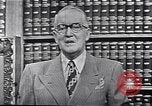
Barry Goldwater speaks on the growth of Federal government encroaching on states' rights
William Bradford Huie and Hardy Burt talk with Senator Elect Barry Morris Goldwater (Republican Party, Arizona). Goldwater speaks about his interest in politics starting during World War 2. Goldwater talks about the growth of the Federal government, stating that it has gotten too big, and that it has a tendency to preempt State functions of states. He says the big federal government has too many federal agencies and too many bureaus. He says the federal government Agriculture Department has multiple agencies in counties that are performing overlapping duties. Goldwater says that what the government is doing can be done more efficiently and cheaper, and in many cases at the state level instead. He speaks about the fear of socialism growing. He cites the example of states being required to involve the federal government when they want to open a new grammar school or high school. He says the issue is one of control and the government taking too much of the tax dollar, and that there could one day be a federal government in Washington DC that believed in socialism, and that if it controlled the schools, it could be telling the schools what to teach. He agrees with presenter that federal tax policies are making it difficult for state and local governments. He says that 78 cents of each tax dollar used to stay local, and now 78 cents of each tax dollar goes to the federal government in Washington DC is not being spent as efficiently as if it was controlled at the local level. Goldwater speaks about the lower standard of living of Native American Indians, and the need to make them "first class citizens". He notes that the Native American Indian can now vote in Arizona, but there is a need to repeal discriminatory laws that prohibit Native American Indians from buying alcohol (liquor), a skillet with handle on it, a gun, or an axe.
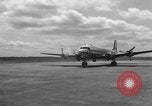
U.S. Secretary of State and Congressional delegation arrives by Army Air Forces plane at Washington National Airport
Film opens showing a U.S. Air Transport Command C-54 aircraft taxiing in to park at the Washington National airport, Washington, DC. Next, U.S. Secretary of State, James F. Byrnes, leaves the aircraft and descends steps, followed by a Congressional delegation, including Senator Arthur H. Vandenberg. The airport ramp is crowded with Army Air Forces personnel, photographers, and news reporters. Other Air Forces members watch from in front of the Army Air Forces Transport Command Terminal in the background. Closeup of Byrnes greeting several men in the crowd. Part of the sequence repeats again.
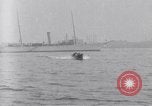
President Woodrow Wilson arrives on the yacht Mayflower to campaign for re-election in New York City
Opening slate states that President Wilson arrives by his yacht, "Mayflower," in New York City, to campaign for re-election. The yacht is seen anchored in New York waters as a motor launch, crewed by U.S. sailors, conveys the President and his party to the shore. Closeup of the launch docking. A Navy Lieutenant Commander aboard the launch emerges from below (possibly the Captain of the Mayflower) and positions himself to assist the President and Mrs. Wilson, as they come up from the launch cabin. A New York City official greets the President and Mrs. Wilson and and also helps them to the dock. They are surrounded by other greeters, including the Navy Lieutenant Commander, who converses with President and Mrs. Wilson. The party begins to climb a ramp from the dock. Scene shifts to a somewhat chaotic gathering of people through which the President and party make their way through crowds pressing on all sides, in an open automobile behind an escort of five mounted New York City policemen. They are followed by more motorcars and mounted policemen. Views from somewhat above, of dense crowd of people
New York Yankees play baseball against New York Giants in 1936 World Series; also Grover Whalen showing 1939 Worlds Fair plans.
Crowd cheers and waves during New York Yankees and New York Giants game in the 1936 World Series at Polo Grounds IV in Manhattan, New york. Yankee manager, Joe McCarthy and Giants manager, Bill Terry on the field and they shake hands. Governor of New York State Herbert H. Lehman throws out first pitch, with Mayor La Guardia beside him. Babe Ruth, guest of honor, watches the match. Crowd cheer as the game proceeds. In next segment: Grover Whalen, President of New York World's Fair Corporation points out highlights of 1939 New York World's Fair on a preliminary model with the help of a stick, for visiting dignitaries. Footage from a September 1961 newsreel hightlighting stories from 25 years earlier.
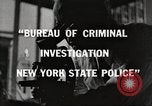
The Works Progress Administration assists New York Police to find a robber in New York.
The WPA (Works Progress Administration) project in New York. The Bureau of Criminal Investigation, New York State Police, in the Great Depression. Scientists and technicians work in a laboratory. A scientist using a microscope. A man shoots at a mannequin or dummy. A demonstration of a thief opening a safe. A sergeant and a police officer speak about the robbery. The officer speaks to a doctor about a report. The police sergeant goes to a house and interrogates a woman and a man. The man is taken to a police station for a couple of tests. Material from his fingernail is sent to the laboratory for examination. A scientist looks through a microscope. Stains on the thief's clothes checked in the laboratory. Views of vials and beakers and experiments underway in the laboratory. Newspaper headlines read 'Tom Brown found guilty'.
Soviet Foreign Minister Andrei Gromyko arrives in New York City, New York for a UN General Assembly emergency meeting.
Soviet Foreign Minister Andrei Gromyko in New York City, New York. Andrei Gromyko comes down the steps of an aircraft at an airport. The Foreign Minister is greeted by Soviet ambassador to the United Nations Arkady Sobolev. The men shake hands. Policemen on guard beside the dignitaries. Photographers take pictures of the officials. Gromyko and Sobolev walk followed by other officials. Foreign Minister Gromyko speaking at a UN General Assembly emergency meeting on the Middle East in United Nations Building.
CRITICALPAST.COM: About Us | Contact Us | FAQs - How to Order | License Agreement | My Account | My Lightboxes | Shopping Cart | Advanced Search | Featured Collections | Website Terms & Conditions | Privacy Policy ©2026 CriticalPast LLC.
License Agreement |
Terms & Conditions |
Privacy Policy
©2026 CriticalPast LLC.