


 Francais
 Deutsch
 Italiano
Refine Your Search
New Mexico United States 1946 stock footage and images
- Showing 12607 to 12612 of 30777 results more
more Hide
Hide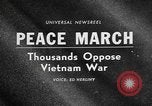
Large crowd of Anti-Vietnam war demonstrators march holding banners in New York and rally in Central Park
An anti-war march event in New York City, organized by the Spring Mobilization Committee to End the War in Vietnam (later became the National Mobilization Committee to End the War in Vietnam). Large crowd of anti-war demonstrators begin in Central Park and march on the streets holding banners. Students, housewives, doctors, businessmen, teachers, Beatniks, Hippies, and other demonstrators attend the protest. Group of demonstrators burns draft cards. Pro war and anti-war demonstrators argue. Right wing demonstrators protest the anti-war march. Civil Rights leader Martin Luther King and officials walk towards the United Nations headquarters building (46th St & 1st Ave, New York, NY 10017) during the peace demonstration. Military policemen arrest demonstrators protesting the Vietnam War.
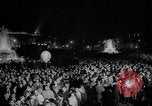
Labor Harold Wilson elected as new Prime Minister of England and Leonid Brezhnev named as new party leader in Soviet Union.
Change of leadership in countries like England and Soviet Union during the year 1964. A large crowd of people gather awaiting the results of elections in England. Outgoing Prime Minister Lord Douglas Home receives farewell from 10 Downing Street residence. Newly elected Labor Prime Minister Harold Wilson waves his supporters as he arrives to his new office. Scene changes to Moscow, Russia, Soviet Union, where Soviet leader Nikita Khrushchev bids goodbye as he departs from his office with his wife. Khrushchev addresses the meeting of the United Nations Security Council. New Soviet Communist Party leader Nikolai Brezhnev takes oath.
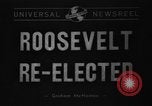
Americans vote in the 1940 Presidential election.
Newsreel opening slate reads: "Roosevelt Re-elected." President Franklin D. Roosevelt is seen in the back seat of an open car, accompanied by his wife, Eleanor Roosevelt and The President's mother, Sara Ann Delano Roosevelt, as they arrive at the town Hall in Hyde Park, New York, to cast their ballots in the 1940 Presidential election. Inside the hall, the President signs a voter registration log and is then seen entering a voting booth. Closeup of him with his mother and wife smiling after casting their ballots. View shifts to the President's car with license plate number 101, as they drive away, with Secret Service agents riding the running boards. Scene changes to New York City, where uniformed policemen control a large crowd gathered around a car carrying Republican Presidential candidate, Wendell Wilkie. He acknowledges the crowd of fans and then enters a voting booth to cast his ballot. As he leaves the polling place he again acknowledges the cheers of his supporters. Another change of scene shows an unidentified politician exiting a polling place and waving to a crowd. This is followed by a view of former New York Governor, Al Smith, who supported Wendell Wilkie. He is seen on a street, waving his hat. His wife, Catherine Ann Dunn smith, stands behind him. Next, several people are seen lined up outside a polling place. Inside, New York Mayor Fiorello LaGuardia is seen signing a registry of voters. Camera focuses again on Al Smith and his wife. He has a stogie (cigar) in his mouth and she wears a corsage and picture of Wendell Wilkie. Several views of unidentified political figures casting ballots. A room filled with reporters and photographers where election returns are being tabulated on a large board. Signs identify the news organizations, such as United Press and Associated Press. A group of persons occupying desks in an area with sign reading :"Tabulators." Closer view of the large board where returns from various voting precincts are being recorded in real time (1940 election). This the Republican Party headquarters. One side of the board has a picture of Wendell Wilkie and the other of his running mate, Charles L. McNary. People napping in some corners of the room as the night progresses. Final scenes show crowds in New York City's Times Square, celebrating the re-election of Franklin D. Roosevelt. News in lights on the New York Times building first spell out: "Roosevelt Carries New York," followed by "Re election of President Roosevelt." Cheering crowd gathered outside the Roosevelt Springwood estate in Hyde Park, New York. The Roosevelt family gathered together in front of the family home. Closeup of the President waving to the crowd.

Cardinal Mindszenty in Hungary. In New York: American Legionnaires Parade. Communists parade. Catholics protest against Russia
Views of St. Stephen’s Cathedral, Budapest, Hungary. Cardinal József Mindszenty and retinue enter St. Stephen's Cathedral (Budapest, Szent István tér 1, 1051 Hungary). Dark interior of cathedral. Cardinal Mindszenty, priests, and sacristans leaving the cathedral. Cardinal in procession during festival. Cardinal Mindszenty blesses the crowd outside St. Stephen’s Cathedral. Several graves in woods, marked with wooden crosses. Hungarian Communist Leader Mathius Rakosi speaks. Photograph of Cardinal during his trial in Hungary. Comparison of Cardinal Mindszenty's signatures made in 1947 with that ostensibly signed to his confession in 1949. Massed American flags carried by members of the American Legion, in May Day loyalty Parade passing Central Park, in New York City. Small parade of Communists Sympathizers in New York. People carry banners reading: "Against KKK; Against War Bases in Africa; Against Universal Military Training; The Soviet Union Wants Peace; Return to Roosevelt's Peace Policy." One man carries a sign "Hail the State of Israel." Roman Catholic priests lead 'Procession of protests' against Communist Russia at the New York Polo grounds.
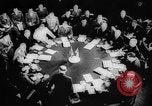
V-J Day: New Yorkers celebrate as President Harry Truman announces Japanese surrender during World War II.
Events surrounding the surrender of Japan during World War II. Scene from the Potsdam Conference meeting. Group of dignitaries together including Clement Attlee, Harry Truman, and Joseph Stalin. U.S. President Harry S. Truman and the General Secretary of the Communist Party of the Soviet Union, Joseph Stalin, in discussion. A parade in Moscow showing Soviet military might (these scenes are from the May 1, 1945 May Day parade just before Germany's surrender). Scene changes to Japanese Emperor Hirohito riding on a white horse in a procession. Next scene shows dignitaries arriving for meeting at the White House in Washington D.C. U.S. Secretary of War Henry Stimson, Secretary of State James Byrnes and Secretary of Navy James Forrestal meet at the White House. Close up view of Secretary Forrestal. View of President Truman with his cabinet in a meeting. Scenes from prior months showing dignitaries involved in the war: Close up of the late President Franklin Roosevelt. A scene of President Roosevelt shaking hands with several Soviet military officers. General Douglas MacArthur seated and talking to President Roosevelt. Close up view of Chairman of Nationalist Government of China, Chiang Kai Shek. View of U.S. Navy Admiral Chester Nimitz shaking hands with a sailor. Views of President Truman meeting in emergency session with his cabinet, and his announcement of the Japanese surrender. View of former Secretary Hull at that meeting. President Truman standing as he reads from a bulletin confirming the Japanese acceptance of the terms of the Potsdam Agreement and their agreement to unconditional surrender. View of media, press, and newsmen running from the White House to file the happy news story. New Yorkers rejoice at the end of war. Daytime scenes of happy, jubilant celebrations on Victory over Japan day, or V-J Day, in the Times Square area of New York City. Crowds cheering, people dancing, soldiers, sailors, and citizens waving hands and American flags. A neon sign with message "Japs Surrender". View of night time celebrations at Times Square as the crowd continues to celebrate VJ Day.
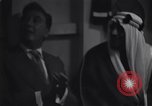
King Saud aboard Destroyer USS Willis A. Lee (DD-929) in New York Harbor
King Saud of Saudi Arabia on Destroyer USS Willis A. Lee (DD-929) in New York Harbor. King Saud talks to an unidentified civilian. A member of the Royal Party holds his son, Prince Mansur, in his arms. King Saud and the Royal Party stand at the railing of the destroyer, as it docks at its berth in New York. They disembark and are greeted by diplomat Henry Cabot Lodge, U.S. Ambassador to the United Nations.
CRITICALPAST.COM: About Us | Contact Us | FAQs - How to Order | License Agreement | My Account | My Lightboxes | Shopping Cart | Advanced Search | Featured Collections | Website Terms & Conditions | Privacy Policy ©2026 CriticalPast LLC.
License Agreement |
Terms & Conditions |
Privacy Policy
©2026 CriticalPast LLC.