


 Francais
 Deutsch
 Italiano
Refine Your Search
New Mexico United States 1946 stock footage and images
- Showing 12673 to 12678 of 30777 results more
more Hide
Hide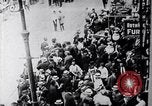
Debacle at Garment Workers Convention in 1914 leads to formation of Amalgamated Clothing Workers of America
United Garment workers (UGW) Union members discuss plan for 1914 convention in Nashville Tennessee. View from railroad locomotive traveling on a straight train track. A steam locomotive pulling a passenger train. Trainman on rail car waving a lantern. Views of the convention, October 12, 1914, in Nashville, headed by UGW President Thomas A. Rickert of Chicago. Labor union locals from New York, Boston, Rochester, Cincinnati, Philadelphia, and Baltimore, were deemed in arrears on dues (although they had been on strike) and not allowed to participate. They walked out, with the Chicago delegation too. View of Telegram sent from Nashville, by the dissidents, to Sidney Hillman in New York, October, 1914, asking him to head a rival union. Photo of Hillman taking telephone call. A special convention at Webster Hall, in New York City, where dissidents join with Journeyman Tailors union and form the Amalgamated Clothing Workers of America, with Sidney Hillman as President. Key members of the new union are seen standing in front of a car. Sidney Hillman in his office dictating to his secretary. Copies of the new union's House organs in various languages. Amalgamated Clothing Workers holding signs in various languages. Workers pose on a truck by a sign reading:"A Fair Deal, A Chance to Live, Arbitration is all we ask." Workers in cars. Girls on roller skates wearing sashes reading: "Don't Be A Scab." A man in a barrel with sign reading: "Can't afford to wear pants. Pa works in an open shop." Women pose in sandwich boards that spell out: "Closed Shop." Philadelphia garment worker ostensibly writing letter to Sidney Hillman. Shop owners examine sewn item and shop records while man works at sewing machine.
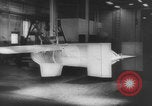
Flying bombs rocket launching with radar system (WW2)
A GB-4 glide bomb in a hanger, suspended from the ceiling. A robot bomb, possibly V-1, launching from a catapult ramp. A United States Air Force bomber drops GB-4 glide bomb during World War II. United States army air men use a television screen with radar system to direct the GB-4 glide bomb to its target. POV view target via GB-4 glide bomb camera. GB-4 glide bomb seen at ground level gliding to target and exploding. United States soldiers preparing a V-2 rocket for launch in the desert in the United States. Men working on radar system. V-2 firing room engineer gives the "go" signal for launch. V-2 rocket lift off in the desert. Scientists in radar control room at Fort Evans. Soldiers at controls of early field radar control system. Large radar console with circular CRT display. A United States soldier repairs radar console. Various types of radar antennas and dishes moving while in operation.
U.S. 712th Preventive Medicine unit soldiers dance with Thai girls in a bar at Korat Royal Thai Air Base in Thailand.
United States 712th Preventive Medicine Unit soldiers at Korat Royal Thai Air Base in Thailand. A neon sign in the dark reads 'Castle'. United states 712th Preventive Medicine Unit soldiers dance with Thai girls at a bar or night club. The orchestra plays as people dance. Soldiers drink at a table. A drummer hits at the drum and a Thai man sings as soldiers and girls dance.
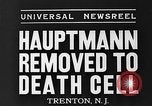
Bruno Hauptmann taken to the State Penitentiary for kidnapping and murder of the Lindbergh baby.
Bruno Hauptmann removed to death cell in Trenton, New Jersey. Bruno Hauptmann under heavy guard taken to the State Penitentiary. He has been sentenced to the electric chair for the kidnapping and murder of the Lindbergh baby.
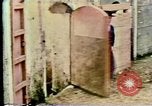
CIA and other U.S. sponsored experiments dealing with control of animals and people using various techniques during the 1960s and 70s.
In 1964, Professor Jose M.R. Delgado, of Yale University's School of Medicine, invented a device he called a stimoceiver. It was a chip that could alter the brain’s electrical impulses via radio signal. In tests sponsored by the U.S. Office of Naval Research, he implanted the device in the brain of a bull. This film opens shows that experiment and its results. A man in Cordova, Spain, opens a bull ring door to allow a fighting bull to enter. It charges a man holding a cape. Another man fires a dart to sedate the bull. Several men plant electrodes for a stimoceiver in the bull's brain. Next, the bull charges a man holding a cape, but pulls up short before hurting him. The bull chases the cape but never attacks the man as the man uses remote control to influence the animal's behavior. The bull charges around in a circle. Scene shifts to Dolley Madison Parkway (Route 123 in Mclean, Virginia, where sign points toward the CIA headquarters at Langley, Virginia. Narrator lists various techniques examined in the 60s and 70s, including brain surgery; psychosurgery; creation of amnesia; parapsychology; and manipulation of genes. Glimpse of some facilities at CIA headquarters. Change of scene to hearing of the Senate Subcommittee on Health and Scientific Research on September 20, 1977. Chaired by Senator Edward M. Kennedy, the Committee sought information about these activities by the CIA. Narrator says witnesses had agreed to limit information they would provide the Subcommittee. Former narcotics officer Charles Siragusa is seen on camera admitting that the man he reported to at the CIA wanted him not to say anything. Former CIA chemist Robert V. Lashbrook is seen testifying that he has no knowledge about the CIA running safe houses. (Narrator states he ran one of them and that a "surprise LSD experiment" was conducted there.) Scene shifts to a California tennis court, where Dr. Sidney Gottlieb is playing doubles tennis, Narrator says he oversaw those activities at the CIA but destroyed all his records when he retired in 1973. View of a letter he wrote at that time, in which he states he and his colleagues had been able to maintain contact with the leading edge of chemical and biological developments in the field of biological and chemical control of human behavior. View of Dr. Gottlieb entering an ante room where he testified before the Senate Subcommittee on Health and Scientific Research without being filmed because of what his lawyer claimed were health and cardiac problems. View of him on the tennis courts as Narrator states he declined ABC News requests for an interview. Change of scene to George White who retired from the CIA and lives in Stinson Beach, California. View of Stinson Beach from high overlooking vantage point. People jogging on the beach. Narrator states that White wrote to Dr. Gottlieb summing up his career saying, "it was fun fun fun, and where else could a red-blooded American boy lie, kill, and cheat, steal, deceive, rape, and pillage, with the sanction and blessing of the All Highest." Narrator strolls on lawn near the U.S. Capitol building and says it appears doubtful that mind control has been achieved. But work, that we don't know very much about, is continuing in this field. He asks how deeply are the Russians and other dictatorships into this. He notes that the CIA is reluctant to give information about it (such as Project MKUltra) and he questions where such a program fits in a democracy. He notes that one person working on these projects told him there are capable, conscientious, and very capable scientists working for our country, and "their work speaks for itself."
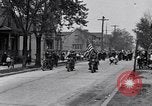
Flag bearer, band and marching units parade in a residential area
Parade in residential area. Motorcycle police seen. Flag bearer, band and marching units in parade. Girls and boys dressed as Indians. Boys in colonial costumes. Pony drawn cart led by a man. A little girl and boy riding on it. Little girls in colonial costume. Groups of children in costumes of several lands. Old and new cars.
CRITICALPAST.COM: About Us | Contact Us | FAQs - How to Order | License Agreement | My Account | My Lightboxes | Shopping Cart | Advanced Search | Featured Collections | Website Terms & Conditions | Privacy Policy ©2026 CriticalPast LLC.
License Agreement |
Terms & Conditions |
Privacy Policy
©2026 CriticalPast LLC.