


 Francais
 Deutsch
 Italiano
Refine Your Search
New Mexico United States 1946 stock footage and images
- Showing 12733 to 12738 of 30777 results more
more Hide
Hide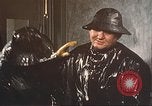
Precautions taken by personnel against foot and mouth virus of animal at the PIADC in Long Island, New York.
A film based on the Plum Island Animal Disease Center( PIADC ) in Long Island, New York which is dedicated to study of foreign animal diseases. Removal of animal virus in a laboratory shows personnel in special rubber clothing inside an animal isolation unit. The rubber is disinfected with lie solution. Caustic solution in rinsed off in a shower. Clothing is cleaned using a brush. A man cleans the room with the lie solution. Sewage passed through welded lines to sewage decontamination building. Three holding tanks receive sewage. Sewage is heated to sterilizing temperature and discharged outside the laboratory. An officer inside research buildings looks at a light blinking on a central trouble panel. A technician takes a look at the diagram of the layout of the building and instructs over a telephone. A technician approaches an overheated motor. He inspects equipment of air control system of the laboratory. Technicians work on machines in a machine shop. A patient being treated in a first aid room. Service area for cleaning and sterilization of glassware and a laundry in the research building. A man cleans his nasal and throat passages, scrubs his hands and takes a shower. Employees board a bus. A guard looks through binoculars.
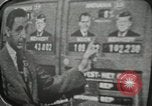
Presidential Election results show Kennedy in the lead and Nixon delivers a speech pledging his support to Kennedy in the U.S.
The 1960 Presidential Election in the United States. A television broadcast showing Presidential candidate John F. Kennedy's lead in the Presidential Election. A correspondent recording figures on a sheet of paper. The returns in a tabulating machine checked by Kennedy's press secretary. The interiors of the press headquarters of the Democratic Presidential candidate in Massachusetts. Men and women viewing a television. The television commentator announces that Republican Presidential Richard Nixon is about to make a statement. A clock showing 3.20 AM. Richard Nixon with his wife Pat Nixon in California, standing behind a podium in front of a tally board which shows Presidential Election summary. Nixon waves at the crowd. His speech being broad casted on television. Richard Nixon talks about the importance of how elections work in the United States, that they are hard fought, but once the decision is made we united behind the man who is elected, and he says that if Kennedy goes on to win the election and becomes the President of the United States then Kennedy will have his whole hearted support. The crowd cheering and applauding. Nixon waving at the crowd. Men and women going out of a building. Vacant chairs in the Republican Party headquarters. A tally board showing figures of the election results. A few men and women in the headquarters.
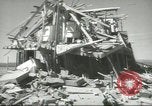
Soldiers assess damage from atomic explosive test shot,"Apple Two," during U.S. Army exercise Desert Rock 6.
Views of various structures and objects after being exposed to atomic explosive test shot "Apple 2" during U.S. Army Exercise Desert Rock VI. A wooden frame house splintered by the blast. A low concrete structure, relatively intact. An overturned Army vehicle. An unsheltered low-wing monoplane, number NG 489851, with skin stripped from its horizontal stabilizer and wing tips. A P-47 aircraft appearing relatively intact. A badly damaged two-wheel trailer. A relatively unscathed auxiliary power unit on a stabilized trailer. Vehicles reduced to rubble. Radar unit and accompanying truck and power unit, seemingly OK, but dish antenna may be damaged. Three soldiers stand around an M2HB heavy machine gun knocked from its stand. A B-29 bomber sits on a ramp with a sign in front of it warning of radiation. A ground crewman sprays the bomber down with a pressure hose to decontaminate it by washing off radioactive particles. A soldier rides a jeep out to check radiation readings on a vehicle that had been exposed. Troops walk back from ground zero and undergo personal cleaning with brooms and checks by geiger counters. A soldier being checked, including his boots. Soldiers sweeping dust from M48 tanks used in the exercise. A soldier being "interviewed" by another, about means of coping with atomic weapons on the battlefield. A formation of soldiers marching, led by one carrying a Corps of Engineers Guidon with the number 14 on it. [Note: According to the U.S. Department of State, Office of the Historian, from February 18 to May 15, 1955, the United States conducted Operation Teapot, a nuclear test series at Yucca Flat and Frenchman Flat on the Nevada Test Site in the continental United States. During the test period 14 nuclear shots and 1 non-nuclear shot were detonated. Several thousand scientific, military (army, air force, navy, marines), and civilian contract personnel participated in the organization, planning, and execution of the test series. Military exercises undertaken during and following the shots took place under the name Desert Rock 6.]
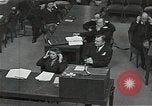
Chief Prosecutor Jackson delivers a speech concerning the prosecution's case against certain organizations in Nuremberg.
During Nuremberg Trials, United States Chief Prosecutor Robert H Jackson delivers a speech concerning the prosecution's case against certain organizations in the Nazi government in Nuremberg, Germany. Quoting the prosecutor, 'The work of these organizations was to incite a mob spirit in the German people.' Mr Jackson states that the SS killed five million Jews unmercifully and with malice. 'These crimes' he says 'with which we deal, are unprecedented; not only because of the large number of organizations which carried them out so methodically, but because of the large number of people who united their efforts to perpetrate them.'
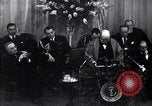
Churchill addresses people at the Westminster College in Fulton, Missouri and talks about the situation in Europe.
Prime Minister of United Kingdom Winston Churchill delivers a speech at the Westminster College in Fulton, Missouri (501 Westminster Ave, Fulton, MO 65251, United States). US President Harry S. Truman and other officials sit behind him on the stage. Churchill talks about the need to develop understanding with Russia and the situation in Europe. This is an excerpt from his speech entitled “The Sinews of Peace” (popularly known as the ‘Iron Curtain Speech’) and contains that reference. Churchill said “From Stettin in the Baltic to Trieste in the Adriatic, an iron curtain has descended across the Continent. Behind that line lie all the capitals of the ancient states of Central and Eastern Europe. Warsaw, Berlin, Prague, Vienna, Budapest, Belgrade, Bucharest and Sofia, all these famous cities and the populations around them lie in what I must call the Soviet sphere, and all are subject in one form or another, not only to Soviet influence but to a very high and, in many cases, increasing measure of control from Moscow.”
General Eisenhower receives an honorary doctorate from University of Toronto, Canada.
United States General Dwight D. Eisenhower visits Canada. General Eisenhower at the Canadian Tomb of the Unknown Soldier (53 Elgin St, Ottawa, ON, Canada) in Ottawa, Canada. He places a wreath on the tomb as photographers click pictures. General Eisenhower salutes as Canadian Prime Minister MacKenzie King stands next to him. General Eisenhower arrives at the University of Toronto (27 King's College Cir, Toronto, ON M5S 1A1, Canada). He enters the building. General Eisenhower talks about the friendship between United States and Canada. He accepts the honorary doctorate by the University of Toronto and extends his support to the cause of education.
CRITICALPAST.COM: About Us | Contact Us | FAQs - How to Order | License Agreement | My Account | My Lightboxes | Shopping Cart | Advanced Search | Featured Collections | Website Terms & Conditions | Privacy Policy ©2026 CriticalPast LLC.
License Agreement |
Terms & Conditions |
Privacy Policy
©2026 CriticalPast LLC.