


 Francais
 Deutsch
 Italiano
Refine Your Search
New Mexico United States 1946 stock footage and images
- Showing 12877 to 12882 of 30777 results more
more Hide
Hide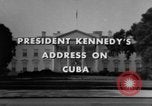
President John F. Kennedy addresses the nation about the missiles in Cuba from his office in the White House, Washington DC.
U.S. President John F. Kennedy addresses the nation during Cuban Missile Crisis. Exterior of the White House. President Kennedy in his office. He speaks about the series of offensive missiles found in Cuba and the range of these missiles. He names the cities that could be covered by medium range missiles and intermediate range missiles and thus are a danger to the western hemisphere. He also talks about Jet bombers capable of nuclear bombing. He refers to the constitution and the charter of the United States. He also discusses his talk with Soviet officials and their refusal to remove the weapons. President Kennedy condemns the nuclear weapons and expresses his concern about the Communist buildup in Cuba as it is dangerous to the United States. He talks about Americans policy to be patient and restrained. He warns that any nuclear attack from Cuba would be regarded as Soviet attack. He talks about an emergency meeting of the UN Security Council for withdrawal of all offensive arms from Cuba under supervision of the United Nations. Kennedy addresses Cuban people and says that they had been betrayed by their leaders. He asks all citizens to be patient
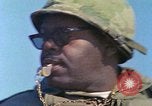
In the U.S. MPs at circulation control points provide river crossing support during war.
A training film in the United States details the role of Combat Military Police of the United States Army in supporting river crossing during war. An MAB (Military Assault Bridge) is emplaced and an armored vehicle rolls over the bridge. MPs direct the traffic. Other roles of MPs showing MPs involved in intelligence reporting on a battlefield, evacuation and control of prisoners. They move forward with equipment gaining advance in enemy area. Additional units of MPs cross the bridge. The MPs direct traffic at circulation control points such as road junctions. MPs with rifles provide security. One MP maintains radio communication. The MPs exchange information at a road junction.
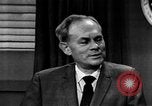
Lieutenant General Ira Eaker talks about his contributions and experiences in the USAF during an interview in the U.S.
An interview of United States Air Force Lieutenant General Ira Eaker conducted by Dr. Maurer in the United States. General Eaker is asked about his contribution to the Air Force. He speaks about the earlier period of World War I when he was a pilot. He speaks about his working as the Commander of the 20th Pursuit Group. He also talks about the working and the activities of the Air Force units during World War II.
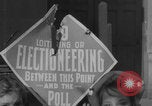
American voters head for the polls to vote in the 1944 Presidential Elections during WWII
Sign saying “No loitering or electioneering between this point and the poll”. Long line to election poll in the United States during World War II. 1944 American voters wait in line on the street to vote. Woman, wearing a Tartan patterned headscarf and fur coat, waits outside. Cowboys gallop with their horses to the polling station. Man, wearing cowboy hat, gets off from his Ford Model-T car. Worker walks out to the street. A truck with workers on open-cargo area. A woman walks in an empty city street. View of crowd outside Bronx Beacon Laundry at W 169th Street Bronx NYC. People enter a house used as a polling station with a huge tree in front. View of different kinds of buildings used as polling stations for the 1944 United States Presidential Elections. Including the Barbara Fritchie House ( 154 W Patrick St Frederick, MD 21701) “Bridgeport High School” engraved in front of Bridgeport Central High school (44 Lyon Terrace Bridgeport, CT 06604 ) now Bridgeport City Hall. United Stastes voters wait in lines outside polling places. Two women eating biscuits together as they wait in line. A stylish woman, wearing a matching leopard print cocktail hat and scarf, smiles. A man, wearing cowboy hat, waits in line. A group of nuns, belonging to the Sisters of the Holy Cross (CSC) Congregation, waiting to vote. Man, with mustache and fedora, looks slightly up. View of American Red Cross volunteer. Americans forming a long line to the polling station to vote. A woman sits as she waits for her turn to vote. African-American voters waiting in line to vote. Woman, wearing a polka-dotted headscarf, glasses and overalls, waits in line. Men waiting in line in the suburbs. Americans wearing thick coats waiting in line to vote.
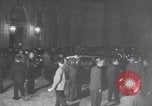
Officials arriving at Central Hall, Westminster, England for first UN General Assembly meeting
United Nations First General Assembly meeting, Central Hall Westminster, London. Officials arriving, entering, and walking through the building. United States delegate Dr. Ralph Bunche walks forward and is photographed smiling with other officials in the background.
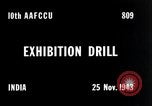
The 848th Engineers Unit performs parade drills during an exhibition in India.
Drill exhibition of United States 848th Engineers Unit in India. Soldiers from 848th Engineers Unit march with rifles on their shoulder. Soldiers perform different activities with rifles and parade. Other unit members witness the drill exhibition. Marching music plays in background. (World War II period).
CRITICALPAST.COM: About Us | Contact Us | FAQs - How to Order | License Agreement | My Account | My Lightboxes | Shopping Cart | Advanced Search | Featured Collections | Website Terms & Conditions | Privacy Policy ©2026 CriticalPast LLC.
License Agreement |
Terms & Conditions |
Privacy Policy
©2026 CriticalPast LLC.