


 Francais
 Deutsch
 Italiano
Refine Your Search
New Mexico United States 1946 stock footage and images
- Showing 13321 to 13326 of 30777 results more
more Hide
Hide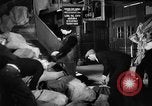
Mail transported by train and airmail by airplanes.
United States Post office employees sort mail sacks filled with letters. A locomotive train approaching camera position and passing by at high speed. Map of United States connecting destinations and a flying plane. A man examining models of various airplanes used for air mail service. Shows postmaster General James A. Farley emerging from a plane with other men to examine the latest technology and advances in airplanes for airmail service. View of exterior of Newark Air Mail Post Office building. Men emerging from plane. A plane takes off. Men load postal mail sacks on plane. View of a pilot reenacting the look of one of the original night mail pilots.

The freighter, SS Flying Enterprise, damaged by storms and foundering in the Atlantic ocean,
The freighter, Flying Enterprise, is seen listing some 80 degrees to port in the windswept approaches to the British Isles. After suffering damage from a storm on December 28th, she had been taken under tow toward England,by a succession of ocean-going tugs over a period of 15 days. Her present position is only about 30 miles from the coast of England, but her tow line has parted and she is foundering. Closeups of "Flying Enterprise" and "Isbrandtsen" painted on her hull. (Narrator states that the Captain, Henrik Kurt Carlsen,is still aboard.) Aerial view of several other ships around the stricken vessel. Officers and crew of the destroyer, USS Willard Keith (DD-775), are seen firing a line to the Flying Enterprise. Heavy seas are flowing over the foredeck of the destroyer. Another view of the listing ship. (During these scenes, Captain Carlsen is heard on the radio, in the background, describing the circumstances leading to their present trouble.) More views of the Flying Enterprise, helpless and battered by wind and seas, before eventually sinking (not seen). Narrator states that Captain Carlson was rescued. (Note: This ill-fated trip which ended in the sinking of the old Liberty Ship made world-wide news when it turned out that she was carrying paper money.)
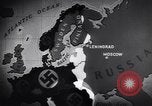
German Operation Barbarossa on the Eastern front in World War II
Animated map shows extent of German controlled areas in Europe following their conquest of the Balkans in World War 2. Norway is under their control and German forces threaten Leningrad and Moscow. A soviet defense line is shown on the map. The German attack is shown to come from 5 directions on June 22, 1941, with the launch of German Operation Barbarossa. A sky filled with German Heinkel He 111 bombers is shown. German Panzer III tanks with 75 mm guns. Army trucks carry German troops into battle. German soldiers on motor cycles and infantry advance under fire. Animated map shows principal German targets as Leningrad, Moscow, and Kiev. It then shows beginning a drive from the North to encircle Leningrad. Arrows show where German Marshal Fedor von Bock's forces drove 480 miles into Soviet territory. Slates identify cities being overrun by German invaders, including: Pskov, Novgorod, Brest-litovsk, Minsk,Mogilev, and Vitebsk. On July 17, 1941, a German tank is seen entering Smolensk, past the Dnieper River threatening Moscow, itself. To the south, German forces, under Marshal Gerd von Rundstedt, cut deep into the Ukraine. Newspapers world-wide consider the Soviet forces close to defeat. Slate shows communique from the German High Command stating: "The issue in the East is already settled. Smolensk is the last halt on the road to Moscow." German infantry marching. Scene shifts to heavy artillery being fired by Soviet forces in a snowy scene clearly later in the year. Animated map shows German forces very close to Moscow on October 15, 1941, forcing the Soviet Government and all foreign missions to move to Kuibyshev, 700 miles to the east. Adolf Hitler, in a speech on October 3, 1941, states that the enemy is broken and will never rise again. Animated map shows 500 thousand square miles of Soviet territory occupied by German forces. Views of fires burning in Russia. Damaged and abandoned Soviet industrial plants. A German guard atop a hill looks down on thousands of Soviet people in the occupied areas of Russia. Damaged and abandoned Soviet T-26 tanks. Glimpse of damaged Soviet aircraft and field artillery. Headline in New York World Telegram newspaper reads: "Berlin Admits Russ War May Last Winter." Another headline reads: "Red Army Holds Push On Moscow." Weary German soldiers traveling in horse-drawn wagons, pulling field artillery. Soviet and German war planners are seen at work. Slate quotes Adolf Hitler saying: "A single blow must destroy the enemy, without regard for losses... A gigantic all-destroying blow." German armor moving along a road. Animated map shows this technique in the German invasions of Poland, France, the Balkans, and Yugoslavia. In contrast, the Soviet planners are seen, as map illustrates how they intend to take advantage of the vast area of their land by holding lines of defense an falling back as necessary to keep engaging the invaders across interior of the Soviet Union. Soviet infantry are seen marching along a road. German troops riding atop their tanks. Soviet troops forcing German invaders into close combat in her cities. Soviet soldiers running in a city and firing heavy machine guns. Bomb damage and rubble inhibit German armor mobility in cities. Cities where this kind of Soviet resistance prevailed were: Rostov, Kharkov, Kiev, Kursk, Smolensk. German troops leaving a city with heavy black smoke rising in the background. More views of cities where Soviet troops are engaged German forces in House-to-house battles, including: Odessa, where the Old Opera Theater building is shown sandbagged and relatively undamaged. The Odessa NI tank, created from an STZ-3 agricultural tractor.

The governorship rivalry between Talmadge and Thompson with rally protesting White Supremacy politics of Governor Talmadge in Atlanta, Georgia.
The governorship rivalry (so called "Three Governors Rivalry") takes a new turn in Atlanta, Georgia. Exterior of Capitol Building (Georgia State Capitol Building, 206 Washington St SW, Atlanta, GA 30334) in Atlanta, Georgia. U.S. State Senator from Georgia, Herman Eugene Talmadge, and Melvin Ernest Thompson (M.E. Thompson), standing together claiming to be the legitimate governor. Mr. Talmadge speaks over a microphone and suggests a 'White Primary' which he said would function "To let the white people of Georgia determine who is their choice for Governor" (to decide between Talmadge and Thompson). Students of university staging protest rally against Gov. Talmadge. University students demonstrate outside the proceedings. The students hang Talmadge in effigy. A Nazi German flag with swastika is flown and a sign reads "It Can't Happen Here" with the word "can't" crossed out and change to "did" so it reads, "It Did Happen here." The students protest the racial segregationist and White Supremacy politics of Talmadge (early in Civil Rights movement). A sign reads "Must Stop" and above it is pictures of a padlock and key, a Nazi Swastika, and a pistol.
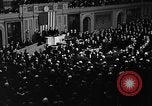
American President Franklin Roosevelt gives his Annual Message to the Congress in Washington DC, USA.
U.S. President Franklin Roosevelt delivers his Annual Message to Congress (State of the Union) in Washington DC, USA. President delivers his message to a new Congress within a fortnight of the expiration of his office term. He reviews the existing state of U.S. National affairs and outline broad future problems. He asks immediate consideration of Congress in matters such as extending the life of certain authorizations and powers, addition to the existing Neutrality Act to cover specific points raised by the unfortunate civil strife in Spain (Spanish Civil War), and a deficiency appropriation bill.

U.S. President Richard Nixon address' s the American citizens on the nation's economy in Washington, D.C.
News correspondent covers the President's address on the nation's economy in Washington, D.C. From the White House office the President shares his thoughts with the citizens upon the country's economy. He talks about the 3 subjects of public interest- the job, income and cost of living. He briefly talks about the problems that the nation is facing and the reasons behind them. He introduces the program which deals with these problems. The first step involves the recognition of problem. There exists a transition between the peacetime economy and a wartime economy. Labors and the businessmen prefers the peacetime economy. He states that his government takes the responsibility to cut down the expenditure in order to strongly restrain current economy, this would in turn raises the price gradually and thus not affect the businessmen, common men and industry badly. They have also decreased the Federal spending as per the previous years figures and will do the same in coming years as well. He talks about his actions against the inflation. They include- to appoint the National Committee on productivity to check how well the resources are being used, has instructed the Counsel of economic advisers to prepare a periodic inflation alert, establishment of purchasing and review board to review all the government actions. The President briefly talks about the actions he will take and those which he wont take. He states that at this time the Congress and the President should co-operate each other on the common welfare programs. He requests the Congress to help him by passing the legislation related with people's job and cost of living and to act on the one which have been already submitted to it by the President. He asks the Congress to join him on the way of cutting down the government spending. He also talks upon the significant happenings taking place in the American economy. The President believes that in the next 5 years the American consumer will be able to buy 20% more than what he does today.
CRITICALPAST.COM: About Us | Contact Us | FAQs - How to Order | License Agreement | My Account | My Lightboxes | Shopping Cart | Advanced Search | Featured Collections | Website Terms & Conditions | Privacy Policy ©2026 CriticalPast LLC.
License Agreement |
Terms & Conditions |
Privacy Policy
©2026 CriticalPast LLC.