


 Francais
 Deutsch
 Italiano
Refine Your Search
New Mexico United States 1946 stock footage and images
- Showing 13453 to 13458 of 30777 results more
more Hide
Hide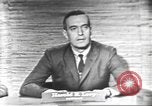
Kennedy and Nixon present their views about tax increments during a presidential election debate in Washington DC.
The second Kennedy-Nixon Presidential Debate in Washington DC, United States. Harold R. Levy of Newsday asks Democratic candidate Senator John F Kennedy about his recommendations to increase tax. Kennedy answers and states that in the present scenario tax increase is not desirable. He says that if it would be essential to U.S. security he would suggest a tax increase. He talks about his programs for economic growth, care for the aged, development of natural resources which would build the strength of the United States. He states that Americans can mobilize their economy and resources. Republican candidate U.S. Vice President Richard M Nixon comments on the increasing expenditures for defense, mutual security, economic and technical assistance. He says that he thinks it may be necessary to increase taxes to maintain a sound economy. He concludes and states that no president can add billions of dollars to his nations expenditures and not pay for it, after all the payment is made by peoples money.

Delegations from the US, Britain and the Soviet Union attend the Dumbarton Oaks Conference in Washington DC, U.S.
Delegations from three Allied nations arrive in Washington DC, United States to study post-war security during World War II. Delegates disembark from aircraft and review a parade of troops. Soviet Ambassador to the United States Andrei Gromyko, U.S. Secretary of State Cordell Hull, British Permanent Under Secretary for Foreign Affairs Alexander Cadogan, U.S. Under Secretary of State Edward Stettinius arrive and attend the Dumbarton Oaks Conference. Secretary of State Hull speaks at the conference. Alexander Cadogan speaks.
Tuskegee-trained home demonstration agent helps African American people in different fields
Home demonstration agent at Tuskegee Institute trains women as part of a Tuskegee Institute "Movable Schools" education outreach program. Collins, a farmer, meets a preacher. Two men with a poster from State Agriculture College. The poster advertises the upcoming arrival of a "Movable School" in the Alabama town. People read the poste and move to attend the school. Knapp truck (A Ford truck called the Knapp Agricultural Truck, so named to honor Seaman A. Knapp, of the national Cooperative Extension System) arrives with a group of instructors. Rural agricultural community of African American people learn skills from the movable school as they work in garden, water plants, erect stairs, mend houses, sharpen tools and make baskets. People learn carpentry under the guidance of an African American instructor. A new poultry house replaces an old hen house. A man views through a transit device as they learn about creating terraced farming plots.
Construction of an iron beam at Carnegie Steel Company's Homestead Plant in Pittsburgh, Pennsylvania.
An iron beam under construction at Carnegie Steel Company's Homestead Plant in Pittsburgh, Pennsylvania for use in New York City's Empire State Building. A huge ingot is brought to required temperature in a soaking pit at blooming mill. The ingot is picked up and put into a trolley. It is rolled into a belt and rolling operation starts. It is reduced to slab and taken for reheating.
Iron beams rolled into plates at rolling mill of Universal Plant Mill in Pittsburgh, Pennsylvania.
An iron beam under construction at Carnegie Steel Company's Homestead Plant in Pittsburgh, Pennsylvania for Empire State Building construction in New York City. Hot ingot at plate rolling mill. Hot iron slab rolled into cover plates for columns at Universal Plant Mill. Slabs are rolled in machine. Then it passes on a cooling table. Cold iron plates on the table.
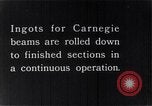
Iron beams take shape of rough beam at Carnegie Steel Company's Homestead Plant in Pittsburgh, Pennsylvania.
Iron beams under construction at Carnegie Steel Company's Homestead Plant in Pittsburgh, Pennsylvania for Empire State Building of New York City. Carnegie beams rolled into sections. An operator controls the rolling of the beams with a lever. Hot ingot takes shape of rough beam. Shear crops ends of beam.
CRITICALPAST.COM: About Us | Contact Us | FAQs - How to Order | License Agreement | My Account | My Lightboxes | Shopping Cart | Advanced Search | Featured Collections | Website Terms & Conditions | Privacy Policy ©2026 CriticalPast LLC.
License Agreement |
Terms & Conditions |
Privacy Policy
©2026 CriticalPast LLC.