


 Francais
 Deutsch
 Italiano
Refine Your Search
New Mexico United States 1946 stock footage and images
- Showing 1351 to 1356 of 30776 results more
more Hide
Hide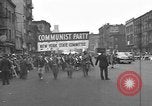
Members of Communist Party, Abraham Lincoln Brigade, United May Day Committee and Veterans march in a rally in New York.
Communists march in New York City. Many carry American flags. They hold banners which read 'Communist Party New York State Committee'. Spectators gathered on the street to watch the rally. A float in the rally. Banner reads: "Abraham Lincoln Brigade Fights Again." and veterans march for peace. Workers of Celeste shop and United May Day Committee members participate in the rally. Several workers unions are represented. A man collects money for charity. A float of Italian Americans moves on the street. Contingents of Army and Navy veterans in uniform participate in the march.
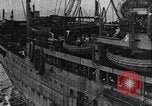
Soldiers march on streets holding rifles during World War I and veterans return to farming and dairying in United States.
A United States troop transport ship at sea during the first World War. U.S. Army troops (aka dough boys) aboard the ship. U.S. Army soldiers march in formation in a large city square area in Europe (likely France) holding rifles during World War 1. United States troop ships being loaded with American soldiers for World War I, and scenes of U.S. troops in WWI marching in the streets of a European city. Scenes from earlier during combat in the war. World War I allied soldiers on battle front in France. Soldiers run to a bomb crater area for shelter when crossing no man's land. Soldiers fire artillery. Artillery shells explode. Allied soldiers running across a battlefield as tanks run beside them toward the German enemy. People wave U.S. flags as First World War war ends with Armistice. Large crowd gathers in New York celebrating WWI armistice. Newspaper held high by a man with headline "Germany Surrenders". Views in the United States of hard times in American towns after World War I ended and war industries were no longer providing money. View of forests. Girl draws water from a well. Man and a boy operate a grindstone sharpening a saw. Farmers plowing fields with horse drawn plows during great depression era. People do agricultural works at fields. White farmer tilling a field. African American farmers working in fields and harvesting hay with help of a horse. African American farmers at cotton office. Cattle in field. Man and a woman milk cows with hands. Man pours milk in vessels. Milk processing before bottling including pouring milk through a cooling device. Men on tractor at fields. A board reads 'For the common defense'. Views of a factory. A man operates a switch on a switchboard for generating electricity. Views of a power generation plant. Narrator describes how America will prevent a slide into hard financial times again after World War 2 ends. From a 1942 production with footage from 1917 through 1942.
16 million men register themselves in United States for the WWII draft, and President Roosevelt addresses from White House.
As World War II heats up, 16,500,000 men between ages 21 to 36 register themselves throughout the United States, signing up during the first peacetime conscription in U.S. history. (This was triggered by passage of the Selective Training and Service Act of 1940, also known as the Burke-Wadsworth Act, the genesis of "Selective Service.") Opening scene shows men lining up to register for the draft before the United States entered World War 2. Views of men filing out their registration forms. At 00:22 famous prize fighter, Barney Ross, is being registered. (He jokes that the registrar shaking his hand has too strong a grip.) At 00:34 Hollywood cowboy Gene Autry is seen registering. Close up view of street signs at Chinatown intersection of Bayard Street and Mott Street in New York City. Sign below it notes "School Street. Drive Slowly. Make no unnecessary noise." Line of many registrants of Chinese-American descent waiting in line, and processing paperwork. Scene changes to another area of the city, where a line of mostly African American men wait outside a registration building. Some cheer and wave for the camera. A police officer at the entrance hustles them inside, pulling some of them along. View of the exterior of the White House in Washington DC. United States President Franklin D Roosevelt addresses the nation's men of draft age, telling them that the call up of 800,000 men for training in year one, and less than one million men in each subsequent year, is a program of defensive preparation only. Roosevelt says to the registrants that "Democracy is your cause. The cause of youth." ( Note: clip is silent except for President Roosevelt speaking at the end.)
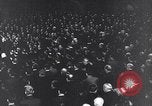
Isolationist versus interventionist sentiments of people in the United States regarding America entering World War 2
Americans express their views about United States entering into World War II after the Pearl Harbor attack. Anti-war isolationist and interventionist views are presented. Senator Gerald P. Nye advocates in favor of an arms embargo. Urging against American involvement in war, Senator Burton K. Wheeler cautions that war mongers and interventioners or intervention advocates control most of the avenues of propaganda. Wendell Willkie speaks advocating unity of purpose in America and importance of assisting the threatened democracies of Europe with war materiel and supplies. Next, Senator Joshua B. Lee of Oklahoma strongly urges support for lend-lease and "setting in motion an industrial blitzkrieg (of war materiel) that will make it possible for England to blast Hitlarism from the face of the earth." View of Congress meeting in the U.S. Capitol chamber. Anti-war college aged students protests against involvement in war and picket at the White House in Washington D.C.,United States. Adjacent to them are other protestors picketing against the peace advocates, with signs like "Americans are against subversive organizations picketing the White House" and "We Americans protest Communists picketing the White House. A women's organization advocating peace or protectionism or isolationism is seen wearing all black. They pull down black veils over their faces in a show of unity against war and the possible loss of American boys to war. An outdoor rally of a fascist organization meeting in America. Also scenes from a German American Bund meeting in 1939 at Madison Square Garden in New York City. Speaker at the meeting is Fritz Julius Kuhn who watches as a protestor leaps on the stage and is subdued by guards. Scenes shown from various other protests in the United States during the same era, including labor strikes and lockouts, and a group holding a rally in favor of equal rights or civil rights, with a woman holding a sign "Did Lincoln Free the Slaves?"
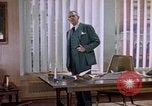
Animated map of Canada and the United States, illustrating North American Air Defense system.
Actor Raymond Massey introducing the subject of North American Air Defense, which is a joint enterprise of Canada and the United States. A map of the United States, Canada and the Arctic. Animation shows radar sites comprising the Dew Line, Mid Canada Line and Pine Tree Line in Canada, as well as coastal and ship borne sites around the United States. Internal U.S. sites tied to the automated SAGE system (Semi Automatic Ground Environment) are shown. SAGE is a computerized control system for tracking and intercepting enemy bombers. The headquarters of NORAD (North American Air Defense) is shown, at Cheyenne Mountain, Colorado. Mr. Massey points out models of new antiaircraft missiles displayed on his desk. Animation shows how these can be fired from the ships at sea.
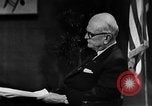
Lieutenant General Ira Eaker talks about his transfer to the Mediterranean Command during an interview in the United States.
An interview of United States Air Force Lieutenant General Ira Eaker conducted by Dr. Maurer in the United States. General Eaker talks about his transfer to the Mediterranean Command. He says that when he was ordered to the Mediterranean, United States Army Air Force General Carl Andrew Spaatz also came up from North Africa. He was named the Commander-in-Chief of the Mediterranean Allied Air Forces. That was a remarkable opportunity and experience for him. He got an opportunity to get acquainted with a new area, commanders of other nations and to work in cooperation with them.
CRITICALPAST.COM: About Us | Contact Us | FAQs - How to Order | License Agreement | My Account | My Lightboxes | Shopping Cart | Advanced Search | Featured Collections | Website Terms & Conditions | Privacy Policy ©2026 CriticalPast LLC.
License Agreement |
Terms & Conditions |
Privacy Policy
©2026 CriticalPast LLC.