


 Francais
 Deutsch
 Italiano
Refine Your Search
New Mexico United States 1946 stock footage and images
- Showing 13573 to 13578 of 30777 results more
more Hide
Hide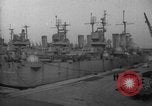
Chile Flag is raised to fore top of the USS Brooklyn and USS Nashville docked at Philadelphia Naval Base in Philadelphia.
Activities aboard a ship docked at Philadelphia Naval Base in Philadelphia. Ships in Reserve Fleet Basin. USS Brooklyn (CL-40) light cruiser in the foreground. Stern view of USS Brooklyn and USS Nashville (CL-43). Camera pans over ships, including the heavy cruisers USS Louisville CA 28, USS Augusta CA 31, and USS Portland CA 33, in the Philadelphia Navy Yard. United States and Chile Naval officials with State Department representatives on deck of USS Brooklyn. Navy band plays. American flag lowered and the Chilean Flag is raised aboard the USS Brooklyn. Chilean flag raised aboard the USS Nashville. United States Navy Rear Admiral Roscoe E Schuirmann hands ships papers to Chilean Ambassador Felix Nieto Del Rio. Chilean flag fly at masts of the USS Nashville and USS Brooklyn. Chilean officers inspect. Ambassador Del Rio and Vice Admiral of the Chilean Navy, Immanuel Holger come up gangway of USS Brooklyn. Rear Admiral Schuirmann greets them. Yni Louis Rivas Voisin and Yoeman Felix Labbe of the Chilean Navy raise flag aboard USS Brooklyn.
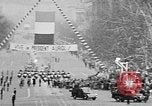
Secret service agent stay close to President to protect him during a public gathering in Washington D.C.
Activities of the United States secret service agents in Washington D.C., United States. Visit of French President Auriol, in 1947. Secret Service mingle and occupy vehicles at edge of gathering. Motorcade leaving White House with Secret Service agents riding on outsides of cars. In crowd secret servicemen are on an alert for the protection of the President or foreign head of State. They operate on a two way radio and keep a record about the route and timings when the motorcade will approach the crowd. During public gathering secret service agents stay close to U.S. President Harry S Truman. They watch individuals and maintain vigilance for unusual movements, or activities. Phalanx of agents escorts President's motorcade through the streets.
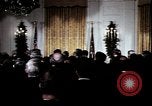
President Nixon makes remarks before signing the National Cancer Act of 1971 at the White House in Washington DC, U.S.
Signing of the National Cancer Act of 1971 in the East Room of the White House in Washington DC, United States. U.S. President Richard Nixon walks up to a microphone in the East Room. The President makes remarks. He speaks about the threat of cancer in the United States which killed many people during World War II and after that. He further speaks about the national commitment to the attempt of finding a cure through the National Cancer Act. President Nixon states that the Congress is totally committed to provide funds to ultimately eradicate cancer which is a major cause of death. He speaks that national commitment is different from government commitment because the national commitment involves all voluntary activities. A crowd applauds as President Nixon walks over to a table to sign the National Cancer Act.
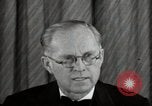
Joseph Kennedy strongly opposes American intervention in World War II during his speech in Washington D.C.
Speech by former U.S. Ambassador to UK, Joseph Kennedy, in Washington D.C., United States during World War II. Kennedy speaks against American intervention in World War II and states that outcome of this war will not bring prosperity to the United States.

Franklin Roosevelt nominated as Presidential candidate during 1932 Democratic Party National Convention in Chicago, Illinois
1932 Democratic Party National Convention in Chicago, Illinois. Democratic supporters carry signs with the names of US states and territories such as Mississippi, Florida and South Carolina. Keynote speaker Senator Alben Barkley of Kentucky speaks to the crowd, calling for the repeal of the Eighteenth Amendment to the United States Constitution, also known as the Prohibition. View of crowd in 1932 Democratic Party National Convention. William Gibbs McAdoo, a senatorial candidate of the Democratic Party for California, speaks to the crowd, nominating Franklin Roosevelt as the Democratic Party’s presidential candidate with the words, "he's entitled to the nomination" during the Democratic Party National Convention. Democratic Party National Convention crowd cheering as parabolic microphones turn to catch audio. Crowds cheer during the nomination of Franklin Roosevelt as the Democratic Party’s presidential candidate for the 1932 United States presidential elections.
Two WAC personnel and a soldier inspect destroyed and abandoned trains in Foggia, Italy (WW2)
Two United States Women’s Army Corps (WAC) personnel (Corporal Mary B. McGillicudy of San Francisco, California and Private Barbara Brophy of Salem, Massachusetts) and Private Merrit Rawley (Great Barrington, Massachusetts) of the United States Army walking into marshalling yards in Foggia, Italy during World War II. A smokestack and piles of rubble are seen in the background. The WAC personnel and private walk over train tracks. View of completely demolished boxcar. The soldier helps the two WAC personnel to climb into an abandoned railcar. The two WAC personnel and enlisted man peer through windows of train. The trio inspects train wreckage. Corporal Mary B. McGillicudy and Private Barbara Brophy of the WAC smiling. Private Merrit Rawley stands in front of abandoned Ferrovie dello Stato (Italian state railways) trains.
CRITICALPAST.COM: About Us | Contact Us | FAQs - How to Order | License Agreement | My Account | My Lightboxes | Shopping Cart | Advanced Search | Featured Collections | Website Terms & Conditions | Privacy Policy ©2026 CriticalPast LLC.
License Agreement |
Terms & Conditions |
Privacy Policy
©2026 CriticalPast LLC.