


 Francais
 Deutsch
 Italiano
Refine Your Search
New Mexico United States 1946 stock footage and images
- Showing 1411 to 1416 of 30776 results more
more Hide
Hide
U.S. President Harry S. Truman announces the surrender of Japan and civilians celebrate victory in the United States.
Victory celebrations and VJ Day in the United States during World War II. The President of the United States Harry S. Truman addresses a gathering and announces the surrender of Japan. In Washington DC: a large crowd of civilians gathered for street parties. A newspaper headline reads 'Japan Surrenders'. In Chicago: a demonstration takes place. In San Francisco: celebrations for the end of the war include a ticker tape parade . People march through streets holding banners. In Seattle: servicemen conduct an outdoor proceeding. In New York: a large crowd of civilians gathered at Times Square to celebrate victory over Japan.
People skiing and moving on dog sleighs in the White Mountain National Forest area in the United States.
A film titled: 'Winter Sports in the White Mountain National Forest' on the winter sports in this area in New Hampshire, United States. A map locates the White Mountain National Forest area in the United States. Mountains in the foreground. People skiing on snow. Some people moving on dog sleighs. The Mount Washington.

The recruitment and training of the SPARS in the United States.
A film titled: 'Battle Stations' on the Coast Guardsmen and United States Coast Guard Women's Reserve (SPARS). The Coast Guardsmen fighting on the battlefront in the European Theater during the World War II. Various citations and medals of honor for the Coast Guards who died while fighting for their country. The Coast Guards marching in formation. Two Coast Guards holding U.S. flag and the flag of USCG lead the parade. Other Coast Guards hold rifles. Coast guard cutters underway at sea. A man aboard the ship watching the enemy actions through binoculars. Other man talking on radio. Smoke from explosions in the area. Dead bodies of the Coast Guards who died in the war in caskets wrapped with U.S. flags. Other Coast Guards standing nearby and salute. Recruitment of women for the job of Coast Guards in the United States. Women taking oaths. The new recruits walking towards a building with their personal belongings for their training. Women in barracks. They ride bicycles and stand at attention on the ground. Women perform drill on the ground. An aircraft parked on air base. A woman walking nearby. The woman standing in front of the building.
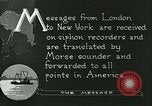
Men operate telegraph keys and an automatic perforator and transmitter in the United States.
A film on technological advancements in the United States. Messages from London, England to New York, United States are received on siphon recorders and are transmitted by a Morse sounder and are forwarded to all points in America. A man operates a telegraph key. A recorder in operation. Students are trained at a training school at a cable station. Manual sending and receiving of a duplex to and from England. A man with earphones receives messages. A man places a record on a machine. An automatic perforator and transmitter sends 100 words per minute. Operators at keyboards. A tape is fed through a machine.
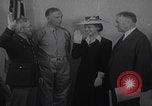
Oveta Culp Hobby is sworn in as Director of the United States Women’s Army Auxiliary Corps (WW2)
Oveta Culp Hobby is sworn into the Army with the rank of Director of the United States Women’s Army Auxiliary Corps during World War II. The organization would later be called the Women's Army Corps (WAC). Major General Myron C. Kramer administers oath of office to Oveta Culp Hobby. General George C. Marshall stands between Kramer and Hobby as he witnesses the ceremony. United States Secretary of War Henry Stimson also witnesses the event. Hobby stands with her arm raised under oath. Hobby shakes hands with Stimson, Marshall, and Kramer after the oath taking. Oveta Culp Hobby makes short statement, noting that, "This new corps is the 1942 expression of the patriotism and courage that the women of America have always demonstrated in every national crisis." Hobby continues, “In a total war, there is a total responsibility of all citizens regardless of sex, race, or creed. Every woman must do her part. The Women’s Army Auxiliary Corps offers an opportunity for every woman eligible under the law to do her part.”
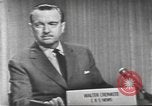
Candidates Nixon and Kennedy debate over prestige of the U.S. overseas prior to the presidential elections in the U.S.
The fourth presidential election debate held between Democratic nominee Senator John F. Kennedy and Republican nominee U.S. Vice President Richard Nixon in New York, United States on 21st October 1960. ABC News correspondent Quincy Howe allows CBS News correspondent Walter Cronkite to ask a question to Vice President Nixon. Mr. Cronkite asks Vice President Nixon if the Eisenhower Administration was suppressing a report by the United States Information Agency that shows a decline in United States prestige overseas as pointed by Senator Kennedy. Vice President Nixon replies and talks about Sputnik space program launched by the Soviet Union (compared to NASA efforts during the Space Race). He further compares the United States and the Soviet Union in terms of education and science. He speaks about UN General Assembly votes called on the Soviet Union to end its Hungarian intervention in 1956 and relates to American prestige. Senator Kennedy says that he did not make most of the statements that Vice President Nixon said he has made and he refers to the first one about Sputnik Program launched by the Soviet Union. Senator Kennedy refers to slums in the United States and talks about support housing legislation which the Eisenhower's Administration has opposed and also speaks about scientists and engineers United States has produced in comparison to the Soviet Union. He further says they were the first in other areas of science but in space, which is the new science, they are not the first
CRITICALPAST.COM: About Us | Contact Us | FAQs - How to Order | License Agreement | My Account | My Lightboxes | Shopping Cart | Advanced Search | Featured Collections | Website Terms & Conditions | Privacy Policy ©2026 CriticalPast LLC.
License Agreement |
Terms & Conditions |
Privacy Policy
©2026 CriticalPast LLC.