


 Francais
 Deutsch
 Italiano
Refine Your Search
New Mexico United States 1946 stock footage and images
- Showing 14371 to 14376 of 30776 results more
more Hide
Hide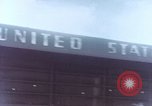
Scenes in and around U.S. Naval facilities at Tsingtao, shantung Province, China during U.S. postwar presence.
U.S. Naval facilities in Tsingtao (Qingdao) Shantung Province, China, after World War 2. Camera pans across top of building labeled: United States Naval Air Base. It pans over semi-tropical flora. View from hill looking down on rice paddies, and coastal waters. A U.S. Navy R5D transport plane seen overhead, through mist, with landing gear down, approaching to land. Series of jerky images from vehicle moving along a road on Naval base and vicinity. Steel framework at industrial site. Partially destroyed building. Various industrial areas. Sign at driveway entrance reads: "ASAN." Heavy construction equipment. Chinese people wading in flooded area, seemingly fishing for something. U.S. military truck, quonset huts, and American servicemen at a base. View down on a cemetery containing various monuments, including some Christian crosses.
U.S. orientation film for Allied occupation forces, to provide background for understanding Japanese and their society
Background information for United States occupation forces in Japan after end of World War II. At start, the film shows sky filled with U.S. Navy airplanes flying in formations. They include Vought F4U Corsair aircraft, among others, and are seen overhead above the Battleship USS Missouri (BBB-63). Closeup of the USS Missouri with her crew in formation on deck wearing dress whites. Next, General Douglas MacArthur is seen and heard speaking from a podium on the Missouri's deck. He invites the representatives of the Emperor of Japan, and the Japanese Government, and the Japanese Imperial headquarters, to sign the instrument of surrender. The date is September 2, 1945, just after the end of World War 2. Closeups of the Japanese delegation, which includes envoys Foreign Minister Mamora Shigemitsu and General Yoshijiro Umezu, and of MacArthur. Japanese Foreign Minister Mamora Shigemitsu sits at a table. Closeups of him signing the surrender document. Change of scene to Japan, where camera pans over many thousands of Japanese people assembled to learn of their fate. Closeups of Japanese soldiers and family members, as Narrator asks how should the U.S. occupying force treat them. View of soldiers in plain non-military uniforms. Views of Japanese responding en masse to a leader, during World War 2. Views of child victims of the war. Closeup of Japanese soldier firing a short barrel light machine gun. Views of Japanese pedestrians including families, most in western dress. Japanese workers in an office. Film shows artists view of one worker's brain, and then many brains, as Narrator refers to need for reorienting Japanese thinking. View of learned wise Japanese leader at a podium. View of a Japanese soldier posed with his sword above the head of a war prisoner. Japanese mother feeding her baby. Closeups of Japanese babies. Closeups of Japanese school age children, in a group, and some doing things in school, and some at a playground. Group of uniformed Japanese students studying the art of Japanese calligraphy. Students doing artwork, studying nature outdoors, and paying attention to a teacher using a black board to explain how to calculate volumes of different shaped vessels. Students in classes of Geography and of geology. Japanese chemists, architects, and lawyers at work. Telephone switchboard operators at work. Electrified train moving on a track.
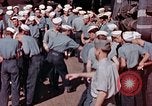
'A' bomb atomic bomb test on Able Day during Operation Crossroads at Bikini Atoll
'A' bomb test on Able Day during Operation Crossroads nuclear testing at Bikini Atoll. U.S. navy sailors aboard a U.S. Navy ship. Sailors practice shielding their eyes with hands and heads bent down. Admiral's flag, United States flag and signal flag can be seen. Mushroom cloud seen rising in the sky due to atomic bomb explosion. Sailors stand to watch impact.
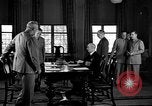
The chiefs of the U.S. Army, the U.S. Navy and the U.S. Air Force at a conference in Quebec, Canada.
Chiefs of Staff at a conference in Quebec, Canada. U.S. Army General George Catlett Marshall Jr. ; U.S. Air Force General Henry Harley Arnold; U.S. Navy Admiral William Daniel Leahy ; Fleet Admiral Ernest Joseph King, Commander in Chief of the United States fleet and others sitting around a conference table.
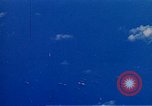
Operation Crossroads: Aerial view of "Able" nuclear weapon test
Aerial view of shot Able, the first test of the United States Operation Crossroads nuclear weapons tests in the Bikini Atoll. Bright flash followed by rising mushroom cloud after bomb explodes. Blast wave seen overtaking unmanned test ships in the ocean.
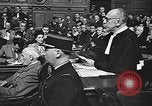
Prosecution witnesses Paul Renaud, Louis Moran, Albert Lebrun and Michel Clemenceau during Petain's trial in Paris.
Trial of Philippe Petain at Palace of Justice (10 Bd du Palais, 75001 Paris, France) in Paris, France. Petain's advocate Fernand Payen speaks. Spectators seated in the Courtroom. Advocate Mornett assails Philippe Petain. Prosecution witnesses Paul Renaud, Louis Moran, Albert Lebrun, and Michel Clemenceau in the Courtroom. Newspaper men report by phone to their newspaper office. Two girls on a telephone switch board. A newspaper journalist or reporter writes and types his report of the events on teleprinter and typewriter. The United States war correspondents.
CRITICALPAST.COM: About Us | Contact Us | FAQs - How to Order | License Agreement | My Account | My Lightboxes | Shopping Cart | Advanced Search | Featured Collections | Website Terms & Conditions | Privacy Policy ©2026 CriticalPast LLC.
License Agreement |
Terms & Conditions |
Privacy Policy
©2026 CriticalPast LLC.