


 Francais
 Deutsch
 Italiano
Refine Your Search
New Mexico United States 1946 stock footage and images
- Showing 1465 to 1470 of 30776 results more
more Hide
Hide
Importance of interstate highways in United States; Point of view shots of American highway system from a moving vehicle
Shining glass panels of a building on a road side. A road construction site. View of Interstate 91 (I-91) construction in Hartford Connecticut. Traffic moving on an interstate highway. A 36 story apartment in New York, above the Freeway leading from the George Washington Bridge. A highway with bridges. View of commuter bus terminal and George Washington bridge over the Hudson River in New York City. Many POV point of view shots of American highways as seen from a moving vehicle. Speaking about the new interstate highway system, narrator says, "Soon, traffic will flow smoothly, in, around, and between every major city and town in America. There will be no traffic tie-ups where the interstate goes. Driving time will become minutes for local trips, and city to city travel will be shorter by hours. The complete network will make it possible to drive coast to coast, city to city, without a stop light and without delays caused by heavy traffic." Many 1950s era cars and trucks are seen moving on the highway roads. View of interstate highway in Atlanta Georgia of southern United States, with exits to Interstate 75 and Interstate 85. Sign on interstate highway 580 near Hayward California. Traffic moving under a bridge. Road signs on highway for exit to Route 21 in North Carolina between Charlotte and Statesville. Cars moving on roads. Back of a truck moving on a highway. A restaurant on the side of a road. Children fishing in a body of water on the side of a road. A family sitting in shade enjoying a picnic during a road trip. People eating at a picnic table. Two young children drink from glasses.
Peacetime activities and contributions by the U.S. Army in the United States.
Scenes from Army Day on April 6, 1934. Secretary of War George Henry Dern, in broadcast to the nation about importance of the Army, in peacetime. Brief glimpses of the Yellowstone River lower falls and Old Faithful and Beehive geysers erupting in Yellowstone Park, Wyoming. View amongst log buildings in Reproduction of Army Fort Dearborn, at the 1933 Century of Progress Exposition in Chicago, Illinois. A pioneer wagon; Native American Indians in ceremonial regalia; antique locomotives and trains at the Exposition. Army General Leonard Wood being sworn in as the Governor General of the Philippines. Closeup of General of the Armies, John J. Pershing, America's highest ranking Military officer. Headquarters of Walter Reed Army hospital, in Washington, DC, named for U.S. Army Major Walter Reed, who confirmed that yellow fever is transmitted by mosquito. Acting on this, the U.S. was able to complete the Panama Canal. View of French dredging equipment sitting idle in the water after Yellow Fever prevented them from completing the Panama Canal. Closeup of U.S. Army General William C. Gorgas, who, in 1904, headed the Sanitary Department that controlled mosquitoes and eradicated Yellow Fever, so the Panama Canal could be finished. View of alligator in swamp near the Panama Canal. Photograph of George Washington Goethals, Chief Engineer credited with making the canal happen. Explosives employed in Panama Canal construction. Earth and rocks being loaded into open rail cars. A steamship transiting the Panama Canal. The Washington Monument; U.S. Library of Congress; and the Lincoln Memorial, cited as examples of accomplishments by U.S. Army engineers. The Wilson Dam, under construction by Army engineers, in Muscle Shoals, Alabama and system of levees being built to control the Mississippi River. The raging Mississippi River during 1927 flood. Flood victims being assisted by U.S. Army soldiers, at a tent camp, receiving food and clothing. An Army airplane flying over a forest fire. Army personnel supervising men in the Civilian Conservation Corps or CCC. Mail being loaded aboard an Army airplane, as airmail service is being opened between Washington DC and New York City. President Woodrow Wilson talking with Army pilot Major Reuben H. Fleet. Mail being loaded into the nose of an airplane. U.S. Army Douglas World Cruiser airplanes in flight, returning from their trip around the world in 1924. A pilot sitting in front seat of a Douglas O-38 airplane, pulls a fabric hood over his cockpit to practice "blind flying". View of the aircraft in flight, with instructor pilot in the open rear cockpit. Army aviators taking a camera and a rifle aboard their airplane as they prepare to leave on an aerial mapping flight. Aerial view of skyscrapers of Manhattan Island, New York City. Army Signal Corps personnel working on communications devices. A cable laying ship operating at sea, in support of the U.S. Army's Alaskan cable and telegraph system. Men loading chemicals into hoppers on Army crop dusting airplane. Several views of Army airplanes crop dusting. Glimpse of boll weevil, the target of their efforts. Closeup of Karl Connell, who as a major in the AEF, in World War I, invented a superior gas mask known as the “Connell” or “Victory” mask. A group of miners wearing gas masks enter a smoky mine entrance. The Army invented tear gas, which is shown being used to thwart a bank robbery, in a staged demonstration. Brigadier General Hugh Johnson, appointed by President Franklin Roosevelt, as head of the Great Depression era National Recovery Administration, or NRA, is seen about to give a speech. Narrator cites him as an example of U.S. Army officers who also serve the country in civilian life. Scene shifts to cadets on parade at the United States Military Academy, West Point, New York.
United States Army Air Corps winter mission before WW2.
United States Army Air Corps Douglas XC-32 military transport plane in flight after take off from Langley Field before WWII. Major General Frank Andrews and staff including Major George C. Kenny, inspecting a map onboard the XC-32. A radio operator in the XC-32 sends a message via morse code and voice. Ground radio operators in Concord, New Hampshire as command is heard on loudspeaker telling pilots to "simulate an air attack on the New York metropolitan area." View of a loudspeaker. Ground crewmen walking across snow-covered field in Concord New Hampshire with a Douglas YO-31A parked in background. Snow is falling on the airfield as crewmen uncover engine of a Martin B-10 bomber parked in a row with other bombers. A crewman in winter uniform carries a machine gun across snow-covered field toward a parked B-10. A gunner in a B-10 as nose turret turns. Crewmen looking in open bomb bay doors in the snow. Two crewmen turning propeller on a B-10 by hand while it is snowing. Two ground crewmen crank B-10 engine by hand to prime it in cold conditions. Engines on a B-10 are started. The snow is blown off wings of aircraft after the engine starts. Two ground crewmen pulling canvas covering off the wing of a B-10 in heavy snow. A Martin B-10 taxiing on snow-covered field. The B-10 taking off from snow-covered field. A Martin B-10 in flight.
Secretary George C Marshall makes a short speech,United States
Secretary George C Marshall climbs up steps of the State Department building (Old Executive Office Building, 1650 17th St NW, Washington, DC 20006, United States) in Washington DC. He enters State Department building. The Secretary makes a short speech about the responsibility he feels for his new post. Secretary Marshall sorting his speech papers in his office room. Flags of Department of Justice and United States are placed beside his desk.

Actors of African American theater unit perform 'Macbeth' under federal theater project at a theater in New York.
Employment for African Americans in the Great Depression provided by Works Progress Administration (WPA) Projects in New York, United States. Actors of Negro People's Theatre troupe perform in Shakespeare's play 'Macbeth,' (known as the "Voodoo Macbeth") directed by Orson Welles, at a theater in New York under the Federal Theater Project. Actor delivers dialog in the play, set in 19th century Haiti instead of Scotland. Body of Lady Macbeth (Edna Thomas) on floor. Fight scene in play with Maurice Ellis as Macbeth, slain by Macduff. Three witches and Macbeth and Macduff on floor. Witches hold cut head. Final scene of play finishes. Viewers clap as the curtains drop. Curtain raises and actors bow.
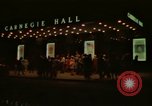
People in Carnegie Hall; various theaters and restaurants at night in midtown Manhattan Island, New York City.
People and buildings in Manhattan Island, New York. People in the Carnegie Hall (881 7th Ave, New York, NY 10019, United States). The Ed Sullivan Theater (1697 Broadway, New York, NY 10019, United States) with marquee, "Confidence. A challenging new TV game starring Alex Trebek". People in various theaters and restaurants at night. Automobile traffic. A man stands on a ladder in front of the marquee sign of the "Cinerama II" Theatre, advertising Connie Stevens in "Scorchy" (this is the RKO Warner Twin Theatre at Broadway and 47th Street).
CRITICALPAST.COM: About Us | Contact Us | FAQs - How to Order | License Agreement | My Account | My Lightboxes | Shopping Cart | Advanced Search | Featured Collections | Website Terms & Conditions | Privacy Policy ©2026 CriticalPast LLC.
License Agreement |
Terms & Conditions |
Privacy Policy
©2026 CriticalPast LLC.