


 Francais
 Deutsch
 Italiano
Refine Your Search
New Mexico United States 1946 stock footage and images
- Showing 15085 to 15090 of 30776 results more
more Hide
Hide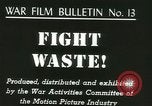
U.S. Government tells citizenry how they can help the war effort by living conservatively and avoiding waste, early in World War II
A public service informational campaign during World War 2 in the United States. A uniformed nurse tends to a U.S. Army Sergeant, Vincent Booth, who lost a leg during the African campaign of World War 2. He is in a wheel chair. The Sergeant speaks about the things that can be done on the home front to ration and help the war effort. As he narrates, a typical American family of three, father, mother, and youth in Boy Scout uniform, are seen sitting down at their dining room table. Missing is their daughter, serving as a WAC overseas (shown briefly in uniform) and their son, in the Navy (also shown briefly, in uniform). Scene shifts to the father at his work place. Narrator says he uses 10 percent of his weekly income to buy war bonds. The mother is seen at home with her Boy Scout son. She is writing letters to her son and daughter in the service. Change of scene shows her in a hospital, volunteering as a Red Cross Nurses aid. Next, the family members are seen in their home, characterized by the narrator as "an arsenal for victory," where they are being careful not to waste resources like electricity, home heating fuel, and cooking oils. They contribute their old metal objects to the war drive collections, and their son in the Boy Scouts participates in the local paper salvage drives. He is seen in Boy Scout uniform tying up a bundle of newspapers (with pictures of Hitler and Tojo on top which he dramatically stands on when tying the papers). They repair and use their old clothes, or contribute them to charities. The propaganda film ends summarizing ways that ordinary civilians can help the war effort, by rationing and avoiding waste at home, with on screen instructions: "Fight Waste! 1. Don't waste anything; 2. Buy only what is necessary; 3. Salvage what you don't need; 4. Share what you have."
Parents of Japanese-American soldiers who died serving in the U.S. army are awarded Purple Heart medals.
Parents of American soldiers of Japanese ancestry receiving awards in the United States, during World War 2. Parents of the Japanese-American soldiers seated at the ceremony. They are receiving Purple Heart medals for the soldiers who died while serving in the U.S. army. Narrator mentions "60 from Hawaii alone gave their lives." (The soldiers were likely from the 100th Infantry or 442nd Regimental Combat Team).
Testing, making of wire reels and carrying of reels to an anchorage during the Golden Gate Bridge construction in the U.S.
The construction of the Golden Gate Bridge spanning the Golden Gate in the United States. Cross sectional view of a cable. The strands forming cables are squeezed together. The cross sectional view of the strands of wire forming a cable. Workers work on steel wires. The wires are tested for elongation and other properties. The wires are carried in a barge to the construction site. Wire reels are hoisted up. The workers around the wire reels. A wire being pressed. The wires are joined through a sleeve. The wires in a sleeve are pressed to make a joint. The wire is stretched during a test. The wire breaks leaving the sleeve intact. The wire reels made in a factory. They are carried to an anchorage by a spinning wheel.
The use of wire ropes at different levels of construction and testing for use in the construction of a bridge in the U.S.
The construction of the Golden Gate Bridge spanning the Golden Gate in the United States. Workers put clamps over suspender ropes. Aerial view of suspenders clamped to the bridge. Ships sail past under the bridge. Scene changes to interior of an office building, with business men wearing suits and hat entering and exiting elevators. A pulley system in operation. Towers on a building under construction. A derrick lifting a railroad freight car. A coal loader at work. A hoist carries coal up a tower. Another hoist carries steel material. A wire rope on a spinning wheel. A massively large crane shovel loads giant boulders into a waiting railroad train car at a construction site. A steam shovel digs at a building foundation. A wire rope on rail tracks. A railroad on the tracks. A wire rope in a groove on the rail tracks. A worker operates a machine. Logs of wood being picked up by wire ropes. A machine in operation in water. A wire rope on a spinning wheel. A flat car on the tracks. A wire rope on pulleys. Men operate a hydraulic testing machine. A load carried on the wire rope. The rope on pulleys along the rail track. The wire rope subjected to a dead load and stretched. The wire ropes being finally measured and then cut on a large shear.
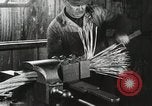
A wire rope subjected to tests and steel beams hoisted to support rope suspension during a bridge construction in the U.S.
The construction of the Golden Gate Bridge spanning the Golden Gate in the United States. The ends of wires are spread out. The wires are dipped in a solution to remove galvanizing. Workers place a socket over the wires. A worker pours molten zinc for sealing. A building. The rope is subjected to varying loads. The rope breaks. Two ropes combined are subjected to a load. The bridge suspended through ropes. A steel beam carried to the suspender end. A man stands on a steel structure carried by a crane to the installing position. The workers work on rope suspension. A steel beam carried to the installing position.
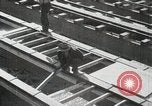
Construction of Golden Gate Bridge road surface, wires being wrapped on cables; and dismantling of temporary foot bridge.
The construction of the Golden Gate Bridge spanning the Golden Gate in San Francisco, California, United States. Workers place wooden planks and platforms for a roadway construction. The workers weld grill structures. A railroad on tracks. Concrete in a slab trolley. The concrete is poured on a grill structure. A leveling machine levels the concrete. The workers make markings on the concrete road. Wires are wrapped on a cable to make it water proof. The completely wrapped cable support the bridge. The workers dismantle the sections of the temporary foot bridge. A truck on the bridge.
CRITICALPAST.COM: About Us | Contact Us | FAQs - How to Order | License Agreement | My Account | My Lightboxes | Shopping Cart | Advanced Search | Featured Collections | Website Terms & Conditions | Privacy Policy ©2026 CriticalPast LLC.
License Agreement |
Terms & Conditions |
Privacy Policy
©2026 CriticalPast LLC.