


 Francais
 Deutsch
 Italiano
Refine Your Search
New Mexico United States 1946 stock footage and images
- Showing 1507 to 1512 of 30776 results more
more Hide
Hide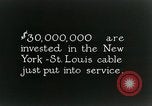
Telephone poles and lines scattered across a country side in United States.
Telephone poles and lines scattered across a country side in United States. The New York-Chicago telephone cable is joined at a celebration. Employees work at the long distance headquarters in New York.
Pan American Congress of Journalists view development in the automobile and road system in United States.
Delegates of Pan American Congress of Journalists travel and learn about the United States. A map depicting the route of the group from Washindton DC to New York, then to Detroit and again come back to New York. They observe gradual development in the automobile and road system. Cabs and caravan of buses pass under a bridge. Views of herd of gazing animals,people on horsebacks, a man ploughing the field with his horse,men using tools and men making wooden barrels.

Crashes showing pilots Lindbergh, Richard B. Byrd, Noel Davis and Stanton Wooster in the United States.
'The Epic American Trans Atlantic Flight' depicts crashes involving various pilots in the United States during early aviation history. Captain Charles A. Lindbergh. On September 21, 1926, Rena Fonck stands in front of his Sikorsky airplane, ready to try a solo flight across the Atlantic to Paris. He takes off and crashes in flames. Navy Commander Richard E. Byrd poses. On April 16, 1927, his Fokker C-2 trimotor airplane ("America"), piloted by Anthony Fokker, with Byrd, Floyd Bennett, and George O. Norville on board, flips over on takeoff at Hasborough, New Jersey. In September, 1927, Clarence Chamberlin in a Bellanca aircraft taxis and takes off. The tail and right main wheel dig into the soft field on landing and the airplane is severely damaged. The wreck of the "American Legion" Keystone Pathfinder airplane that carried Commander Noel Davis and Lieutenant Stanton Wooster to their deaths, in a crash landing, in the Back river, near Langley Field, Virginia, In Paris, on April 26, 1927, French pilot, Captain Charles Nungesser, and Francois Coli pose before taking off on their ill fated flight in a Levasseur PL8 aircraft named " White Bird." Charles Lindbergh standing next to his mother, Evangeline Land Lindbergh. The "Spirit of St. Louis" is towed out and refueled at Mineola, New York. Charles Lindbergh climbs into the plane and makes a bumpy takeoff. Bystanders watch. People gather to greet him upon arrival in Paris. Lindbergh poses with U.S. Ambassador to France Myron Herrick. Lindbergh honored by the French President Gaston Doumergue.
Construction of houses for people involved in defense activities and workers at industrial centers in the United States.
Film 'Homes For Defense' on the construction of homes for war workers under the Division of Defense Housing Coordination in the United States during World War 2. Houses constructed for soldiers and war production workers through the Federal Defense Housing Program. Houses for the people who construct planes, ships and guns for the protection of America. View of run down tenements and slum housing in a city or town. A car parked outside a house. Children stand near a fence outside the house. A map shows industrial centers. Men move to various industrial centers. Newport News: workers work on machinery for the Battle of Atlantic. Hartford: workers work on machine guns. Detroit: workers in an auto industry. Rock Island: workers in industry make coastal field artillery. Rolla Waynesville: army men at a training center. Corpus Christi: Army men at a new airfield to accommodate the expanding air force. Aircraft in flight. San Diego: workers construct planes in a factory. Signs of the various housing agencies that are doing a special job under the coordinated program.

Aaron Douglas, an African American painter, paints a mural and views murals with a woman in the United States.
A study of African American artists in sculpture, photography, painting, sketching, etching, writing and on antique in the United States. Aaron Douglas, an African American painter during the Harlem Renaissance, paints a mural. He stands on a ladder, working on his series "Aspects of African American Life." A woman with Aaron Douglas views the mural. Murals made by Aaron Douglas, seen hanging in the New York Public Library on 135th Street in Manhattan, New York City. He walks with the woman and is joined by Arthur Schomburg as they view Douglas' murals.
Major changes in lifestyle of the people in United States in the 1920s leading to economic prosperity.
Brief view of Mussolini in Italy wearing a top hat. Clip proceeds on theme of lifestyle of people in United States in the 1920s, also referred to as the "Roaring 20s". Pedestrians and various people on busy streets of New York City as cars and truck move past them. A woman gets her make up done in a makeup studio. A woman in flapper fashions smokes a cigarette. View of a line of women's legs all wearing silk stockings and shorter skirts than in prior times. Women in swimming suits at a beauty pageant. Federal agents smash liquor bottles and break up wooden barrels draining liquor to enforce prohibition. Gangsters killed in an encounter in the street. Gangsters, possibly mafia, being arrested and led away by police at gun point. Men and women perform Charleston dance. A bartender is seen mixing a drink. Men and women enjoy ballroom dancing at a night club. Closeup of a street sign for Wall Street. Brief view of crowds outside New York Stock Exchange building around time of stock market crash of 1929.
CRITICALPAST.COM: About Us | Contact Us | FAQs - How to Order | License Agreement | My Account | My Lightboxes | Shopping Cart | Advanced Search | Featured Collections | Website Terms & Conditions | Privacy Policy ©2026 CriticalPast LLC.
License Agreement |
Terms & Conditions |
Privacy Policy
©2026 CriticalPast LLC.