


 Francais
 Deutsch
 Italiano
Refine Your Search
New Mexico United States 1946 stock footage and images
- Showing 15325 to 15330 of 30776 results more
more Hide
Hide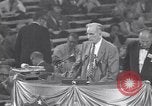
Kefauver is announced as Vice Presidential candidate at the Democratic National Convention in Chicago in Illinois
The 1956 Democratic National Convention at the International Amphitheater (4220 South Halsted Street Chicago, Illinois 60609 United States) in Chicago in Illinois, the Chairman declares the results for election of Vice-Presidential candidate. He announces a candidate's decision to withdraw in favor of Senator C. Estes Kefauver, as the representatives from various states cheer it loudly.
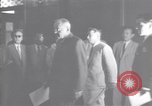
Signing of the US-Korean Mutual Defense Treaty by John Foster Dulles and Y.T. Pyun
United States Secretary of State, John Foster Dulles and Korean Minister, Pyun Young T'ao, sign the US-Korean Mutual Defense Treaty . After signing the papers they shake hands. Dulles is seen as he leaves the building, in the company of U.S. officials, including John Cabot Lodge who accompanies him in his departing car. Others exit the building including the U.S. Commanding General in Korea, Maxewll Taylor.who enters his own car and departs.
Signing of nuclear test ban treaty in Kremlin, Soviet Union
Soviet Premier Nikita Khrushchev enters a room with minister Andrei A. Gromyko in Kremlin, Soviet Union. Minister Gromyko, Lord Alec Douglas-Home of Great Britain and United States Secretary of State, Dean Rusk sign nuclear test ban treaty as Hubert Humphrey and Adlai E. Stevenson look on.
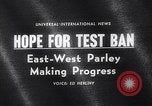
Chairman Nikita Khruschev and Averell Harriman for nuclear test ban talks.
U.S. Under-secretary of State Averell Harriman and Chairman Nikita Khrushchev and Britain's Lord is at the Opening session as the United States, Britain and Russia meet for atom test ban talks. View of the dignitaries discussing.
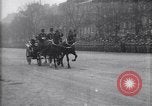
Reception for President Woodrow Wilson in Paris following World War I.
United States President Woodrow Wilson in Paris, France after World War I. A horse-drawn carriage on the road and crowd lined up on sidewalks. President Wilson, Secretary of State Robert Lansing, General John Pershing, and Peace Commissioner Henry White on horse-drawn carriages leaving. The crowd waving hats and cheering for the visiting Allied leaders.
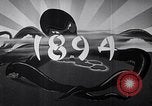
The Rise of Japanese militarism in the 20th Century
Film opens showing reenactment of Japanese attack ostensibly against Formosa, in 1894. Japanese troops and artillery are shown. The event is depicted in a critical political cartoon. Next, Japanese Admiral Heihachiro Togo is seen in 1904, standing with other naval officers. Then, Japanese warships are shown, firing barrages of naval gunfire at the Russian fleet in Port Arthur, Manchuria. Huge black clouds arise from burning ships. Scenes of Japanese people celebrating their naval victory. Date shifts to 1910. Cartoon depicts Japanese annexation of Korea. Cartoon illustrates Japanese actions in World War I when, siding with the Allies, Japan acquired the German-held Shandong (Shantung) Peninsula of China, as well as German-held Marianas, Carolines, and Marshalls islands in the Pacific. Japanese representatives are seen participating in Post World War 1 international activities. They signed the so-called Five-Power,Four-Power, and Nine-Power treaties, and participated in the League of Nations. Glimpse of two Japanese officers, followed by cartoon depiction of the Mariana, Caroline, and Marshall Islands, that Japan insisted on keeping. Cartoon shows them being fortified. A Japanese military marching band parades down a city street while being cheered by spectators on the sidewalks. Next, Japanese military General, Baron Tanaka Giichi, is seen in uniform with other officers. Cartoon illustrates the so-called Tanaka Memorial document that Baron Tanaka allegedly presented to the Emperor, in 1927, outlining a strategy to conquer the world. Cartoon then illustrates plan of conquest by acquiring Chinese manpower; Manchurian iron and coal; Siberian timber, coal, wheat, and metals; Tin,oil and rubber from Malaysia and the East Indies. The United States is shown as the last conquest. Views of ordinary farm and factory activities in the U.S. Cars parked in the Ford Motor Company factory lot. Japanese officials and legislators meeting in the Diet (Parliament). Japanese theater patrons and a Japanese woman singing with an American-style band, are shown as examples of activities the Japanese Government sought to discourage. A Japanese female ensemble in traditional dress, playing traditional instruments, is shown as more desirable. Western dancing and western hollywood movies are shown and narrator states they were forbidden by the Japanese government. Japanese movie scene depicts ancient martial arts. A musical production on stage displays German Nazi swastika flag , Japanese rising sun, and symbol of Kingdom of Italy, celebrating the axis alliance. Japanese men are shown playing the ancient game of Chu Shogi, instead of playing Western card games. People are shown in a library, where Western books are replaced by more militaristic tomes, such as: "If we fight" by Admiral Shinsaku Hirata, March 15, 1930 (shown on film slate). Slate goes on to quote about attack on Hawaii as the first battle in war of the Pacific. Film cites another approved Japanese publication: "Arguments Against American Policies" by Kawashima Seichiro, Christmas Day, 1924. It discusses distruction of the American fleet and subsequent landing on the U.S. West Coast.
CRITICALPAST.COM: About Us | Contact Us | FAQs - How to Order | License Agreement | My Account | My Lightboxes | Shopping Cart | Advanced Search | Featured Collections | Website Terms & Conditions | Privacy Policy ©2026 CriticalPast LLC.
License Agreement |
Terms & Conditions |
Privacy Policy
©2026 CriticalPast LLC.