


 Francais
 Deutsch
 Italiano
Refine Your Search
New Mexico United States 1946 stock footage and images
- Showing 15781 to 15786 of 30776 results more
more Hide
Hide
American artists Gutzon Borglum and Lincoln Borglum sculpt the Rushmore Memorial.
Children build sand castles on a beach. Artist Gutzon Borglum working in his studio and later on site building the Mount Rushmore Memorial. His son, Lincoln Borglum, is also pictured and interviewed about the project. Footage of the actual carving efforts is shown. The sculpture of the Mount Rushmore Memorial shows face sculptures of George Washington, Thomas Jefferson, Theodore Roosevelt and Abraham Lincoln in South Dakota, United States. The American flag over the face of Abraham Lincoln's sculpture. Tourists view the Rushmore Memorial.
World War 2 U.S. aircraft bombing scenes; Strategic Air Command Headquarters at Offutt Air Force Base, Nebraska
History and scenes related to the U.S. Air Force Strategic Air Command (SAC). Wheat crop blowing in wind and abandoned harvesting machinery in fields of Nebraska. World War II aerial view of several U.S. Army Air Force B-17 bombers in formation flight. Tail Codes of "triangle C" identify them as belonging to the 303rd Bomb Group (H), 1st Air Division, 41st Combat Wing Eighth Air Force, based at RAF Station, Molesworth, England. A closeup shows B-17,tail number, 41-24416 of the 358th Bomb Squadron. (Its name, "Black Diamond Express,"is not seen.) Lettering on side of one of the B-17 aircraft includes word, "Doodle". View of bombardier using bomb sight in aircraft during bombing run.. Aerial view of buildings on ground. Close up as bombardier completes settings and pulls lever. Bombs away view as bombs are dropped from open bomb hatch toward industrial target. View from aircraft as bombs hit industrial buildings and massive explosion as buildings in target zone are destroyed by B-17 bombing during World War II. Dramatic view of smoke, and rubble soaring upward toward camera on aircraft. View on ground of bombs hitting target and workers in an oil tank and marshaling yard area rushing to assist after damage from U.S. bombing campaign in World War 2. Fire fighters try to extinguish fire. Wreckage due to bombing. Damaged rail lines and trains. U.S. Army Air Force B-29 aircraft in flight as seen from air. POV B-29 bomber from pilot seat area looking forward at bombardier and nose of aircraft. View of bomb door hatch open on B-29 and release of an atomic bomb similar to "Little Boy" atomic bomb that destroyed Hiroshima. View of a massive atomic bomb explosion. Smoke rises from nuclear bomb blast. Views from cameras used in atomic tests showing buildings and equipment at moment of impact. Massive wind and immediate destruction from atomic blast wave. Sweeping views of undeveloped land near SAC HQ at Offutt AFB, and views of the Headquarters of Strategic Air Command, United States Air Force. A Minuteman missile standing near the building. Point of view from visitors entering the headquarters, as an an air policeman directs them. Insignia of SAC (Strategic Air Command) on the wall. Identity card of visitor matched. Model of airplane. Guards checks the Identity card of visitor and opens door
Delegates from Pan American Highway commission pass by Kingsley Bridge and Nicholson Bridge in Pennsylvania
Official cars transporting delegates of the Pan American Highway Commission pass by two arch bridges in Pennsylvania during a United States tour. One bridge is the Kingsley Bridge (Martin Creek Viaduct) and the other is the Tunkhannock Viaduct known as the Nicholson Bridge. It is the largest concrete bridge in the world. It spans Tunkhannock Creek in Nicholson, Wyoming County, Pennsylvania. A man walking along the sides of the road is seen.
Brig Gen William Mitchell and Capt Moffet observe aerial bombing experiments on submarine U-117 and destroyer G-102.
Experiments on the aerial bombing of water crafts off Virginia Capes in the United States. C-Class airship (blimp) on mooring mast and in flight over the water. Bombing crews gathered in field for briefing. Mass takeoffs of SE-5A scout planes, a 2 seater DeHaviland-4B and Martin Bombers NBS-1. U.S. Navy battleship of the Atlantic Fleet watch the maneuvers. Bombing observation ships, the seaplane tender USS Shawmut and transport USS Henderson at sea. 4 ex-German vessels - The submarine U-117, destroyer G-102, cruiser Frankfort, and battleship of the First Class the Ostfriesland at sea. Brigadier General William Mitchell observes the bombing from a DH-4 while U.S. Navy's Captain Moffet observes from a USN NC-8. June 21, 1921: The bombing begins with starting shots on the U-117. Three 163lb HE bombs dropped on the submarine. The submarine half submerged and its debris on the surface after sinking. July 13, 1921: The destroyer G-102 bombed by an Army aircraft. Smoke from the explosions.

Mrs. T.D. Robinson christens the 5th USS Lexington, at Fore River Shipyard, Quincy, Massachusetts
Launch of the aircraft carrier USS Lexington (CV-16) in World War 2 at Fore River Shipyard, Quincy,Massachusetts, United States. The decorated aircraft carrier stands in the dock. A sign reads 'The navy wants this ship to replace the Lexington. Let's go. Fore River!' Several sailors who served on the 4th USS Lexington, are present for the launching. Mrs. T.D. Robinson, who also christened the 4th USS Lexington, does the honors for the newest one, and the aircraft carrier glides down the ways into Boston Harbor.
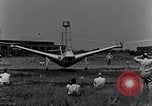
U.S. Air Corps XR-1 helicopter in preliminary testing at Eddystone, Pennsylvania
U.S. Army Air Corps XR-1 helicopter undergoing preliminary tests in a field at the Platt-LePage Aircraft company's plant in Eddystone Pennsylvania, United States. The pilot uses power only sufficient to allow the helicopter to break ground by a foot or less. Company technicians manually move the XR-1 helicopter into a hangar following the tests.
CRITICALPAST.COM: About Us | Contact Us | FAQs - How to Order | License Agreement | My Account | My Lightboxes | Shopping Cart | Advanced Search | Featured Collections | Website Terms & Conditions | Privacy Policy ©2026 CriticalPast LLC.
License Agreement |
Terms & Conditions |
Privacy Policy
©2026 CriticalPast LLC.