


 Francais
 Deutsch
 Italiano
Refine Your Search
New Mexico United States 1946 stock footage and images
- Showing 15823 to 15828 of 30776 results more
more Hide
Hide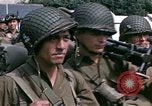
War correspondents board Landing Crafts along with 101st Airborne Troops in South England (WW2)
War correspondents board crafts on the South England coast shortly before D-Day Invasion in World War II. The correspondents film United States 101st Airborne Division troops marching towards Landing Crafts at the docks. They carry grenades and bazookas. Soldiers board Landing Crafts. The heavy crafts have to be pushed off the docks by military trucks. The troops are taken to larger crafts and ships further into the water. Soldiers pose for the camera. A fleet of ships and Landing Crafts Infantry (LCI) in the water. The correspondents with Commander of the invasion group Lt. Patton and the Captain of the ship, LCI number 5. A correspondent shows his camera to an officer. War correspondent Wes Hanes trims his beard.

B-17 Flying Fortress bombers strike Berlin and return to England some badly damaged (WW2)
United States bomber aircraft during first day light raid on Berlin during World War II. Bombers leave condensation trails in the sky while flying in formation toward Berlin. Views of American soldiers in aircraft. Aircraft drop bombs. Smoke arises due to explosion. B-17 aircraft in flight. Return of damaged B-17 bomber. American soldiers stand on and around a B-17 bomber after the bombing run.
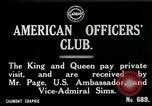
King George V visits American officers club in England during World War I.
During World War 1, King George V and Queen Mary visit American officers club and are received by Mr Walter Hines Page, United States ambassador, and Vice Admiral William S Sims in England. Officials stand at the stairs. Car arrives at a building. Guard salutes. Flags at the balcony. King enters a door with the officials. Crowd gathers and a dignitary addresses them. King and the ambassador stand and pose.
U.S. Army Air Forces repair and re-fly a battle-damaged B-17 after an emergency forced landing in World War II
Film opens showing a large formation of U.S. Army Air Forces B-17 bombers flying high overhead as they return to bases in the United Kingdom, during World War 2. Closeup of one plane shows Triangle tail code of the 97th Bombardment Group, and tail number 42-23383. View looking past tail tunner turret towards numerous aircraft in a formation. Scene shifts to view from a B-17 of black flak clouds from German anti-aircraft guns. A B-17 in flight with flak damage to a wing, and another with a destroyed left tail stabilizer and elevator. Closeup of feathered right inboard engine on a B-17 in flight. More views from behind the formation, and looking straight up at passing B -17s overhead. View looking down at a B-17 approaching for landing. Closeup of both right engines feathered on a B-17 in flight. (Narrator states an aircraft named "Stella" had three engines inoperative and was unable to reach the field to land.) Army Air Forces controllers communicating by radio with crews of aircraft. View from ground of the B-17 ("Stella") coming in for a crash landing in an oat field, with landing gear not extended. Closeup from cockpit, of number 3 engine running and number4 feathered. View from inside the aircraft as it crash lands. View of it in the field. It displays tail number 42-5910 and a "G" tail code in a white triangle, identifying it as belonging to the 40th Bombardment Wing, 305th Bomb Group at RAF Grafton Underwood Trucks are seen carrying mechanics and technicians to the crash landing site. Next, the B-17 is seen surrounded by repair crews. It is sitting in a cleared area and its landing gear is intact. Closeup of the aircraft's flak torn fuselage. A severely damaged gun turret on the ground next to the aircraft. Section of cockpit sitting on the ground. Views of mechanics working in their portable shops as they make repairs to the B-17 aircraft. Machinist running a lathe in one of the portable shops.View from ground of the mechanics at work on the aircraft's engines, as engineers employ earth-moving equipment in the background to create a temporary runway to facilitate takeoff. Closeups of the earth-moving equipment at work. More closeups of mechanics working to restore the aircraft. Some work on an engine suspended from an A-Frame. Closeup of two mechanics, one of whom displays images of a Lockheed P-38 lightning fighter aircraft and a B-26 Marauder aircraft on his jacket. More views of eath-moving operations. Closeup of a mechanic being moved by crane as he guides a propeller into place on the B-17. Closeups of mechanics affixing propellers on the plane. View of engineers employing surveying instruments as they ready the emergency strip for the B-17's takeoff. Closeup of the aircraft ("Stella") surrounded by seated mechanics, as she is about ready to fly again. View from behind spectators, including local English people, as the aircraft engines start. The repaired B-17 taxis onto the improvised air strip, and raising lots of dust as she takes off. Glimpse of local people waving as the aircraft becomes airborne.
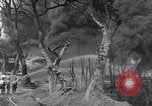
British soldiers fight fire at a bombed oil supply depot near their base in England, during World War II.
United States soldiers at a base camp in England, prior to D-Day invasion in Normandy, France during World War II. Immense smoke rises off a bombed oil supply depot. British soldiers use chemical foam apparatus to fight fire at the oil depot. Flames come out of a building on fire.
British and U.S. soldiers build dikes to fight fire at a bombed oil supply depot near their base in England, during World War II.
Flames and smoke rises off a bombed oil supply depot near base of British Army, during World War II. A building nearby catches fire and British soldiers and firemen use chemical foam apparatus to fight fire of the building. Bulldozers smother fire and build dike to hold back flaming oil. One bulldozer operated by a British officer and another by a United States Seebee officer.
CRITICALPAST.COM: About Us | Contact Us | FAQs - How to Order | License Agreement | My Account | My Lightboxes | Shopping Cart | Advanced Search | Featured Collections | Website Terms & Conditions | Privacy Policy ©2026 CriticalPast LLC.
License Agreement |
Terms & Conditions |
Privacy Policy
©2026 CriticalPast LLC.