


 Francais
 Deutsch
 Italiano
Refine Your Search
New Mexico United States 1946 stock footage and images
- Showing 1591 to 1596 of 30776 results more
more Hide
Hide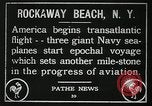
Curtiss NC aircraft being prepared for flight and the crew gets ready in New York for the first transatlantic flight.
Preparations before the first transatlantic flight from New York, United States.. A United States Navy flying boat Curtiss NC stationed. Aircraft in front of a hangar. Three aircraft on ramp being prepared for flight. A sailor hands supplies to a man in the cockpit. Men climb down from an aircraft. Naval officer walks in front of men of the Aero Oceanic Cruise standing in attention and shakes hands with them. A group of military men salute. Commander of the USS Langley (CV-1) John Henry Towers. Curtiss NC-3 taxis on water. Curtiss NC-4 with engines warming up as the aircraft taxis on water. Curtiss NC-1 taxis on water. Curtiss NC-1 in flight.
U.S. President Franklin D Roosevelt and Governor of Kansas Alfred M Landon arrives at Town Hall in New York to cast their vote.
United States Presidential election in New York. Civilians lined up to cast their votes outside the Town Hall. Inside the hall men at desk help the civilians in casting votes. President of the United States Franklin D. Roosevelt arrives at Town Hall to cast his vote. Governor of Kansas Alfred Mossman Landon gets off a car at Town Hall. He casts his vote. President addresses the gathering after his victory. Large crowd at the Times Square to cheer and congratulate winner.
President Woodrow Wilson and other dignitaries draw draft slips at New York Herald's office in New York, during World War I.
U.S. President Woodrow Wilson talks at New York Herald's office in New York, United States, in World War 1. Headlines of the newspaper 'The New York Herald'. Draft slips enclosed in gelatin capsules are put into a glass bowl. Woodrow Wilson's eyes are covered with a blindfold. Wilson draws a draft number from the bowl. Other dignitaries also draw draft numbers one by one in the same fashion. The draft slips read and result declared. Man writes results on a New York Herald's Bulletin Board. People gather in large numbers to see the results. Men raise their hats and cheer after knowing the results. U.S. flags hung outside New York Herald's building. (WWI; WW1)
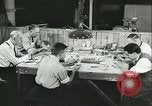
WPA workers build a massive scale model of New York City; also WPA art, library, and theater programs
Works Progress Administration (WPA) projects in New York City during the Great Depression. Skilled architects, draftsmen, and artists work for the WPA on a massive scale model of New York City, built in cooperation with New York University (this model predates the famous Panorama of New York City model built for the 1964 World's Fair). An artist is seen leaning over part of the model painting one of its features, which include detailed roads, bridges, buildings, and waterways. A hand lifts a building and measures its base with a ruler. Cartographic Survey WPA workers are seen creating a relief map of Staten Island for educational use. Men and women artists, including sculptors, are seen creating new sculptures funded by WPA. A man carves a bust in an art studio or class. Another man carves a relief stone commemorating Dewitt Clinton. A man stands in a Free Library and looks at books. Two women on a park bench look at books from the WPA Free Library holdings. A skilled artist is seen laying out and buildings stained glass windows for the United States Military Academy at Westpoint in New York. Stained glass panels depicting George Washington and soldiers are seen. A series of the George Washington stained glass windows is seen in place, with the artist applying final touches. Men work on the Federal Theater Project. Billboard signs advertising various WPA funded theatre productions in 1936 are shown, including Jefferson Davis, The World's Greatest Circus, Taking the Air, The Mikado, Macbeth, All American Minstrels, Battle Hymn, and Horse Eats Hat.
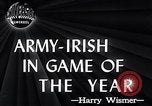
Football game between Army and Notre Dame ends in a tie at Yankee stadium,New York
A newsreel titled ' Army-Irish in game of the year' shows spectators entering the Yankee stadium to witness a football game between Army and Notre Dame in New York,United States. Spectators include Major General Taylor,Secretary of War,Patterson,Post Mater General, Academy superintendent and West Point Cadets. The two teams battle it out in a major game which finishes off in a tie.
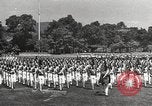
An officer awards West Point cadets and they march on the completion of their graduation at the academy grounds in New York.
The graduation of West Point cadets in New York, United States. The cadets gather at the academy grounds. They march in formation. They hold rifles. Trees in the background. An officer awards and congratulates some of the cadets on their achievements. The cadets stand in formation. A statue on the ground. Officers and a dignitary come near the statue and place a wreath. The officers take off their caps and bow. The cadets march. They take off their caps. A flag flutters from a flag pole.
CRITICALPAST.COM: About Us | Contact Us | FAQs - How to Order | License Agreement | My Account | My Lightboxes | Shopping Cart | Advanced Search | Featured Collections | Website Terms & Conditions | Privacy Policy ©2026 CriticalPast LLC.
License Agreement |
Terms & Conditions |
Privacy Policy
©2026 CriticalPast LLC.