


 Francais
 Deutsch
 Italiano
Refine Your Search
New Mexico United States 1946 stock footage and images
- Showing 17347 to 17352 of 30776 results more
more Hide
Hide
German prisoners march towards the stockade in France.
German prisoners of war during World War I in France. Prisoners of war march in large numbers on the battlefield. French soldiers march along with them. Some soldiers on horses, horse-carts, military vehicles and bicycles. Prisoners are marched to the stockade. Trees in the area. United States flag flutters on a flag pole.

Japanese prisoners of war in a stockade in Philippines (WW2)
Japanese prisoners of war in Philippines during World War II. The captured Imperial Japanese Army soldiers stand in a stockade. Trees in the background. A United States soldier questions them while another stands on guard. Young and old Japanese prisoners of war are seen.
The launching of the first pilot-less aerial torpedo at Carlson Field in Arcadia, Florida.
A review of research and development in guided missiles by the United States Air Force from 1919 to 1948. A civilian technician assembles first pilot-less aerial torpedo at Carlson Field, in Arcadia Florida. A launching track and gear. Technicians work on the missile beneath camouflaged netting. Attempted launching of the missile results in a crash due to track failure. The missile is launched and takes off. First successful launching of the aerial torpedo on October 24, 1919. The missile crashes immediately after the take off. First successful flight on October 2. Aerial view of hangars and airstrips of Wright Field in Ohio during early 1940s.

Take off of the General Motors GM A-1 'Bug' missile from a launching automobile in Muroc, California.
A review of research and development in guided missiles by the United States Air Force from 1919 to 1948. General Motors power-driven bomb (GM A-1 Bug), number 9 on tail, in Muroc, California. Technicians work on the same. The bomb is raised into position for attaching to the launching automobile by means of a hoist on a truck. The missile is nick named the 'Bug'. Technicians work at the automobile being driven beneath the suspended missile. The missile is radio controlled. The automobile specifically built for the launch of the missile is powered by two 165 HP Cadillac engines attached to a single drive shaft. Attaching the 'bug' missile to the launching car. The tractor and the hoist are removed. The automobile is driven across terrain at Muroc. A testing station for testing radio control section of aircraft during test. A technician checks over the radio equipment and shows television camera and equipment used for test. The automobile start at a high speed across the launching strip. Take off of the missile from the automobile. 'Bug' missile in flight. Views from a control aircraft beside the GM A-1 Bug while the Bug is in flight. (World War II period).
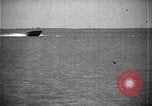
A-3 water missile moves across water in the European Theater.
A review of research and development in guided missiles by the United States Air Force from 1919 to 1948. Type A-3 water born missile move across water. The missile is a radio controlled motor launch. A-3 radio controlled motor launch maneuvers about on the water surface.
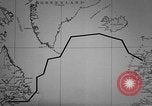
U.S. Coast Guard operations in Greenland prior to U.S. involvement in World War II. Cryolite mine. German weather station
Chart showing U.S. Coast Guard routes across the North Atlantic during World War Two. Scenes of the rugged Greenland landscape. Views of the Greenland Cryolite mine. A U.S. Coast Guard Cutter berthed at the pier near the mine. Greenlanders working in the open pit cryolite mine with jackhammers and steam shovels. U.S. Coast Guard officers seated, conferring with Danish Naval officer. James K. Penfield, first United States consul in Greenland looks on and interjects a comment, while pointing at a map. Supplies being transferred to a Greenland small boat. Two German meteorologists pose by their small weather station. German flag seen in background. View inside the German weather station, shows instruments, clip boards, weather maps, and radio equipment.
CRITICALPAST.COM: About Us | Contact Us | FAQs - How to Order | License Agreement | My Account | My Lightboxes | Shopping Cart | Advanced Search | Featured Collections | Website Terms & Conditions | Privacy Policy ©2026 CriticalPast LLC.
License Agreement |
Terms & Conditions |
Privacy Policy
©2026 CriticalPast LLC.