


 Francais
 Deutsch
 Italiano
Refine Your Search
New Mexico United States 1946 stock footage and images
- Showing 1771 to 1776 of 30776 results more
more Hide
Hide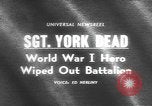
Past events show the life of U.S. Army Sergeant Alvin Cullum York after he passes away in the United States.
U.S. Army Sergeant York passes away in the United States on September 2, 1964. Scenes from the life of Sergeant York. Alvin York seen flashing the 'V' for victory sign. York in the front yard of his home. Newspaper headline reads, 'War with Germany.' World War I newly drafted men in civilian clothing marching along with tags pinned to their civilian clothes. World War 1 new recruits undergoing physical examination as they enter the U.S. Army. Soldiers standing in formation learning to drill. Closeup of front of artillery piece as it fires. Trench fighting against the enemy on a World War I battlefield. A soldier hurls an explosive toward no man's land. Soldiers rushing out of trenches going "over the top" to charge the enemy. Sergeant York in uniform during WWI. Later in life, Sergeant York is seen seated in a car with his wife as photographers scramble to take photos. Sergeant York at the White House with his family. York receives a citation from the Gold Star Mothers Club and then gives a short speech.

JB-2 robot bomb produced and test launched in the United States during WW2.
Manufacture and testing of a new robot bomb in the United States: A Republic Aviation and Ford Motor Company collaboration known as the JB-2 Loon, modeled after the German V-1 flying bomb. Interior of a war production factory. Worker welding part of bomb frame. Workers wheeling completed bomb fuselages on wheeled platforms in the plant. Closeup of an African American man wheeling a bomb. Henry Ford II and Ray Rausch, of Ford Motor Company, who oversaw the production of the pulsejet engines for the JB-2 bomb. Men working for the construction of the robot bomb. Closeup view of engine being fired on a test stand. Men and women war production workers at the Willys-Overland production plant in Toledo, Ohio are seen working on the interior components of the flying bomb, then closing the completed fuselages, and attaching the wings to the flying bomb. Engineering officers from the Army Air Forces Air Technical Command inspect a completed JB-2 flying bomb. View of a test launch o the bomb from a sandy beach area. The bomb engine fires and the bomb launches out over ocean waters, dropping its auxiliary launching apparatus beneath it, close to shore.

Men taking measurements of recruits for uniforms and shoes at a training camp in the United States.
A training film in the United States depicts training of soldiers in the army. A U.S. flag on a building. New army recruits seated in the hall. An officer addressing them. The army recruits taking the oath of the army. They arrive at a training camp. The recruits standing outside buses and officers instructing them. They march towards camp buildings. A board outside a building reads: 'Infirmary'. The recruits enter the building. Their physical examination is conducted. The recruits march towards another building after their physical examination. A board outside the building reads: 'Insurance and Allotments'. The recruits seated in chairs outside the building. An officer instructing them. They are given papers. The recruits reading the papers. Men taking fingerprints of the recruits for their routine records. The recruits lined up outside a building. Men taking measurements for their uniforms inside the building. Measurements for shoes are also taken. A board reads: 'Here Stands the Best Dressed Soldier in the World'. A recruit putting on his uniform. (World War II period).
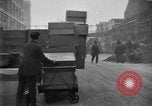
Safety precautions by workers in factory settings in the United States, to ensure safe labor conditions.
Safety measures to be undertaken while working. Boxes are loaded in a hand truck in the United States beside a warehouse. The boxes fall on a passerby due to being carelessly loaded on the hand truck. A worker carefully lines up the boxes on the truck. Inside a factory plant, a worker rolls up the sleeves of his shirt before operating a large drill press in the factory. View of a large platform machine being operated by a giant pulley. A foreman views the pulley and the worker stops the machine. The pulley is disengaged and a man approaches with safety barricade pieces to place around the pulley while it is worked on. Slate indicates, "Cyanide is valuable in treating steel, but it is dangerous to the eyes. Use goggles and be safe. A worker working without goggles is then seen near a furnace. He covers his face with his hands and runs away from the furnace. A maintenance worker partially disassembles and then attaches a new guard over a large grinding wheel in a factory.
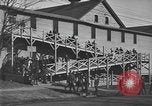
Recovering WW1 U.S. Army soldiers come out of a building and operate various machine tools and equipment in the United States.
Wounded and recovering veteran soldiers in the United States learn new skills and practice physical therapy after World War 1. Exterior of a building. Recuperating U.S. Army soldiers accompanied by nurses leave the building by way of a long ramp. Vehicles drive past the building. Interior of an office. An assignment officer interviewing soldiers. The soldiers operate machine tools and a pedal-driven saw. A man with bandaged eyes making wicker furniture. A display of lamps and other small articles. Disabled veterans walk along a hallway. Men exercising in a gymnasium. A photographer sets up a studio portrait of a soldier.
Uses of dynamite for agriculture, digging ditches, exploding buildings and breaking ice jams in the United States.
A film on uses of dynamite in the United States. Use of explosives for advancement of agriculture. An area is cleared for agriculture by exploding it with dynamite. Smoke rises from the explosion. Men watch the explosion. A ditch is dug with the help of dynamite. An old church building is exploded with dynamite to make a new building. Smoke rises from the explosions. Ice jams are broken by exploding.
CRITICALPAST.COM: About Us | Contact Us | FAQs - How to Order | License Agreement | My Account | My Lightboxes | Shopping Cart | Advanced Search | Featured Collections | Website Terms & Conditions | Privacy Policy ©2026 CriticalPast LLC.
License Agreement |
Terms & Conditions |
Privacy Policy
©2026 CriticalPast LLC.