


 Francais
 Deutsch
 Italiano
Refine Your Search
New Mexico United States 1946 stock footage and images
- Showing 19249 to 19254 of 30776 results more
more Hide
Hide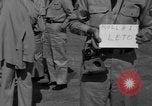
Film shot by U.S. Air Force personnel during visit to Cuban Air Force base at Campo Columbia near Havana, Cuba in January, 1953
Scenes of Cuban Air Force Base and headquarters, at Campo Columbia near Havana, Cuba, and aircraft acquired from the United States Air Force. Film opens with U.S. Air Force sergeant photographer holding a slate marked roll #1, LETO. He is dressed in starched khaki uniform. Other U.S. Airmen stand behind him. Scene shifts to a North American T-6 trainer airplane, Number 119, with skin removed from forward fuselage. A maintenance stand and tools are positioned in front of the aircraft. Hangar number 3 sits behind the T-6. The camera pans right showing two bubble-top P-47Ds parked on the ramp. The first displays number 458 (One of twenty-nine P-47s purchased from the USAF in the period, May, 1952 through June 1953). Work is being performed on the engine of the other. Camera panning right shows another T-6. Also seen is a Lockheed C-56 Lodestar (Lockheed Model 18) that was purchased in 1950 and numbered CU-EDU 2. It is parked in front of a low building with parapets and a flag flying atop it. A large multistory Headquarters building, topped with a control tower is seen in background. Closeup of another P-47 parked on edge of ramp, with its tail in the grass. Camera is moved back showing P-47s and T-6s on ramp in front of the headquarters building. Next, several U.S. Airmen are seen walking across the ramp towards the operations office on ground floor of the Headquarters building. More views of P-47s and T-6s plus a Consolidated PBY 0A-10 Catalina amphibious aircraft parked on the airfield. Several C-47 (DC-3) transport aircraft are seen at the end of the film.
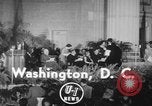
President Harry Truman is principal speaker as National Council of African American women honors Doctor Bunche in Washington D.C.
African American women honors Ralph Johnson Bunche in Washington D.C., United States. U.S. President Harry S. Truman, seated to attend the program as a principal speaker. National Council of African American women honors Doctor Bunche for his services as mediator in Palestine. National Council members and audience applaud. African American women greets President Truman.
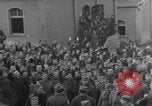
Group of US, Czech, Russian, Yugoslavian prisoners cheering, waving and laughing at liberation of OFLAG XIII-B Camp Hammelburg (WW2)
Freed Allied prisoners of war at OFLAG XIII-B, known as Camp Hammelburg, outside of Gemünden, Germany during World War II. A group of United States, Czech, Russian, Yugoslav prisoners of war standing together along with the liberating 14th U.S. Armored Division soldiers. Two prisoners talk to each other. The prisoners cheering, waving and laughing. Two prisoners walk down the road smiling; one waving a copy of Yank Magazine, the other a chunk of bread. U.S. Amry M-4 tank crashes through barbed wire fence of Camp Hammelburg. A group of freed prisoners gathers. Several prisoners stand and pose. Mass gathering of elated former prisoners. Freed prisoners of war dash toward U.S. soldiers and embrace them. (Note: This was the conclusion of the originally failed "Operation Hammelburg", initially attempted by "Task Force Baum," under Captain Abraham Baum, ten days prior. Inmates at the camp included the recently injured and captured Captain Baum, and Lieutenant Colonel John K. Waters, son in law of U.S. Army General George Patton. LTC John Waters was injured during the initial rescue attempt 10 days prior and was hospitalized and not seen in this film.)

MPs rubber boats transport German Pow and U.S. soldiers running through streets of town in Gemunden, Germany (WW2)
14th Armored Division (United States) in Gemunden, Germany during World War II. Soldiers with rifles are in position. U.S. MPs rubber boats transport German Pow (Prisoners of war) from opposite side of river. U.S. soldier kicks German soldier to hurry him along. German prisoners standing with hands up. U.S. soldiers running through streets of town. Houses are in flames in the background.
Soldiers move down street, break doors and windows of buildings in search of snipers in Gemunden, Germany.
14th Armored Division (United States) in Gemunden, Germany during World War 2. Soldiers move down street, break doors and windows of buildings in search of snipers. Buildings in flames and smoke rising in the background. Ruins of buildings and fire burns. Soldiers capture a sniper. Sniper is being walked under guard by U.S. Army soldiers.
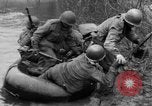
Soldiers get out of rubber boats, race across field, through farmyards and into village of Gemunden, Germany.
14th Armored Division (United States) in Gemunden, Germany. Soldiers get out of rubber boats and move across field through farmyards to village. They move through streets of town. Debris seen, smoke rising. Soldiers walk down bridge and move through debris. (World War II period).
CRITICALPAST.COM: About Us | Contact Us | FAQs - How to Order | License Agreement | My Account | My Lightboxes | Shopping Cart | Advanced Search | Featured Collections | Website Terms & Conditions | Privacy Policy ©2026 CriticalPast LLC.
License Agreement |
Terms & Conditions |
Privacy Policy
©2026 CriticalPast LLC.