


 Francais
 Deutsch
 Italiano
Refine Your Search
New Mexico United States 1946 stock footage and images
- Showing 22387 to 22392 of 30776 results more
more Hide
Hide
Rheinmetall-Borsig JATO units fire during a test flight (WW2)
Two Rheinmetall-Borsig JATO units mounted on wing of Luftwaffe Junkers Ju-52 transport aircraft while in flight. The JATO units fire jet flame in flight.
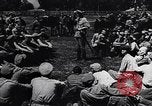
Home guard cavalry unit training during World War II in Soviet Union
An old bearded Russian Cossack stands in the midst of a contingent of Soviet cavalry, seated on the ground, during World War 2. Closeups of some in his audience. Next, the old man is seen riding at the head of a troop of cavalry. They pass close to the camera, and then are seen from above, as they proceed along a dirt path. Marshal of the Soviet Union, Semyon Audyonny, is seen consulting with other officers. (Narrator states he is involved in training home guard cavalry.) Cavalry mounting up and heading out, past a fence where several rural people wave to them. A troop of Cossacks in Papaha (black Cossack hats) is put through their paces by their commander. He directs one of his troop to charge on horseback, brandishing his sword. The Cossack charges through a series of wooden stakes, swinging his sword at each as he passes. Closeup of one cut clean through. Final scene shows the entire troop charging in formation
Nazi Storm troopers officiate at the opening of a new Alpine road in Austria
Building Alpine highways in Germany in 1930s: View of idyllic lake and mountain scene with a boat moving, in the Austrian Alps. Ceremonies marking the opening of new roadway in the Alpine region. Stormtroopers (brownshirt Sturmabteilung or SA) are formed up for inspection by leaders, in an Alpine field. A banner across a new road says that German labor will pave the way to freedom. Stormtroopers and spectators line a new road as an official car begins to travel it beneath the banner. The car breaks a ribbon, officially opening the new road. A stormtrooper leader stands in the car. Several cars form a motorcade filled with Stormtroopere leaders, on the new road. A motorized Cornucopia float travels the new road, along with a float of flowers and an open truck filled with local citlzens. Scenic views of mountains and valleys from the new road.
Indonesia is promised independence from Japan, at ceremony in Istana Gambir (Gambir Palace). Indonesian crowds celebrate news.
The promise of independence for Indonesia is broadcast throughout the city of Jakarta, following a ceremony at Istana Gambir, or the Gambir Palace (Merdeka Palace, Jawa Timur Jawa, Jawa Timur 65455, Indonesia). Exterior of Gambir Palace in Jakarta Indonesia. Indonesian leader Sukarno, head of the Japanese-created Poesat Tenaga Rakjat (POETERA - Concentration of People's Power) emerges from a car, climbs steps, and enters the Gambir Palace, presently known as Merdeka Palace. He stands together with other Indonesian officials. Imperial Japanese Army Lieutenant General Kumakichi Harada addresses the gathering and delivers news of Japanese Prime Minister Koiso's September 7, 1944 promise of future independence for Indonesia (the so-called Koiso Declaration). Large Japanese flag seen on the wall behind speakers. Sukarno approaches General Harada, bows and then speaks into a microphone. Scenes of jubilation in the streets of Jakarta as citizens hear the news that Japan has promised future independence for Indonesia (date undeclared). A man standing atop a truck announces the news over a megaphone. People stand near the truck, listen and cheer. A caravan of loaded trucks rolls slowly through a Jakarta neighborhood spreading the news about the promised independence. Citizens cheering and smiling. People standing at a railway station and at stopped trains hear the news and cheer. Citizens including men, women, and many children wave to the passing caravan. Sign on side of truck includes words "Bangsa Indonesia diperkenankan merdeka" meaning "Indonesia allowed Independence". Clip is from a Japanese newsreel during World War 2, with Japanese narration.

Highlights of the Allied New Guinea campaign and other Pacific battles against the Japanese in World War II
The Allied campaign across New Guinea and onward to the Philippines during World War 2. U.S. warships firing their guns at night. Flashes illuminate the blackness. Bombs dropping from an aircraft bomb bay. Bombs exploding on stretch of jungle near water. A U.S. Army Air Forces B-26 bomber in flight View rearward from very low flying USAAF bomber as it bombs it drops explode behind. U.S. troops making amphibious assault on New Guinea. Map showing path of Allied attacks from Australia, across New Guinea from Port Moresby to Buna and on to the Admiralty Islands, cutting off Japanese-held Rabaul, New Britain. Map shows Allied forces moving towards Japanese strongholds at Wewak and along the North shore of New Guinea and bypassing Wewak to strike at Hollandia. General Douglas MacArthur is seen aboard a U.S. warship conferring with American and Philippine officers. Annimated map shows Allied assaults on Japanese positions along the coast from Hollandia, to Warde, Biak, and beyond, stepping along towards the Philippines. Views of numerous fallen Japanese soldiers numbering more than 150 thousand dead. Crosses in battlefield cemetery at graves of some of the more than 13 thousand Allied military who lost their lives during the campaign. A soldier paying respects at one of the gravesites. Admiral Chester Nimitz with members of his staff at his headquarters in Hawaii. U.S. Navy F4F aircraft launching from an American aircraft carrier. American aircraft bombing Japanese positions on an atoll. U.S. warships bombarding Japanese positions with their heavy guns. Admiral Nimitz standing with Admiral William Halsey. More Navy gunfire and amphibious assault scenes. Map showing places where Allied forces had to battle the Japanese, including, Tarawa in the Gilbert Islands, Kwajalein, in the Marshals, Saipan, and Guam in the Marianas, and Palau to complete the "bridging" of the Pacific to the doorstep of the Philippines.
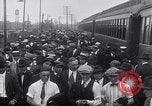
New U.S. Navy recruits arrive at the Great Lakes Naval Training Center in Chicago, Illinois
New recruits for the U.S. Navy line up on a train platform after arriving in Chicago. Sailors in uniform organize the recruits into groups. The next scene shows the recruits, carrying personal belongings, being escorted through the gates of the Great lakes Naval Training Center. Several U.S. Navy officers step from an official staff car and are seen posing in front of a flag pole at the Navy Station. The senior officer is Captain William A. Moffett, USN, Commandant of the center, flanked by a Lieutenant Commander and a Lieutenant, and two other officers in the background. Captain Moffett is later seen observing the new recruits as they are escorted on the base. Next, the recruits are seen carrying white towels as they march to a building where they will be issued personal clothing and uniforms. Later they are seen marching in their new summer uniforms, carrying their original civilian luggage. Under the watchful eyes of the officers, the new sailors use their new mess kits to get food from a chow line. Captain Moffett watches and converses with other officers (not seen). The recruits are next seen, in winter blues, exiting a building carrying their bedding, and presumably headed toward their billets. (World War I; World War 1; WWI; WW1)
CRITICALPAST.COM: About Us | Contact Us | FAQs - How to Order | License Agreement | My Account | My Lightboxes | Shopping Cart | Advanced Search | Featured Collections | Website Terms & Conditions | Privacy Policy ©2026 CriticalPast LLC.
License Agreement |
Terms & Conditions |
Privacy Policy
©2026 CriticalPast LLC.