


 Francais
 Deutsch
 Italiano
Refine Your Search
New Mexico United States 1946 stock footage and images
- Showing 2293 to 2298 of 30776 results more
more Hide
Hide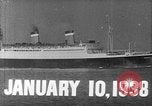
Scenes aboard ocean liner SS Manhattan: Ambassador William Dodd interviewed in 1938 and passengers fleeing war in Europe in 1939.
A large number of passengers aboard the ocean liner SS Manhattan (later USS Wakefield) in the United States. Scene from January 10,1938 as the USS Manhattan returns from her Europe trip. A large number of passengers aboard the ship. U.S. Ambassador to Nazi Germany, William E. Dodd, is interviewed by media persons about his Europe trip. He declares that living in Europe at the time is discouraging and there is crisis in Europe as German Nazism and Fascism are gaining ground everywhere. In next shot, from 1939, the ship is underway and arriving at New York Harbor on September 30, 1939, carrying 1837 persons, its largest passenger count ever. The passengers include many Americans from overseas fleeing war-torn Europe early in World War 2. A sign on the ship: 'Manhattan United States Lines'. The passengers in mass numbers at a harbor. The Statue of Liberty in the background.
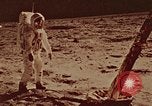
Still images Apollo 11 mission, newspaper headlines, NASA displays at the Smithsonian.
Still photos of the NASA Apollo 11 mission. Neil Armstrong walking on the moon. Buzz Aldrin next to the Passive Seismic Experiment Package (PSE) with the lunar module Eagle in the background. Buzz Aldrin stands next to the United States flag on the moon. Spacesuit and lander on display at the Smithsonian’s National Air and Space Museum in Washington DC. Front pages of major United States newspapers, such as The Miami Herald and Chicago Daily News, report the historic moon landing. Headlines include, "Ohioan Walks on Moon!" "Man Walks on the Moon" and "Americans on Moon." Teenagers looking at Apollo display at the Smithsonian. Empty mission control years after Apollo.
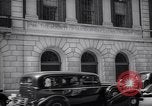
View of the entrance of 'Society of Tammany of Columbian Order' or the Tammany Hall.
View of the entrance to the 'Society of Tammany of Columbian Order' or generally called the Tammany Hall (City Hall Park, New York, NY 10007, United States) in New York City. Taxi cabs are seen in the busy street ahead of the hall. On the sidewall of the hall a poster supports Royal S. Copeland, the Democratic party nominee for election as Mayor of New York. 1937.
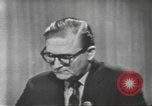
Vice President Nixon and Senator Kennedy debate in the U.S. over a summit conference between the U.S. and the Soviet Union.
The fourth presidential election debate held between Democratic nominee Senator John F. Kennedy and Republican nominee U.S. Vice President Richard Nixon in New York, United States on 21st October 1960. News correspondent John Edwards ask Vice President Nixon about the conditions to be met before meeting Soviet Premier Nikita Khrushchev at Vienna Summit of 1961. Nixon replies that an agenda should be prepared which should delineate those issues on which there is a possibility of some agreement or negotiation. He says that U.S. President should not go to the conference unless they have such an agenda, unless they have some reasonable assurance from Khrushchev that he intends seriously to negotiate on those points. News correspondent Quincy Howe asks Senator Kennedy to comment on the topic. Senator Kennedy says that the U.S. should not go to the summit until there is some reason to believe that a meeting of minds can be obtained on either Berlin, outer space or general disarmament including nuclear testing. He mentions the failure of the conference on May 15th 1960 in Paris, France. He further says it is important that they maintain their determination, that they indicate that they're building their strength, that they are determined to protect their position and that they are determined to protect their commitment.
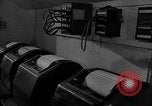
Toscanini conducts the NBC symphony orchestra accompanied by Jan Peerce and Westminster Choir after Mussolini's downfall.
A documentary depicts Italian conductor Arturo Toscanini in the United States. A radio broadcast room. An emergency news item comes in. News being broadcast about the removal of Benito Mussolini as the Prime Minister of Italy. Toscanini plays a piano. He works on musical notes of Forza del Destino. At NBC broadcasting station preparations being made to put the music of Forza del Destino on the air in radio broadcast. Jan Peerce and Westminster Choir at a recording studio. NBC Symphony Orchestra at NBC Studio in New York. Toscanini conducts the orchestra. Westminster Choir sings as Toscanini conducts the music. Jan Peerce sings.
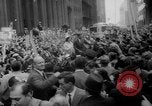
Kennedy elected President. Kennedy seen in pre-election parade procession and greeting Eisenhower following election win.
John Fitzgerald Kennedy and his wife are cheered at a New York ticker tape parade on October 19, 1960, during the 1960 Presidential campaign. A large crowd gathered in New York City during a ticker tape parade for Senator John F Kennedy on October 19, 1960 near the end of the campaign. John F. Kennedy and his wife Jacqueline Kennedy in an open roof car wave and smile at the crowd. Views of Republican candidate Richard Nixon and his wife Pat Nixon campaigning. The scrolling text marquee on the New York Times building at One Times Square in New York flashes news of Kennedy taking lead in New Jersey on election night. Next scene shows United States President elect John F. Kennedy as he shakes hands with President Dwight Eisenhower on the steps of the White House.
CRITICALPAST.COM: About Us | Contact Us | FAQs - How to Order | License Agreement | My Account | My Lightboxes | Shopping Cart | Advanced Search | Featured Collections | Website Terms & Conditions | Privacy Policy ©2026 CriticalPast LLC.
License Agreement |
Terms & Conditions |
Privacy Policy
©2026 CriticalPast LLC.