


 Francais
 Deutsch
 Italiano
Refine Your Search
New Mexico United States 1946 stock footage and images
- Showing 23509 to 23514 of 30776 results more
more Hide
Hide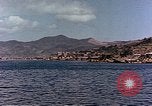
A harbor shows small buildings and homes situated on the side of the hill and Landing craft construction in Nagasaki, Japan.
Physical damage caused by the atomic bombings in Nagasaki, Japan during the end of World War II. A harbor shows small buildings and homes situated on the side of the hill. Boats on the shoreline with a building area of wooden ships. A Japanese lighthouse located at the end of a small island. A view of the harbor. Ships with gantry crane and sheet metal shop is viewed from the harbor. Two ships, a barge crane at the harbor. Minage Saki outfitting works located at the center of the harbor. Landing craft construction on a pier located on a dry dock at Nishi-Kotohiramchi on side of the harbor. A boat underway in the background.
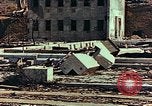
The damaged buildings in a Medical School and the damaged stone monument after the atomic bombings in Nagasaki, Japan.
Physical damage caused by the atomic bombings in Nagasaki, Japan towards the end of World War II. The Medical School. A collapsed granite column in the destroyed building which originally stood between building H and J. The direction the column fell. The mannered in which the column sheared when it hit the stone steps. The granite column which originally stood just south of the entrance of a wooden frame building between buildings H and J. The columns and relative distance they were moved. A wall of a building H. The remains of the wooden frame structure which was situated between buildings H and J. The face of the building H clearly shows manner in which this building was attached to south wall of building H. The face of building J in the background with foundation of a wooden frame structure, which was destroyed by fire in the foreground. The wall of building D of reinforced concrete structure. The shadows cast on flash burn surface of building by roof overhang and a water pipe and copper down spout. The wall of the building F, a reinforced concrete structure, whose west wall although affected by blast did not fail completely. The three fourth inch concrete stucco scrubbed off. The dissecting tables in a small building which was employed as an autopsy room. A monument off the north east corner of building G, the direction trees fallen on monument with the column of building in the background. The stone monument with following inscription engraved in German 'Perseverance Leads to Success'.
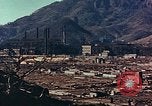
Children walk through the ruins of the University Hospital and the collapsed square column after the atomic blast in Nagasaki.
Physical damage caused by the atomic bombings in Nagasaki, Japan at the end of World War II. Damaged Mitsubishi Small Arms plant in the background. Foundations of the buildings that has collapsed in the foreground. The collapsed square brick column. An intact round concrete structure. The entrance of shrine. A set of stone lanterns on the steps leading up to the shrine. The lantern on the left falls west while the lantern on the right remains standing. The stone railing on the north side of the step which is protected by a blast from a stone wall. The south railing is blasted. The shrine and steps leading to shrine , the railings, stone lanterns and arc at head of stairway. Five children walk through the ruins of the University Hospital. A concrete wall support bent. A bridge with railing fallen and one standing. A view of the fallen side and the hospital in the background. The round concrete structure shows little effect of blast, while on of the square brick collapsed.

The priest turns around, faces worshipers and gives final blessings at a chapel in Nagasaki, Japan.
Worshipers at a chapel pray in Nagasaki, Japan. A choir in a chapel look into a book and sing a song. The worshipers kneel and sing. Father Prudent Monfette at altar. The priest and his server at altar during the Communion at Mass. A miniature crib and the priest at the altar. A close up of the miniature crib. The priest and his server at altar during the Gospel part of the mass. The priest bends down and kisses the altar. The priest turns around, faces worshipers and gives final blessings. A choir singing. The worshipers kneel and sing.
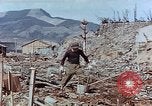
A Japanese uses a long handled ladle to pour fertilizers and seaweeds is laid onto concrete slabs to dry in Nagasaki.
A Japanese drying seaweeds after the atomic bombings in Nagasaki, Japan during the end of World War II . A Japanese stands on the ruins and debris. He uses a long handled ladle to pour some fertilizer into the ground. The seaweeds is laid onto concrete slabs to dry.
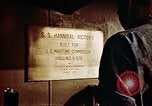
Men load locomotives aboard SS Hannibal Victory and lay pine timbers to cushion the weights of locomotives, San Francisco.
A film depicts how victory ship, SS Hannibal Victory delivered a cargo of 8 railroad locomotives, tenders, flatcars, rails etc. from San Francisco to the U.S. Army in the Philippines. A man cleans a plaque of SS Hannibal Victory ship with a cloth. The chassis stacked at the port . A trolley tows the freight car underframes. The stevedores and longshoremen at work . They load freight car underframes aboard SS Hannibal Victory. The freight car underframes is hoisted and lowered aboard the deck. K-rations, cots, hospital supplies like bandages and plasma loaded in the spaces between the cargo. Men aboard the ship at work. The eight full-grown railroad engines complete with tenders taken towards the ship on the railroad flat cars. Men stand near a locomotive on the railroad flat car. The men aboard a ship and at the dock. A man attaches ropes to the locomotive. The hoisted locomotive is taken aboard the ship. A man directs. The locomotive is cautiously lowered at the deck. A crane operator operates the controls. The locomotive is being lowered. The men giving directions. The men lay road bits and big pine timbers to cushion the weights of the big locomotives . Several views of men turn buckle and put steel rod assemblies to the deck , clamped them tight and wedged chained and bolted them down. A chief with his wife walk and talk. A view of the city in the background. They walk towards the dock. The men covering the locomotives. The chief and his wife cross a road and walk along streets of San Francisco with harbor views behind them. Cars parked on side of the road. The crane operator seated at controls. Men finishing the end tasks. The chief meets his wife before leaving. The chief boars the ship. His wife stands at the dock. Men aboard the ship at work.
CRITICALPAST.COM: About Us | Contact Us | FAQs - How to Order | License Agreement | My Account | My Lightboxes | Shopping Cart | Advanced Search | Featured Collections | Website Terms & Conditions | Privacy Policy ©2026 CriticalPast LLC.
License Agreement |
Terms & Conditions |
Privacy Policy
©2026 CriticalPast LLC.