


 Francais
 Deutsch
 Italiano
Refine Your Search
New Mexico United States 1946 stock footage and images
- Showing 24103 to 24108 of 30777 results more
more Hide
Hide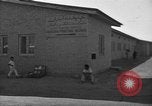
Two British men leaf through papers while a man types on a typewriter at Abadan Printing Works in Abadan, Iran.
British people in Iran during tensions surrounding Iran's nationalization of the Iranian oil industry. A building with a sign that reads 'Abadan Printing Works'. An arrow points towards the entrance. A man sits at the corner of the building below the sign. People outside the entrance. They walk away. Daily News newspaper with headline, "Talks on Oil Dispute Broken Off in Tehran." A man strikes off the name of the newspaper 'Daily News'. A British man types on a typewriter. Two other British men standing near him leaf through papers. The name of the newspaper ' Daily News' is struck off and a paper is placed on the newspaper. The men go through papers as the typist types.
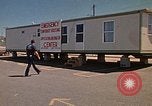
Finishing touches to mobile homes before flood victims occupy them, Rapid City, South Dakota
Relief operations after floods in Rapid City. Sign on trailer home reads 'Emergency Temporary Housing Application and Information Center'. Men enter trailer homes. Workers give finishing touch to HUD (Housing and Urban Development) trailer homes. The homes are set down on cement blocks and plumbing is added to structures. Men working under trailer home. HUD mobile trailer park showing sections where new mobile homes will be placed. Sign reads 'Federal Disaster Assistance'. Tractor tows new trailer home into HUD lot and backs it into its designated spot. Flood victims enter their new HUD mobile home.
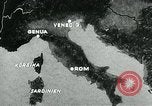
Scenes from the Battle of Monte Cassino during World War II, from the German perspective
Opening scene displays map of Italy, Sardinia, and Corsica. A German soldier at the front in the area of Monte Cassino, reads military news entitled, "South Front" which contains news about the battle of Monte Cassino, in Italy during World War 2. The high hill known as Monte Cassino and the Monastery located there are seen in the background. German troops are seen hidden among foliage at the base of the hill. One is hunkered down behind an M-42 machine gun equipped with a tripod. Glimpse of troops in trench, conversing. Next, American aircraft (too far away to see) begin bombing the Monte Cassino hilltop and Monastery. Numerous explosions are seen and heard as the bombs explode. A German soldier jumps over a stone wall to find better protection. German soldier observes through binoculars. At a campsite, where some clothes are drying in the background, Several German officers consult maps and discuss their plans. German infantry move into new positions at the base of the hill. One fires short bursts from an M-42 machine gun. Others fire their rifles. One uses a Schiessbecher to fire a rocket propelled grenade with his rifle. As they advance further, they come upon the bodies of several dead American soldiers. They capture an American soldier and disarm him. They capture several more American soldiers and march them back from the front. German officers interrogate the captured soldiers. Finger points at a location on an area map. German artillery then fires at that position. Artillery officers use periscopic binoculars to monitor the targeting. German artillery shells burst in a valley below the Monte Cassino hill.
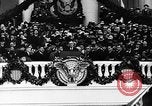
Inaugural address of Franklin Roosevelt, the 32nd U.S. President, during his inaugural ceremony at U.S. Capitol in Washington DC.
The inaugural ceremony for the newly elected U.S. President Franklin Roosevelt in Washington DC. The new President-elect Franklin Roosevelt, outgoing U.S. President Herbert Hoover, the Chief Justice of the Supreme Court of the U.S. and other officials in the U.S. Capitol. Franklin Roosevelt addressing a crowd during the inaugural ceremony. Officials behind the new President-elect. The new President Franklin Roosevelt says that he is certain that the Americans expect him to address them with frankness and a decision that the situation needs. The President says that he is prepared, under his constitutional duty, to take measures that a stricken nation may require and shall adopt the measures within his constitutional authority. He also says that in the event of a national emergency if the Congress fails to take measures, he shall ask the Congress for broad executive power to wage a war against the emergency. The President concludes his address by asking the blessings of God. The President shakes hands with the officials. The President and the officials talking. Aerial views of the U.S. Capitol.
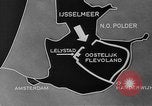
View of the Oostelijk Flevoland flood control project during construction. Queen Beatrix officially opens a dam of the project
Map depicting area of flood control activities in the Southeast part of the Ijsselmeer lake in the Netherlands. Spectators watch as a dredge deposits mud spoils to form storm surge barriers in the lake. Aerial views of the dredging operations. An excursion boat takes passengers near for a closer look at the operations. Passengers seen in various costumes. Tug boats and sail boats near the dredging site. Crowd of workers and spectators stand near and upon the newly dredged mud spoils. View of dredge operator. Several persons cross newly formed bridge between two spoils hills. Aerial views of new storm surge barriers taking form. Numerous working boats, barges and a few pleasure boats seen from the air. Boats tied up at dock next to a dam building. Visitors inside the building looking at lock controls and other items of interest. Decorative murals on the walls. Reporters and photographers on a steel landing above seated group of spectators. Queen Beatrix, of the Netherlands, formally opens the new dam by moving levers forward on stage. View of turbine generator sets rotating and engine tappets moving. Aerial view of the entire storm surge barrier in place around Oostelijk,Flevoland and of new lands under cultivation.
German civilians read newspaper Kolnischer Kurier distributed by SHAEF in Cologne, Germany after World War II.
German civilians read the news of end of Hitler and Mussolini era in a newspaper in Cologne, Germany after World War II. Newspaper Kolnischer Kurier published and distributed by the Supreme Headquarters, Allied Expeditionary Forces (SHAEF). Group of men read the news of death and the end of rule of Adolf Hitler in Germany and that of Benito Mussolini in Italy. A mother and her son read the newspaper. An old man reads the news with excitement.
CRITICALPAST.COM: About Us | Contact Us | FAQs - How to Order | License Agreement | My Account | My Lightboxes | Shopping Cart | Advanced Search | Featured Collections | Website Terms & Conditions | Privacy Policy ©2026 CriticalPast LLC.
License Agreement |
Terms & Conditions |
Privacy Policy
©2026 CriticalPast LLC.