


 Francais
 Deutsch
 Italiano
Refine Your Search
New Mexico United States 1946 stock footage and images
- Showing 24265 to 24270 of 30777 results more
more Hide
Hide
Radio broadcast following death of President Franklin Delano Roosevelt; reaction and reporting from Washington and Luxembourg (WW2)
(Audio only). Radio broadcast from Washington DC during World War II. Musical prelude before reporting of news. This is followed by reporting by correspondent Morgan Beatty on the death of President Franklin D Roosevelt and national events following it. Vice President Truman retains Roosevelt's Cabinet before taking oath of President's office. He indicates that news of the President's death was released immediately from Warm Springs. Cabinet meeting in White House. The White House Press Secretary Stephan Early makes an official announcement of President Roosevelt's death in Warm Springs, Georgia. Reports from White House radio room. Correspondent Ralph Howard Peterson summarizes events immediately before and after the death of the President. In Luxembourg: Correspondent Lowell Thomas reports President Roosevelt's death and on the war in Europe.
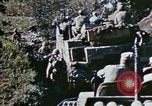
Batteries of M-7 firing 105mm howitzers out on enemy positions in Okinawa.
U.S. 3rd Battalion 22nd Marines in combat with enemy in Okinawa. Marines and several M-7 mortar carriages move across creek to new positions. M-7 tanks in new positions, firing 105mm Howitzers out. Marine carries shells to side of M-7 and hands it over to crew in turret. Artillery fire in valley. (World War II period).
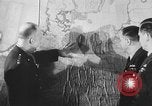
Invasion of Allied Forces in Germany and German surrender (WW2)
General Eisenhower confers with British Air Marshal Leigh-Mallory and British Air Chief Marshal, Sir Arthur Tedder, in front of a map of Europe on a wall. New York Post, June 6, 1944, headline reads "INVASION Smashing Inland." U.S. troops assault beach at Normandy on D-Day and several fall from enemy fire during World War II. German troops surrendering as Americans advance. Dead German soldier. Adolf Hitler sits in a room. B-24 bombers of the U.S. Eighth Air Force, 2nd Air Division, 2nd Bomb Wing, 446th Bomb Group, in flight on mission over Germany. Bombs falling on target. View through gun camera of fighter strafing German aircraft on the ground and strafing a railroad train filled with ammunition, that explodes. Sun newspaper headline reads: 'Allies plunging deep into Reich.' U.S. troops move through grassy field. U.S. artillery crew fires M-114, 155mm Howitzer under camouflage net. New York World Telegram newspaper headline reads: 'Allies swarm across Rhine'. U.S. troops crossing the Ludendorff Bridge, at Remagen, Germany. View of dead victims at German concentration camp. Journal American newspaper headline reads: 'Mass surrender of foe underway'. German prisoners of war double-time march running along a road with hands held high in surrender. Emotion and distress show on face of very young German boy soldier as he unbuttons his coat. A German woman sits quietly in background. A mile long line of German prisoners march in a field. A Nazi Swastika flag burning on the ground.
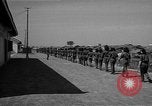
The Vietnamese WACs issue uniforms to the women recruits in Saigon, Vietnam.
Vietnamese Women's Army Corps stationed in Saigon, Vietnam. The WACs walk in long columns in a compound. A concrete building in view. American WACs Major Kathleen I. Wilkes and Sergeant Betty L. Adams serve as advisors of the Vietnam Women's Army Corps. They help the Vietnamese WACs. The Vietnamese WACs issue uniforms to the women recruits. Several new recruits wear native dress. Blouses are held against the girls for possible fit. Sergeant Adams tries a jacket on a new recruit. A Vietnamese woman works at a sewing machine. Major Wilkes, Sergeant Adams, Vietnamese WAC Sergeant and a Vietnamese girl walk out of the building. (Vietnam War period).

Whales swim in water near the camp area and a seal peeps out during U.S. Admiral Byrd's Antarctic Expedition.
Antarctic Expedition of U.S. Admiral Richard Evelyn Byrd. The vessel 'City of New York' anchored in the snow. The ship is sheathed with ice. Sled dogs and the men stand near the ship. Several men aboard the ship. The ship sails for New Zealand. Smoke rises from the smokestack. Forty-two men on the South Pole. Admiral Richard Byrd's second in command Doctor Laurence Gould stands on snow. Captain Ashley McKinley, third in Command. Whales swim in water near the camp. Men watch the whales. A man stands near a fissure as a seal peeps out.
President Roosevelt's address during the dedication of Bethesda Naval Hospital in Bethesda, Maryland.
During World War 2, the new Bethesda Naval Hospital in Bethesda, Maryland is dedicated by the Naval Bureau of Medicine and Surgery (NBMS ) on its 100th anniversary. New hospital building. Guards out front marching. Patients on hospital beds. Pharmacists in a sterilization chamber. A nurse at work with equipment. A group of doctors in an operation theater performs a surgery on a patient. U.S. President Franklin D. Roosevelt arrives at the hospital in a chauffeur driven motor carriage with other personnel to address the patients on the occasion. Patients in wheel chairs with their attendants. A large gathering of doctors, nurses and other staff and patients of the hospital outside the hospital building. President Roosevelt addresses the gathering. He says that there is a national shortage of doctors and nurses. Medical, surgical and nursing care should be given to every civilian. To allow use of medical staff for the war effort, he also cautions Americans to be cautious and safe, citing those civilians who drive recklessly and those who do not take preventive measures in industrial plants.
CRITICALPAST.COM: About Us | Contact Us | FAQs - How to Order | License Agreement | My Account | My Lightboxes | Shopping Cart | Advanced Search | Featured Collections | Website Terms & Conditions | Privacy Policy ©2026 CriticalPast LLC.
License Agreement |
Terms & Conditions |
Privacy Policy
©2026 CriticalPast LLC.