


 Francais
 Deutsch
 Italiano
Refine Your Search
New Mexico United States 1946 stock footage and images
- Showing 24757 to 24762 of 30777 results more
more Hide
Hide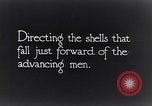
French soldiers use teletype to direct artillery during World War I.
Group of French soldiers direct moving artillery barrage ahead of advancing infantry, during World War 1. (The actual artillery is not seen.) Two of them wear headsets. One holds field chart, while another transmits instructions to the artillery via teletype. The French soldiers walk across a field and take up new observation post in a tree line.
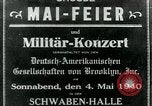
Animation of night sky, man harnessing fire and steel and early blacksmith operations leading to World War 1 era war production
Opening shows a German language poster promoting a May 4, 1940 Grosse Mei-Feier and military concert sponsored by the German American Companies of Brooklyn New York City, to be held in Schwaben Hall at Myrtle and Knickerbocker Avenue in Brooklyn. Next is opening credits for German film "Mettaldes Himmels" (Metals from Heaven), made in 1936. Animation shows the night view of the sky in Germany. Moon and stars in the sky. Meteors shoot. One impacts the earth and explodes. A crater on the earth's surface. Blacksmith of middle age pounds piece of glowing metal into a sword. A water wheel in a hut. Men work. They hammer metal in glowing hot fires. Rapid montage of scenes of war armament production and application of metals in war materiel. Rifles and artillery on a World War I era battlefield. World War 1 German tank on the battlefield. Military biplane aircraft fly in the sky. Naval ships fire guns and bombard targets. A German naval torpedo running near surface of water. Smoke arises due to firing.
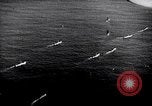
Preliminary U.S. Naval bombardment of Iwo Jima before invasion in World War II
February 17, 1945, Minesweepers move across the beaches of Iwo Jima, where U.S. amphibious landings are to be made. Diagram shows their positions and paths. Minesweepers are seen running parallel to the shore and then with Mount Suribachi behind them. Diagram illustrates Japanese shore batteries pattern of fire at U.S. gunboats. Actual scenes of the gunboats being destroyed and damaged by Japanese fire. At the same time, American reconnaissance swimmers jump from fast patrol boats. U.S. Navy ships begin firing white phosphorus shells to set up smoke screens. U.S. swimmers are recovered, after reconnoitering the beach areas. Gunboat 474 (USS LCI(G)-474) is seen severely damaged. Stretcher bearers seen on deck of a U.S. ship. Diagram shows the plan to employ naval gunfire from the battleships, Idaho, Nevada, New York, and Tennessee, at close range, against Japanese shore batteries. Numerous views of gunfire from those battleships.

Milwaukee Braves win game one of 1958 Baseball World Series over the Yankees
Newsreel clip on baseball's 1958 World Series, a rematch of the '57 Series -- the Milwaukee Braves against the New York Yankees. Views of County Stadium, the site for games one and two, and the capacity crowd of 46,000 inside. Yankee manager Casey Stengel and Braves manager Fred Haney shake hands before the game, as do game one starting pitchers Warren Spahn of the Braves and Whitey Ford of the Yanks. In top of the fourth inning, the Yankees' Bill Skowron hits a home run to left field. In the bottom of the fourth, hits by Del Crandall, Andy Pafko and Spahn put Braves on top 2-1. Hank Bauer (seen in closeup) hits two-run homer for Yankees. Braves tie the game and send into extra innings, where hits by Crandall and Billy Bruton win it 4-3 in the tenth. Braves celebrate on field. Announcer notes that the Braves also won game two and moved "toward another world's championship." But Yankees would come from behind to win the series in seven games.
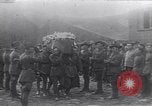
The burial of German Ace fighter pilot, Manfred Von Richthofen, in France.
Officers and men of the Australian Flying Corps, who controlled the combat area, in France, where he died, give Ace German pilot, Baron von Richthofen a funeral with full military honors. Six Captains, of their Squadron number 3, serve as pallbearers, and others participate as honor guards. Pallbearers place the flower covered coffin of Richthofen (also known as The Red Baron) on a vehicle for transport to a cemetery at the village of Bertangles, near Amiens, France. There a Priest officiates as the coffin is lowered into the grave. ANZAC (Australian and New Zealand Army Corps) troops assemble in formation and ceremonially position themselves with heads bowed. They then raise their rifles and fire several volleys into the air, in salute to the fallen German aviator. (Reportedly, memorial wreaths were received, for the funeral, from other Allied Flying Squadrons, including one with the words, "To Our Gallant and Worthy Foe"). This was the first of several burials of von Richthofen's remains. (World War I; World War 1; WWI; WW1)
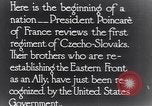
President Raymond Poincaré of France reviews Army Regiment from Czechoslovakia upon France's recognition of that nation on June 30, 1918.
Raymond Poincaré, President of France, strides in a field with Czechoslovak and Allied Armed forces officers, reviewing the 21st Regiment of Czechoslovak legionnaires, who are in formation, at attention, presenting arms. Official guests at the ceremony include Edvard Beneš and other officials of the Czechoslovak National Council. Views of a Czechoslovak soldier holding aloft a banner presented by President Poincaré that was designed by Czech painter František Kupka, as a gift from the city of Paris. The banner being held aloft as reviewing officers stand at attention. View from rear of the Regiment in formation. Several views of the Regiment parading on the field behind a color guard holding the new Regimental colors.
CRITICALPAST.COM: About Us | Contact Us | FAQs - How to Order | License Agreement | My Account | My Lightboxes | Shopping Cart | Advanced Search | Featured Collections | Website Terms & Conditions | Privacy Policy ©2026 CriticalPast LLC.
License Agreement |
Terms & Conditions |
Privacy Policy
©2026 CriticalPast LLC.